Tag: problem solving

  • What are you searching for?


    My little niece – we call her Chinu – has a couple of  videos and books. In some of the videos and books there is a story, in this story the main character – Lenny (in one story) – is searching/waiting for a friend. The idea is – Lenny wants a friend did not know how to identify the friend. Some of the dialogs of the story –

    …”Oh Sorry! cheeped a little voice”

    “Never Mind,” growled Lenny.

    “My name is Tweek. And yours?” cheeped the voice.

    “My name is Lenny, but I don’t have time to stop and talk,” Explained Lenny. “I have to get home and wait for a friend”.

    “May I wait with you?” asked Tweek.

    “If you want to, but don’t disturb me,” replied Lenny.

    “So what does your friend look like? when is he coming?” asked Tweek.

    “Don’t know,” said Lenny.

    Believe it or not, the search/wait is on…. everyone of us is searching for something. TV channels are searching for next sensational singer or dancer. News channels are searching for next breaking news. Box office is searching for its next bigger hit or super star. Citizen of India in general for good governance and so on. Whatever said and done, search is on.
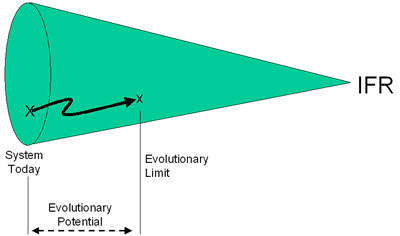
    Ideal Final Result

    When we turn to individual, the search is for a better friend, good house, better life style, peace of mind, love or a superior job. No doubt search is on. Many a times what is observed is that the search is on but one does not know what is that he/she is searching for.

    When an organization is on the journey of innovation, not knowing what is required becomes a very big problem. In my innovation consulting and TRIZ learning I used to have a framework for removing the problem of not knowing what are we searching for. The method is Ideal Final Result (IFR). The concept of IFR seeks the destination or best solution in the beginning itself. This method helps identifying what are  looking for and where we want to go?

    So what are you searching for?

    By the way, when the Buddha was searching (enlightenment), he could not attain that. However, when he even dropped the idea of “searching” he achieved it! To start off – the Buddha knew what he is searching for.

    Image source – TRIZ Journal, article by Simon Dewulf and Darell Mann

  • The Theory of Inventive Problem Solving (TRIZ)


    I have written few blogs using concepts of TRIZ, so let me explain what is TRIZ?
    It is a problem solving methodology, more below from my earlier post at other place.
    How do we look and try to solve our problems?
    Generally, it is observed that everyone thinks in his circle of intellectual dominance (emotional, intellectual, social or technical). But when our interest is to find out solution for any problem relating to any particular technical field this becomes rather more obvious and clear that we tend to search into our field of expertise to find a better way or solution for anything. I shall explain this with a joke I heard when I was doing my Engineering:-

    Once four Engineers, namely mechanical, Electrical, Chemical and Computer science, were traveling in a car. Suddenly the car stopped and everyone was puzzled. Mechanical Engineer suggested that that there is some problem with the engine. Electrical Engineer suggested that its due to the fault in ignition system. Chemical engineer said “no-no car was making some strange knocking and the problem was with the fuel.” Suddenly the computer science Engineer intervened and said that “I think we need to go out and then come in the car (log out and log in).”

    The above joke may give you an idea about the “circle of intellectual dominance” I am talking about, that is everyone tries and looks into his field of expertise for finding solution of any problem.

    A new look at same things
    This “circle of intellectual dominance” called “Psychological Inertia”, which limits even experts to come up with better perhaps “OBVIOUS”, solutions (in terms of expert of other field) for any particular problem or improvement.
    TRIZ provides a big leap for experts to learn to look beyond their area of expertise and get a general look at a problem, find a similar problem in other field and its method of solving the problem then customize the solution according to need. Thus, it gives a generalized method for solving virtually every problem in any field.
    History
    TRIZ is a Russian acronym which means “Theory of Inventive Problem Solving”. This concept and theory came in to existence when a Russian Patent Expert Genrich Altshuller and his colleagues studied over 200,000 patents looking for problems and the way they were solved. Of these only a small fraction 40,000 had somewhat inventive solutions; the rest were straight forward improvements. With these studies Alshuller came up with a systematic approach, termed TRIZ. It was a generalized way for finding out solution of any technical difficulty or for any further improvements.

    TRIZ concept in nutshell
    The method used in solving problems in TRIZ can be summarized in the following points –
    1. Identifying the problem or finding out opportunity for improvements in the present product, design etc.
    2. Formulating the problem and searching for similar, previously solved problems with an overview to understand the concept of solution.
    3. Looking for analogous solution(s) for presently defined problem or conceived improvement.
    4. Applying the best identified analogous solution.

    Thus, TRIZ gives a general concept, for virtually every field, to find out opportunity and solutions for problems or improvement sought. I myself have played with concepts of TRIZ beyond engineering fields such as social sector innovation, medical field, Travel infrastructure in Mumbai and currently working in management domain specially economics, marketing and finance.

  • Every problem is a nail… if you only have hammer in your tool box!


    In a class of Prof Moradian we were learning about a model, a model which had two dimensions. Each axis has ‘Low’ and ‘High’ as the extremes. I have learnt that for few thing quantification is not necessary, ok! When I saw this combination of ‘Low’ and ‘High’, I understood it is a qualitative measure. I waited for two minutes (a long duration for struggle in mind), at last a typical attribute of a classic personality came out.
    “Sir, how do I define a number is ‘Low’ or ‘High’ on this model and on the scale?”
    I took two minutes because I struggled to put this in my mind – ‘do not try to quantify everything’. I was thinking quantify or not to quantify? It was equally a struggle for Prof Lopez to teach me – don’t try quantification of everything. Old habits die hard! Six Sigma taught me to be data centric and this struggle has always been in mind – clarity with data or instinct with less or no data (I worked as TRIZ/Innovation consultant). Seemingly two different approach six sigma data centric and innovation instinct based.
    I knew it is qualitative, and Prof Mordian said – ‘Pravin, it is not necessary to quantify this measure, come out of the engineering mind’. To save my face I can say I was just questioning my assumptions, you may check possibility thinking and questioning assumptions blog.
    Let me come to the “classic personality” type. Personally, this incident was making the same mistake (of course learning from that too). The trait I want to highlight here is ‘engineerish’ e.g. engineer and mathematician type thinking. What else can you expect from an engineer – numbers, data, technical details and much more concrete information?
    Here, I came up with few future blog ideas of Blue ocean strategy, frameworks and problem solving. I will try to cover them in future. As I wrote in my introductory blog, not necessarily every blog entry will be on relation between Business and the Buddha. I will not offer correlation here, though I can do that. For a change I would quote a real life example which many of us are suffering from –
    Dr Mankad taught us in class of Macroeconomics that – few bright engineers turned MBAs have created many models e.g. financial models that ‘quantified rationality/irrationality’ which became one of the worst problems and resulted in the melt down.
    So, I write here a cliché of many management consultants – Every problem is a nail… if you only have hammer in your tool box! I also encountered it many a times. It is occasionally a struggle to pull people out of their thought process and make them realize that – some problems are not nails. Our myopic thinking can be summarized in (again a cliché) joke to explain the issue –
    Once mechanical, Electrical, Chemical and Computer science engineers were traveling in a car. Suddenly the car stopped and everyone was puzzled. Mechanical Engineer suggested that that there is some problem with the engine. Electrical Engineer suggested that it is due to the fault in ignition system. Chemical engineer said “no-no car was making some strange knocking and the problem was with the fuel.” Suddenly the computer science Engineer intervened and said “I think we need to go out and then come in the car (log out and log in).”
    The message is …
    “Every problem is a nail… if you only have hammer in your tool box!”
    And the lesson – “Because you have a hammer, don’t go searching for a nail”!!