Tag: Prisoners dilemma

  • Incentive to cheat – Problem with Democracy


    I read a book – Games Indians Play by Mr Raghunathan a Professor in IIM-A and CEO of GMR group. I have written on this book earlier too – Individually smart collectively dumb. The problems with Indian – supposedly sharp – minds is given below in story format.

    This story is from a book – ‘The prayer of the Frog’ by Father Anthony de Mello, S.J. This book has very interesting stories on religion, spirituality and human relations etc. The story precisely explains how we – Indians – think and act.

    A great festival was to be held in a village and each villager was asked to contribute by pouring a bottle of wine into a giant barrel.

    When the banquet began and the barrel was tapped what came out of it was water. One of the villagers had had this thought: “If I pour a bottle of water in that giant barrel, no one will notice the difference.” But it hadn’t occurred to him that everyone else in the village might have the same thought.

    This happens in Indian political system. Everyone thinks that yes there is corruption, but I am paid 100/- let me vote this corrupt politician. Others would not vote him… similar to the story above. Every poor person gets an incentive to cheat – that cheating is a responsibility of politician – development Vs one time benefit to voter – 100 rupee note or a quarter of alcohol etc.

    The interesting part is we Indians more complex yet cheat always. We think in two fashion. 1. the way story suggests above and 2. why should I do it when everyone else is cheating?

    Option two suggests that every Indian knows what others are going to do and thinks why should not I do the same?
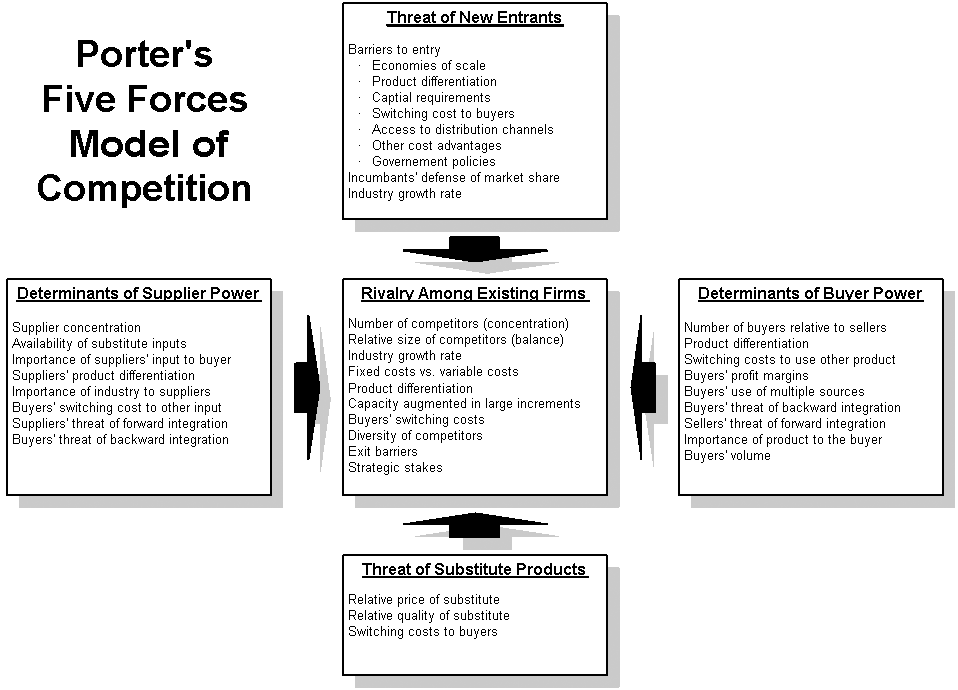
  • Porters five forces


    Three or four years back when I was reading the book – Blog – Old path white clouds (Book – Old Path White Clouds), I started looking at businesses with a changed mindset. In India, there are small stalls on roadside. The stalls could be tea stall, paratha stall, idly dosa stall, Sandwich or others. What I observed was, at many places these stalls were near each other e.g. tea stall near the sandwich stall or the idly stall. This is so common that we overlook such arrangements of shops.

    What is the reason of them being next to each other? The reason is roughly 50% of the buyer of sandwich would buy a cup of tea or the other way round some people buying tea would order for a paratha. These offerings are seemingly different for the stall owners, they are selling a refreshing drink or a breakfast however, from the point of view of a customer it is a wholesome offering – tea with paratha/sandwich.

    Well the point I am trying to make with the example is one and the same. In terms of business Prof Mohan Sawhney (of Northwestern University) says ‘Metamarket’ and in Buddhism they called it interdependent co-arising.

    Representation of porters five forces
    In organized retail, there are two parties catering to the end customers. One the manufacturer and the other retailer. Here too, we would see the collaboration or the dependence of one on the other. If I relate the concept of interdependent co-arising further with the very basic management lessons – Porters Five Forces – we would observe few things. Earlier the manufacturers had power (suppliers power) and now the retailers are gaining power (buyers power), and this cat and mouse game would continue. This power would shift to the ultimate buyer – the customer – perhaps it will happen in the future.

    How can the forces be balanced? Well, when we look in the basics we would learn. The idea in any game theory based dilemma (Prisoners dilemma) is that when each one starts co-operating everyone wins. That would apply in long term. Net net – we would have to be on the basics – the concept of interdependent co-arising.

    Image source – http://www.smartcode.com/