Tag: Possibility thinking

  • Uncertainties and acceptance

    It has been more than a week, we wake up to the no-water in the overhead tank of our wing of our residential complex. Initially, it was annoying. Daily, I or my wife went downstairs to tell the security to switch on the water pump. We raised the issue to the society manager, secretary, etc. I think it takes about 3 days to form a habit, soon we accepted this challenge as part of our life. The new ritual now is – wake up, open the tap – hoping system is fixed, go downstairs tell security to switch on the pump, come back and proceed as per the available resources. After a week, now security calls me daily to ask “do you have water in your taps now?”

    Uncertainties and acceptance

    Uncertainties make us jittery and annoyed. It depends on the situations, in some cases uncertainties make us anxious too. There was news that Deepika Padukone wanted to face the Narcotics Control Board (NCB) with her Husband because of anxiety; it is just an example. This initial annoyance made way for the acceptance of the situation. Once, we accepted the situation, we started planning our next day before we went off to sleep. The morning started with the acceptance of the unavailability of water and our workflow was changed to accommodate the situation. Once we had figured it out, life was easy, the disappointment of delay in fixing the problem was there but the annoyance and frustration ended. This happens many times in our business too.

    A conversation

    We had figured it out for our daily life. I and my wife were talking about it in the morning, the same evening I received a call from my ex-colleagues – Deepak Taunk. By chance, we happened to speak about the certainties of the outcome. The discussion started with analytics, human intelligence, AI, and business processes. It was an interesting discussion on how our brain connects the dots from analytics and business processes to our daily lives. He is a creative person who questions assumptions. So, when we spoke about some business processes he shared his displeasure with the templatization of work. When I say templatization, I mean making work process-driven and asking others to follow the guidelines. It is not that he is not process-driven – he is a very successful project manager. His point was the templatization results in blindly “follow the guidelines”. People are discouraged to ask questions.

    It is a very valid objection. His point of view was – educated people must be allowed to understand “the why”, freedom to figure it out, otherwise what is the need of highly educated people when they have to always follow the SOP (Standard Operating Procedure). I personally have seen this issue that even intelligent people follow things blindly or are asked to follow blindly. In case some ask questions they are termed as “unfit” or non-cooperative. This becomes the responsibility of the team leader or the leadership, in general, to figure out the best course of action. There is no right or wrong in being templatized for few things and creative for others. We need both the ways to run a business well – follow the process and question the assumptions.

    World of possibilities

    In business, personal life as well as in spiritual path too both the approaches are required. I had been an inquisitive person, including on my small journey of spirituality. I asked a lot of questions to many of my guides – Dr SaxenaRamana uncle ji, my father, Sai KakaDada ji, and Dr Agashe, my art of living teacher. Dr Agashe told me – “…for a few things you need to trust the predecessors/process for others ask questions, do not stop any of these. Indian spirituality offers you both the ways…” Interesting isn’t it?

    Following the process brings certainty of outcome whereas questioning assumptions bring opportunities. Uncertainty many times brings opportunities. One has to be aware of the uncertainties, accept the situation, and find out options. When we look at situations, accept the situation(instead of fighting it), look for options, and be creative we have a whole world of possibilities.
  • Every problem is a nail… if you only have hammer in your tool box!


    In a class of Prof Moradian we were learning about a model, a model which had two dimensions. Each axis has ‘Low’ and ‘High’ as the extremes. I have learnt that for few thing quantification is not necessary, ok! When I saw this combination of ‘Low’ and ‘High’, I understood it is a qualitative measure. I waited for two minutes (a long duration for struggle in mind), at last a typical attribute of a classic personality came out.
    “Sir, how do I define a number is ‘Low’ or ‘High’ on this model and on the scale?”
    I took two minutes because I struggled to put this in my mind – ‘do not try to quantify everything’. I was thinking quantify or not to quantify? It was equally a struggle for Prof Lopez to teach me – don’t try quantification of everything. Old habits die hard! Six Sigma taught me to be data centric and this struggle has always been in mind – clarity with data or instinct with less or no data (I worked as TRIZ/Innovation consultant). Seemingly two different approach six sigma data centric and innovation instinct based.
    I knew it is qualitative, and Prof Mordian said – ‘Pravin, it is not necessary to quantify this measure, come out of the engineering mind’. To save my face I can say I was just questioning my assumptions, you may check possibility thinking and questioning assumptions blog.
    Let me come to the “classic personality” type. Personally, this incident was making the same mistake (of course learning from that too). The trait I want to highlight here is ‘engineerish’ e.g. engineer and mathematician type thinking. What else can you expect from an engineer – numbers, data, technical details and much more concrete information?
    Here, I came up with few future blog ideas of Blue ocean strategy, frameworks and problem solving. I will try to cover them in future. As I wrote in my introductory blog, not necessarily every blog entry will be on relation between Business and the Buddha. I will not offer correlation here, though I can do that. For a change I would quote a real life example which many of us are suffering from –
    Dr Mankad taught us in class of Macroeconomics that – few bright engineers turned MBAs have created many models e.g. financial models that ‘quantified rationality/irrationality’ which became one of the worst problems and resulted in the melt down.
    So, I write here a cliché of many management consultants – Every problem is a nail… if you only have hammer in your tool box! I also encountered it many a times. It is occasionally a struggle to pull people out of their thought process and make them realize that – some problems are not nails. Our myopic thinking can be summarized in (again a cliché) joke to explain the issue –
    Once mechanical, Electrical, Chemical and Computer science engineers were traveling in a car. Suddenly the car stopped and everyone was puzzled. Mechanical Engineer suggested that that there is some problem with the engine. Electrical Engineer suggested that it is due to the fault in ignition system. Chemical engineer said “no-no car was making some strange knocking and the problem was with the fuel.” Suddenly the computer science Engineer intervened and said “I think we need to go out and then come in the car (log out and log in).”
    The message is …
    “Every problem is a nail… if you only have hammer in your tool box!”
    And the lesson – “Because you have a hammer, don’t go searching for a nail”!!

  • Possibility thinking continued…


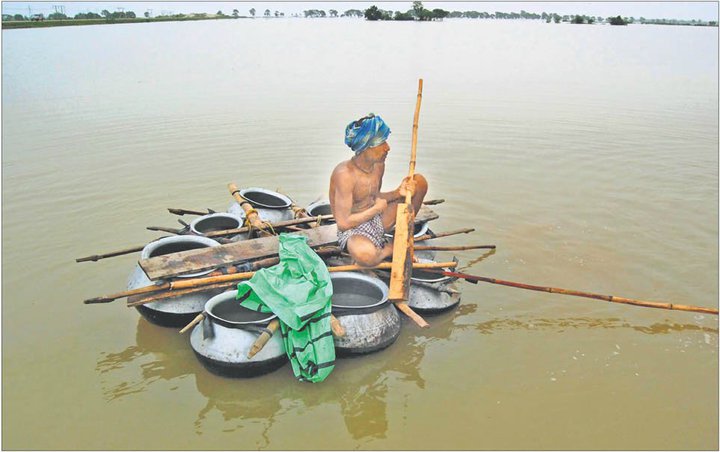
    I posted possibility thinking blog yesterday and one of my friends, Amol, responded to one of the photo I posted on Facebook earlier. The context of the image and the image is as follows –

    Flood in Western India
    Necessity is mother of invention
    This was a photo in Mid-day (a newspaper in Mumbai) sometime in 2007/08/09. I do not own the copyright for the picture.
    Posting this photo for sensitizing people about problem in some parts of India…

    Caption for this image in Mid-day was – Father of Invention.
    Response of my friend to this (possibility thinking) is
    I see few good things in it…
    1. It supports “go green” concept as this boat is not made of wood – saving trees..
    2. It shows next generation boat where one or two holes wont drown it – multiple air sockets help it float…at the same time, it has option for expansion due to open ends…
    3. I see unity – multiple pots r helping together to keep this guy float
    4. I see alternative way of selling veg/fish/flowers, etc. which can be carried out in these pots as permissible – fun way of shopping for me!
    5. At the end of the day, u can bring home some fresh water… 😉

    If he can do this without education, he can do ++ with education….

  • Learning… and possibility thinking


    Today, after a long time I was watching Television, the channel was Fox History and program – building the ultimate: roller coaster. This program was a story of development of roller coasters, a very good and informative program. What struck to me was one development which was taken from the world war II German defense system. This system was a breakthrough in material for the wheel of the coaster. I started wondering, how these roller coaster designers took one thing (about 20 years old) from one place to different place and with some success. My take from this is – we can learn from anywhere; only basic need is willingness to learn and being open to possibilities. I heard some author earlier used a term – ‘possibility thinking’. This concept has been reinforced often to me. I have worked on TRIZ– the theory of inventive problem solving – and have worked on application of TRIZ (a very engineering based problem solving method) to social sector innovation and medical science etc. The concept of TRIZ is similar and very structured.

    Half full, half empty, possibility thinking, optimism, pessimism
    Possibility thinking
    Let me give one analogy – a glass is half-full. An optimist says – the glass is half full, a pessimist says – the glass is half empty and the possibility thinker says there is room for more water in the glass. Going one step further – what if the glass is not there? Some would say – Glass IS (many possibilities). In my opinion this is possibility thinking; when you say Glass IS, you open opportunities to think more and more about what can be? The challenge is to switch back and forth from structured to more creative thinking.

    Coming back to the point of learning, the idea I want to reinforce is – we can learn from anywhere; only basic need is willingness to learn and being open to possibilities. The idea of this blog – Business to the Buddha was similar concept.

    References –
    1. Fox history schedule – http://www.foxhistory.com/Schedule/Daily.aspx
    2. Glass half full – http://www.zazzle.com/glass_half_full_23_poster-228602679415734701