Tag: Mumbai

  • Mumbai and ego


    Mumbai is a unique city. I was talking to a friend of mine and had a eureka moment. There is a relationship between Mumbai and ego. One can learn a lesson or two on spirituality from Mumbai.

    Ego puts itself at center and everything – including the world – around itself. Similar thing happens in Mumbai. Geographically Mumbai is in length, unlike many other cities. There is no way you can be in center of the city if you are in a corner.
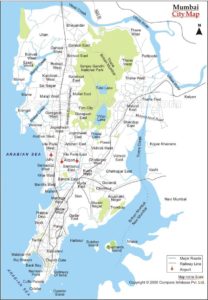
    Map of Mumbai, Mumbai and egoMumbai has three railway lines – Central, Harbor and Western. Western line is of affluent people, Central line people feel they are in the center of city. Harbor line is of Navi Mumbai, one of the largest planned city in the world.

    Western line is very crowded, at times if you are stuck in traffic on western express highway you are immobile for an hour or so. When you talk to people of Western line, you will hear oh “western” is far better. It is centrally located, I get everything in my locality. Standard of living are simply incomparable with rest of Mumbai.

    Similar logic you get when you talk to people of central line. They will say trains run fastest on our line, eastern express highway is really a highway. We are centrally located and can reach anywhere easily. When you talk to people living on harbor line you will hear almost similar good reasons to be on harbor line. It is far more planned has a lot of space, wide roads and planned neighborhood unlike mainland Mumbai. Standard of living are far better than any other part of Mumbai – at least we have some space to live at home. These points are mostly by those who live in Navi Mumbai.

    Our ego also works in the same manner. We are centrally located, everything is centered around me. Ego tends to look at sunny side of self and possibly shortcomings of others.

    Whether you talk to a person living in Borivali (Western), Bhandoop (Central) or Chembur (harbor). Borivali is in north – similarly Bhandoop or Chembur. This is a unique learning you have from Mumbai. You consider yourself as the center and whole world is circling around you irrespective of whether it is so. It is like Shashi Throor hidden in all of us.

    Ego and Mumbai are one to one mapping, both of these show us how our mind manipulates us. We need to stop manipulation of self by the self.

  • Government’s “job”


    As usual Monday morning, my milkman – Ramlal – rang the doorbell. I opened the door, with his endless smile he poured milk in my container and returned it to me. I know he is an old man from Uttar Pradesh – a state in India, he had gone to his village for sowing in his farm in the fag end of summers. During this time when he was not in Mumbai, his son used to deliver milk.

    My milkman is a hardworking person. At this age he cycles about 10 km delivering milk about 25 ltr daily. He comes delivering milk from different places to my home at 6:30 AM, he starts from home at 5 AM. I asked him that day – “Ramlalji after delivering milk what to you do?” I was under an impression he drives auto or mostly remains at home as his son might be working. He said he goes to a catering place and works as cook. I thought he does that only during day, he said in the evening too he works there.

    FarmerI was surprised, was happy for him that he has some work and is keeping himself busy. However, it made me question Why do so many people migrate to Mumbai or other big cities? In fact I am too an immigrant to Mumbai its been 10+ years I am here. People migrate from UP or Bihar to Mumbai or any other big cities because in their home state they do not find suitable employment. Almost same was the case for me, even if I want to go back to MP (where my parents still live), I would not be able to find a relevant employment opportunity for myself.

    Furthermore, I asked myself, why so, cant I go back to MP? Why cant I find relevant work for myself? In my case I don’t see any such company there in MP where my skills can be utilized. Even if I consider starting my owns company I have to come to other big cities for getting work! This is about organized sector, what about Ramlal ji, my milkman? Can he not go back to his village? He is struggling for two square meals in Mumbai. It is so expensive a place e.g you can buy bottle gourd in INR 10 per kg (Indore – by population 14th biggest city of India), we pay as much as INR 60 in Mumbai (prices of July 2016); prices must be far less in a village. Not just my milkman, I have spoken with various auto/taxi drivers in Mumbai, they say the same – if I get work in my hometown, why would I leave everything? Some had told me their monthly financials too – they save as much  as INR 3000 a month.

    While I was ruminating about these things I asked myself where is the problem? Let us say there is Charm in Mumbai – city of dreams – so many people migrate here. But is it the only reason? Not all come to Mumbai to be another Amitabh Bachchan! Why would a villager who can save only INR 3000 a month want to come here, where he has to living in a 10X10 square feet room with 5 to 8 other people in almost a slum? Many come here because they do not have any work to do in their village. So, what is the role of Government? Well, we can talk at length about Government; in India Govt has 3 basic building blocks – Judiciary, legislators and administrator and so on. I was thinking to concentrate on only one thing when I looked at the situation of Ramlal ji. Point is, even after living in such conditions, spending about 10X extra on food only, they save 3000 which is far better than being in village. Means there in the village or nearby area there is not employment opportunity that can fetch them better returns / savings!

    The job of Govt also include creating job opportunities, isnt it? Well, those who think of capitalism may argue entrepreneurship is a solution. Well, after 2008 US Govt has also been looking at a key metric to consider many policy decisions – the unemployment rate. It has become as important or perhaps more important than rate of inflation in the US, isnt it? India is a developing nation, the State and Union Govt has a big responsibility to create job opportunities – mind it, we do not need NREGA (employment Guarantee Scheme). Reasons – a recent case here (you can find many if you search on net) another reason is – our citizen do not necessarily need to just dig holes there may be many people who are educated and need other suitable opportunity to work, isnt it?

    The least State Govts can do is – creating employment opportunities in their states, be it UP, Bihar, MP or any other state. How long Ramlal ji (or Aarti Amma) will keep on shuffling between village and Mumbai to just earn two square meals & saving a few thousand rupee?

  • Mumbai’s Vada pav


    This video I checked a couple of weeks back somewhere. If you do not understand Marathi, read the subtitles perhaps watch twice.

    Liked the video thought to share it here.

    Source – Pocket Films – Short Films Channel

  • Drop meets the ocean


    In 2006 I was new to Mumbai city, when I met Anisha. She was studying in 9th standard. My distant relative asked me to meet her and guide her for preparing for IIT-JEE (I’d prepared for JEE too). When I met her, I felt as if she has accepted the things the way they were. I scolded her for the lax attitude and said – “…this is the problem with Mumbaikars, they accept the things and are comfortable in traveling in crowded trains, getting pushed etc. Why you people get angry when outsiders come here and make good money? Outsiders are new and they may feel uncomfortable and they would want to have a car instead of traveling in crowded trains. I never catch train, because at times it hurts my ego!..”

    When I was new to Mumbai, I tried avoiding crowd, traffic and trains. The way people told me & what I observed – crowd and packed trains was actually amazing experience in itself. Well, over a period of time, I got used to traveling in local trains. Though mostly I traveled the opposite direction of traffic so that was not that painful to me.

    Recently, my wife joined her office. She had heard stories of packed trains as any new person hears in Mumbai. She was scared to travel. I had tried to help her travel in most comfortable trains – starting from our nearest station, early morning and first class etc. However, at the time of dropping her at station I realized this –

    Drop meeting OceanIn whatever circumstances when one becomes a part of the crowd and goes with the flow, he/she does not need to make way and things just happen naturally. One can get in the trains effortlessly and get out also effortlessly. This analogy is similar to drop meeting the ocean or drop become the ocean itself. An individual is drop and the crowd is ocean. A very spiritual connection I could make, however incorrect it may be in terms of example. When an individual becomes part of the bigger consciousness, he/she may leave his/her ego!

    I dont know what conspired (God knows inspired), Anisha has completed her Engineering and now pursuing her Masters from a good university in the US. She is becoming somebody not part of crowd (nobody).

    Image source – https://www.flickr.com/photos/alex_hill/4010380393/

  • Free market, corporate espionage & Government


    What is free market? A very straightforward definition of free market is – a market system where prices of goods and services are set freely by consent of sellers and consumers.

    In very simple words – I have an apartment and want to sell it – I quote (asking rate) price of USD 100,000. If a buyer or buyers are willing to buy the apartment at my asking rate that can be put as the market rate for similar kind of apartments in that given area. In the same simple language if no one comes forward to buy the apartment at USD 100,000 I may decide to reduce price to say USD 80,000. So on and so forth. The logic can work in reverse direction as well If there are more than one buyer I may increase my asking rate to sat USD 125,000.

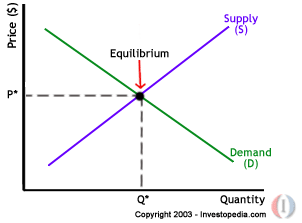
    Demand Supply economicsThis concept of free market introduces a very interesting and important Basic Economics principle of “Demand and Supply”. If demand is more compared to supply prices may go up and vice versa.

    However, I have been asking a question to myself and have this to many educated economists or free market experts. Have you ever questioned the same logic of demand supply and free market in scenario of Mumbai reality? Have you not wondered about hoarding? How often the free market is really a free market?

    I have been searching for an apartment for last couple of months. In fact since 2008 I am hearing that Mumbai housing prices will be under pressure. In 2009-2010 when economy worldwide was struggling it was heard that the housing bubble of Mumbai will burst. Did it happen? I have my doubts. Recently, I received a call from a firm regarding buying a flat (apartment) in some areas in Mumbai. I – instead of responding to the questions – asked the caller –

    1. Tell me how many projects in Mumbai are stalled by construction companies because of lack of funds?
    2. How many projects have been almost complete but have unsold apartments?
    3. How many projects are rescheduled for possession date/month/year?
    4. How many properties are unsold?

    The caller responded with a number in lacs of sq ft. I could not hear the answer properly but that turns out to be almost (perhaps more than) 100,000 apartment in Mumbai. [Please do not quote it has a accurate statistic it was an approximation of the caller]

    Are we really talking about free market? Or is it really a created bubble of price.

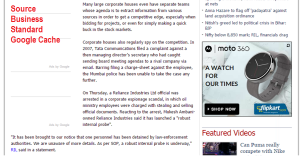
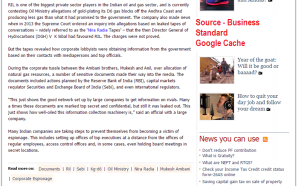
    These questions roll on to the question of leaking Govt. In free market we speak about Government’s role of regulation. Have you heard of crony capitalism or the recent corporate espionage case in India. In one online news it was stated that many CEOs say that there is nothing new with corporate espionage. The article was published in Business Standard but that has been removed by the company now! Check the screenshots attached.

    I rememberr this Hindi idiom when Govt is not functioning or driven by the private businesses instead of public good.

    जब बागड़ ही बाग खाने लगे तो बगिया का क्या होगा?

    Addendum – The article is up again (as of 17th March) http://www.business-standard.com/article/companies/corporate-espionage-is-not-new-to-india-inc-say-ceos-115022000432_1.html

    1

    2


    3

    4


    Source

    1. Demand Supply Curve – Investopedia
    2. Image 2 to 5 from Business Standard Google Cache screenshot. Original article not available on the link Image 4

  • Time is just a reference


    [Tweet “Mumbai has taught me the value of time”]Mumbai has taught me the value of time e.g. after 7:55 am, there is 8:00 and then 8:02 am… not necessarily 8:05 am.  8:02 because I used to catch an 8:02 local for office :). [Tweet “Value the time, it never comes back.”]

    I went to meet my cousin sister and my aunt yesterday. My brother in law – Jay Phadke – is an electronics engineer. He actually is one, otherwise Indian engineers irrespective of their field of engineering become software developer or MBAs (I am on of them :)). He designs electronics devices and interesting ones. At my cousin sister’s home there was no wall clock at least in drawing room.

    Clock 1I could not see a wall clock anywhere, but while speaking when we went to the Kitchen, there was a digital clock which shows temperature as well – of course he made it. We started speaking on “Time”. Here is edited talk
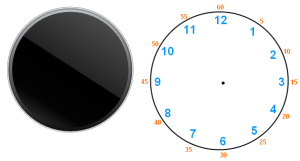
    I am going to contradict myself from 1st para – Time is “just a reference”. In our generation we have become slaves of time.  [Tweet “Time is “just a reference”. In our generation we have become slaves of time.”] Our work is defined and decided by “What is the time?”.

    If I show you the first column second row clock to you (7:50 AM) on a working day morning, you will start rushing to office. If it is, the second column and first row (2:20 PM) you might have just had your lunch in office. Now look closer (corners of each clock), all those 4 clocks are actually one clock tilted by 90 degrees. That is the mad rush we have created for ourselves.

    Now if you look at the other set of images on right, you would realize, there is a dial without numbers and thereClock 2 are numbers on dial without hour/minute hands. Both these hands are just references. These references are driving us crazy in the competitive world. I am of the opinion that – One’s purpose should drive the person and not necessarily the hour/minute hands of a wrist watch. [Tweet “One’s purpose should drive the person and not necessarily the hour/minute hands of a wrist watch.”]In my opinion one must take things seriously but not so seriously that one becomes salve – as we are of time. The best day for human being will be a day when the first dial becomes the clock – no digits and no hour/minute hand – we would be free.

    Mumbai has taught me a lot – I respect and value time. At the same time, Mumbai has taught me a lot to think while traveling more than an hour daily. Think about why am I doing what am I doing?

    Related – Fruit will arrive in its season…

    Race – never ending

    Race – never ending
    Race – never ending
    Race – never ending

  • Impermenance


    Recently, I relocated from Posh South Mumbai to Suburban Mumbai. There were reasons for this move. I used to travel 2+ hours one way in different public transports (a meager 35 KM distance). Not that I cannot afford a personal vehicle (or can not drive); I do not want to buy one. Considering various issues in Mumbai (India) – parking, traffic jam and notwithstanding petrol prices.

    So, after a troublesome one year travel of 4+ hours each working day, I decided to move on from the coveted South Mumbai (SoBo) to Suburban Mumbai. Now I travel 20-25 min (walk). Considering the kind of horrible experiences I had in last one year, this was a wonderful change. Alas! it had cost associated with it. (If you want to achieve something you have to let go of something else!) One one side I was happy that I am saving more than 3 hours of travel daily but the flip side was the kind of royal life e.g. three swimming pools (one Olympic size), track (again Olympic size well maintained) Golf Course at backyard (yes you can see a hole from 1 window of my bedroom), Happening place etc etc.

    I knew since day one of shifting to SoBo that I cannot afford it and I don’t belong here (at least currently). I always knew that this is not a permanent place for me. However, when I moved out of that comfort I felt strange as if that was my permanent abode. While I am yet settling down in Suburb, I know this is also a temporary abode (rented apartment). Yet, slowly we try to settle down as if we are to stay here forever. This transfer taught me good lesson on impermanence and our inability to come to terms with life and change. Change is difficult and change makes us uncomfortable.

    As an individual I found a very important change difficult; this must be even more difficult for organizations where many do not even realize the need for change, many are not willing to change and many just can not withstand change.

    Now I remember my MBA Marketing class with Prof Lopez, even more. He told me – “Pravin Marketing is like playing golf, you need to swing naturally.” Now there is no Golf course view from my bedroom and I did not move out of SoBo Naturally! Everything is impermanent even Sachin Tendulkar (God of Cricket) playing Cricket for India.

  • Marginal analysis


    We, as a community, are too evolved to be simple. We complicate many things which are Simple.

    One of my friends wrote on Facebook few days back – “Trying to figure out whether the marginal utility of the next shot increases or decreases.” At times this marginal analysis becomes a problem in our life.  We think too much about the outcomes and benefits of taking an action rather than taking the action.

    I believe life is indeed very simple. I have observed struggles of families living on the Footpath of Mumbai. I always wondered the tough life for them. It is another thing that we may talk about them encroaching on footpath and so on, which actually results in few death once in a while, when some people – when drunk returning home from late night parties – drive over the footpath dwellers.

    Poor on footpathWhat surprised me lately was, observing a few kids playing on footpath. The kids were happy, playing with discarded polythene. They do not have toys or an Android (Akash) etc to play. They are enjoying their life, dancing on the footpath. At times they are wearing something, many a times nothing. But they were happy. Also, their families (parents / uncles) were happy smiling with the kids.

    I started thinking – how often we get such time to enjoy with our family?A typical young parent is struggling in office long hours during the week. Do we have time? In Mumbai I travel about 2 hours one way (my stupidity if not Mumbai on the wrong side), how much time and energy I am left with to be at home and just relax? Think of someone who has kids and traveling so much daily. Does he/she have time to be with the kid as I say the footpath family has? For the footpath family life is simple. They enjoy life with whatever they have. I thought that they do not think so much, they do not do a lot of marginal analysis. They take decisions with whatever “limited” options and resources they have.

    They do not own few Mercs and don’t eat in five star hotels, they do not hide behind big words such as inflation, GDP and “we do not need to worry when rupee is sliding!” These people are just working on daily wages not having a proper shelter, yet I have seen the smile with their kids, happy in whatever they have. Most precious thing they have is Time. Time to spend few peaceful minutes with kids though on a footpath.

    We do a lot of marginal analysis – if I buy a Honda Amaze worth X amount and Y liter mileage. Is it going to be a good decision over a  Mahinda Quonto worth A amount and B liter mileage.Than what is the maintenance cost and this and that and whatever and parking place. EMI per month, expense per month. Utility of the vehicle over the cost of the vehicle.

    I feel we have made progress. Alas! we have made ourselves miserable.  We need some introspection.

    Image source- http://www.rediff.com/money/slide-show/slide-show-1-column-can-we-trust-indias-poverty-figure-well/20130724.htm#1