Tag: marketing

  • Served by biases


    Though the technology has made things / opinions / news available and discoverable, however this has resulted in information overload as well. This information overload has made us divide, restructure and focus on what we (as an individual) want to read, know and learn. Look at the image, for example from The Indian Express news site. There are many such examples, where we are served by biased news (in India many people call it paid media). Recently, Network18 group was acquired by Reliance group.
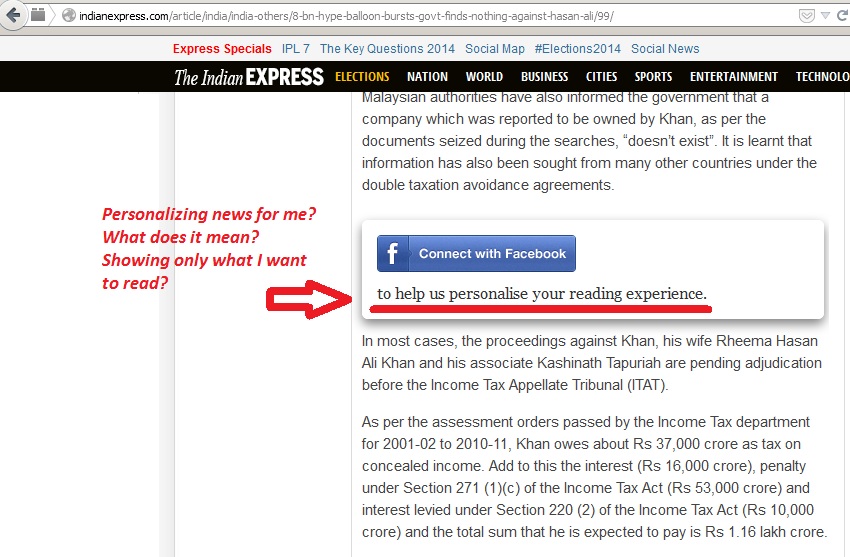
    What you want to readThis content customization or focus (in marketing called as targeting) of each one of us is actually alienating us from many realities. Reason for that is – we either do not know what actually happened but are bombarded by the other side with their perspective. In that case responsibility lies with us to know or try to understand what is actually happened. Thanks to the customization and therefore negative information we have already received from our “sources” we do not know what is right and if something is serious. I have been occasionally termed biased when I tried to provide different perspectives. Tough time! one has to live through it.

    Take an example of environmental damages. If you followed environmental cause related opinion makers you could know something wrong is happening, but if you are just following weather reports – you would say everything is ok! this year this typhoon, tsunami, hurricane, earthquake happened. Why? Well, have we asked these questions? Can we identify or try to search for the reasons for such changes in environment? Monsoon in India is delayed this year, can we ascertain reasons; and if we can avoid the reasons.

    We make our economics / political / national / Environmental opinions based on such biases. Take an example of economics. Capitalists’ project their system is right, socialists (communists) projects wrongs in the capitalists approach and vice versa. Is there a possibility when we think and design something which tries to bring good from different systems? Think, open your mind and look at the bigger picture. Should not we ask ourselves – are we served unbiased information or we are seeing what powerful people want to show us.

    Disclaimer – The author has no intentions to tarnish image of Indian Express/Network18. It was the easiest available screenshot for providing author’s perspective.

  • Big data – lesson on spirituality


    I was talking to my MD – Dr Vivek Damle. I said, Big data is “relevant information provider” for real time. One cannot rely on old data generated by a person, say in 2010, for marketing strategy (I am writing this blog in 4th Quarter of 2013). The discussion went on a very strange yet lovely tangent, Dr Damle said – “… so big data would take us on the road of spirituality, is it? I mean to say – like suggesting us to live in the present!”

    I was impressed with this thought. So here comes the lesson learnt from spirituality and applied to the Big Data and vice versa.

    Big-dataBig data is all about volume, variety and velocity… so data generate say 2 yrs back is likely to be irrelevant for today’s marketing campaign. In coming days or say months – all analytics would move to the real time e.g. at the moment of truth. Spirituality teaches us this very simple lesson (difficult to apply in real life though) – “live in the present moment”. As Master Oogway says in The Kung Fu Panda – Yesterday Is History, Tomorrow Is a Mystery, but Today Is a Gift. That Is Why It Is Called the Present.

    I was thinking – is technology forcing us today to spiritual concepts? Or unknowingly are we moving towards concepts of spirituality through technology?

    Big data can help identify a persons choices and predict his or her future course of action… but what in case of older data? That data would have lesser significance. Take an example in India, Narendra Modi (PM candidate in India from Opposition Party – BJP) for someone was communal few years back now is a hope, why? because perceptions changed. Vice versa for Dr Man Mohan Singh (PM of India). Old data less relevance. If I talk about my owns example of last month – I was searching for rental apartment, not now. The data I created while searching for a rental apartment last month is irrelevant now. The marketing campaigns will be more real time e.g. the present not based on “Historical” data.

    Earlier in my professional engagement as a marketing analytics consultant, we made a predictive model. The client executed the recommendation more than 8 months later. result – failed. no one wanted to take the blame. That’s what is the case is in a fast moving world.

    Live in the present.

    For Business people – try to be more real-time data based decision makers.

    Image source – http://www.greenbookblog.org/2012/03/21/big-data-opportunity-or-threat-for-market-research/

  • Do what is right in perpetuity


    The class was nostalgic, remembering the last couple of days of sessions of Operations Management with Prof Moradian. Today we were attending his last session of Operations Management. We all enjoyed each session, the quick wits and learnt a lot. We were attending his last session and thus all that was coming to an end for Operations Management.

    That session was very special, I could still hear his one statement very clearly that – “…in your career whenever you have to take any decision, always do what is right for your company in long term…”.

    When I recollect those words from Prof Moradian – “… do what is (make decisions which are) right for the company in perpetuity…” that makes a lot of sense to me. That one statement made me speak couple of tough truths in my career, but it feels good when you consider big picture vis-a-vis to your personal interests.

    An organizations need to learn the art of balancing between the short term sustainability and the long term growth OR short term profit and long term uncertainty. In current economic scenario short term sustainability seems the way to survive, let alone long term growth or profit for that matter. Message seems clear to me – Do what is right for the company in perpetuity.

    Actually this statement equally applies to each individual in life too – we should do whatever is right for us and others – IN PERPETUITY.

    Related blogs –

    Balancing Act – Professor Mankad shared this story of Balancing act with me earlier.

    Fruit will arrive in its season

  • Conflict of interest


    Disclaimer – Author himself is an MBA in Marketing (has been and is in the business of – kind of – selling dreams) and has worked as operations management consultant (has been and was/is/has been facing the challenges faced by operations department)

    I was comparing ourselves as an organization. I am an organization in myself, so are you and Ms Y. I was wondering about the departments Marketing and Operations. Marketing is selling dreams and Operations is capabilities. What I dream to be, could be the job of marketing department and what my capabilities are is the reality of operations.

    There is nothing wrong in dreaming, in fact it is good. At the same time knowing the capabilities is also important, that would help us realize the true potential and opportunities of improvements. Though, how often we dream then review our current potential and then think of building future capabilities to achieve potential? That’s where I think Marketing and Operations Department lock horns.

    An incident reminded me of a lecture of Prof Moradian, long term Vs short term and conflict between Marketing and Operations departments. I started seeing more reasons for conflicts between Marketing department and Operations Department.

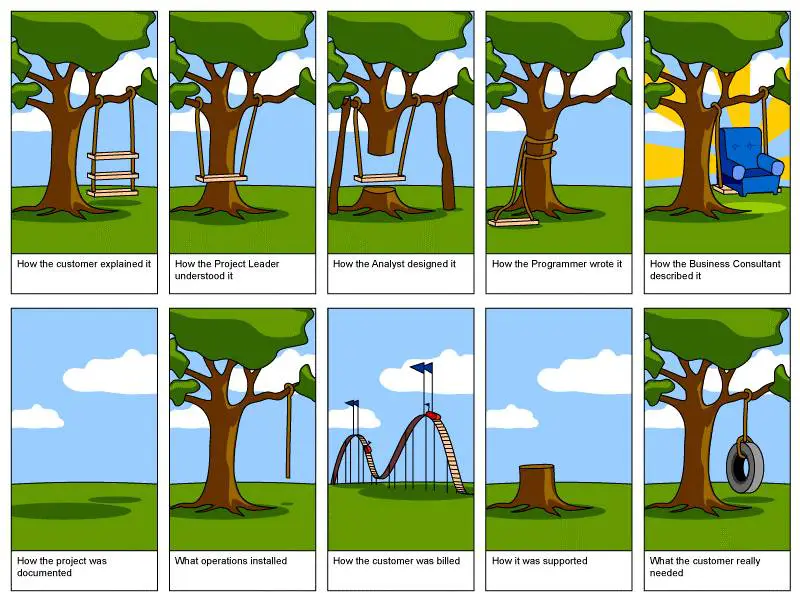
    Marketing and Operations lock horns with each others. Because generally Marketing team communicates moon, Sales team sells the idea of “reaching the moon as a reality” to prospect and Operations finds it difficult to do that. Why? Because Operations had the capabilities and was supposed to put the prospect in the sky (not necessarily on moon). Thus, challenges faced by operations and promises made by marketing are different.

    The second issue is Marketing and Sales team lives on quarter on quarter (Q-o-Q). They have to show the revenue which is the goal for any organization. On the contrary Operations team cannot take decision for one quarter. For example – operations may not say we need infrastructure for one quarter and not in other quarter and thus make huge investment in one quarter and sell those equipment back in next.

    A branding expert told us that marketing managers (brand manager) want to start new brand building exercise (to gain in short term for writing on their resume – ‘I started this initiative’) and move to next level. New manager comes he/she too does the same. Short term gains are there for the marketing manager; yet for long term the brand is diluted perhaps no one knows what would the brand stand for in future.

    This was/is the case of 2008 melt down. Decisions were made on short term with one phrase in each agreement – “systemic risk”. BFSI industry created various certificates (CDR) etc to sell junk to make big buck in short term. Dreams were sold without real fundamentals. In other words, operations did not have the capabilities of generating the kind of returns promised – with a rider of systemic risk – to prospects.

    This is what is conflict of interest for us as individuals – our dreams Vs our realities. The same is true with Organizations – their marketing Vs operations. This is also true for us as economy – our dreams Vs the reality of systemic risk and capacity of economy to fulfill the dreams.

    Image source – http://www.cravingtech.com/blog/wp-content/uploads/2007/11/project.jpg

  • The Middle Path


    I was thinking about the change happening around us on a daily basis. On a lighter side – roads of Mumbai with so many potholes. Well, on a serious note the economic situation in USA, changing thought process of middle class Indian etc etc. Keeping so many thought aside and together what I was thinking to write is about the middle path suggested by the Buddha.

    I believe the challenge economies are facing and have faced are because of their lopsided strong stance. USSR failed (various reasons) one reason was strong rooted socialism. USA is facing great challenges one reason – blind faith in capitalism. I see the good part of Indian economy is balance between socialism and capitalism e.g. public private partnership. The message I see is – there has to be a balance. The balance is needed on various fronts such as the one I suggested earlier e.g. controlled aggression in earlier blog on Balancing Act.

    When I think about following the middle path, I see many avenues for the same in our daily life, in our profession. Think of emotion and logic there has to be a balance. If one is too passionate about something, it may turn into obsession which may be harmful. There is a thin line difference between being a Courageous person and being a foolhardy. Balance between work and life. There are various personality type that need balancing.

    Further, I thought about Prof Lopez and my class of Marketing and his advise to me. I realized – what is required is an accountability when any Marketing activity is pursued. I heard someone saying that Marketing is a bottomless pit. Now – and in the future – there would be a great demand and pressure on Marketing departments for controlling the expenses and achieving the results e.g. Return On Marketing Investments (ROMI). This would require a balance between Marketing analytics and creativity. Message should be conveyed creatively yet keeping the returns expected and doing a first hand analytical research on the ROMI.

    Net net, we have to follow or learn to follow the middle path – economies, Governments, businesses, society and individuals. Isn’t it?

    Related blogs – Irony! Balancing Act and Cause…

  • Business of religion!*


    The first message we heard in the class of Brand Management of Professor Ram Kumar, was “It is an eco-system…”. An entangled, closely knit or perhaps confusingly mingled ‘Eco-system’. Econ-system of brands, products, product variants (variants are very confusing, no doubt) and bombardment of marketing messages (communication). Here everyone wants to say that our product is the best using different channels and different language. Hum! it sounds very common, right? So common that we overlook it.

    In another class of Marketing we were asked which is the oldest business in the world, still running successfully? I (when I say ‘I’, literally I) responded ‘religion’. Every religious institution says our religion is better (perhaps the best) than others and is the only path for salvation. Walmart, Google, Microsoft, Facebook, Tata or Reliance might exist, or not, for 1000 years but for sure we will (and had) many religion for 1000’s of years and we will have them in future too. Why? Because – religious institution sells itself on emotions. Even without learning any Marketing concept, religious institutions learnt that emotions should be hit directly to let people decide emotionally and justify rationally.

    Let us talk about the channels they use. It is similar to what we learn in distribution channel or managing supply chain. ‘Retail store’ of Religion or distribution channels are found everywhere, and finances? Well there is no limit to it (find it for yourself – a recent News in an Indian Newspaper The Hindu or Google search for $ with any major religion of the world…). Every religion has a source of income this source of income germinates from the EMOTION we talked earlier about. Yet there is a lot to learn from religious institutions, learning the administration, Marketing and distribution channel and much more, is not that true?

    Personally, I am a strong believer that religion plays an important role in building and binding society. Religion is a path wherein you have to follow the traffic rules. If you do not follow the rules you are likely to meet with an accident. What is the question of saying rules of left hand drive better than right hand drive? The rules are there to avoid accidents and make the journey safer and easier. When I say ‘firm believer’ I mean the rules taught by the religion, and not the comparison of one to the other.

    Well, not only for business but also for being righteous person we can learn a lot from religion!

    * Conditioned applied – Thoughts presented here are my own and learnt from different sources, I do not intend to hurt any sentiment or question any religion.

  • The Machine that Changed the World


    I read this book recently “The Machine that Changed the World“. It is indeed a good book every businessman should read it. “The business is run on trust” or “the business will be run on trust”. When we hear this statement it seems odd, however it is true Trust is the factor. I wrote often about ‘interdependent co-arising‘ (Blog 1, Blog 2 and Blog 3). When I read this book I realized that it is practiced in Japan for many years. Toyota has substantial equity share in its suppliers and the suppliers of suppliers. This is a complete mesh of cross-locking equity structure. They trust each other decide a profit margins rather than hiding the cost structures. According to the book “…This system has replaced the vicious circle of MISTRUST into VIRTUOUS circle of COOPERATION…”.

    The cross linking equity structure goes to a deeper level and different competitors also own each others share. This shareholding pattern is to help each other raise funds. Reference to this is – “The Machine that Changed the World” page 194 perhaps it is edition 1.

    What I found interesting (page 151 of the book I think first edition) – when the volume of demand changes and assembler gives notice to the supplier and in case the volume (demand forecast) fluctuates “…The assembler will work with the supplier to look for other business…”. This is not only interesting but also a surprising and welcoming effort to build trust. One more thing I found very impressive and useful – “…we (suppliers) work without safety net, so we cannot afford to off the high wire…” and thus suppliers maintain the quality not only for their own sake but also for the assemblers.

    The other interesting fact is not just production but also product development is done in cooperation. We hear “crowd-sourcing” as a means for innovation however, a crude system has been used by Toyota for years now. New product development at Toyota involves the suppliers and major work of NPD is done by the suppliers.

    One more interesting factor I realized while reading the book. When we say “one customer at a time” and “managing customer relation in Marketing”, this concept was far more ingrained in the Lean system of sales even in 60s. So beyond Operations the Lean system has been a pioneer in Marketing and Sales too.

    Still after praising the book I am of the opinion that there would be some method which will change the game even further. The question to ask is when and how (which I contemplated earlier)?

  • Balancing act… continued!


    Recently, I wrote about the ‘balancing act’ based on the story of the Buddha. I started observing the concept of balance to a greater detail when I received the story from Prof Mankad, and here are few pointers in this continued blog.

    What I have realized in my studies lately is, the “engineerish thinking” (numbers all the time all the way) is not the end in itself. Marketing has long been a function requiring creative thinking. Long time back – before my joining my MBA – someone (talking to me) made a remark – ‘marketing is a bottomless pit, you do not know the return on investment etc etc. Now in the era of result orientation everything is being measured and therefore the results are key for marketing departments too’. Here again creativity should not take toll on numbers. Thus, a balance has to be made between being creative and being critical for return on investment.

    Second thing what came to my mind with reference to marketing, and in general to all of us, was perceptions. While communicating to outside world e.g. marketing companies try to play on ’emotional’ hot button of target audience yet want to be analytical of the effect of the marketing efforts. Again the balancing act comes into play based on the perspective inside out Vs outside in.

    In case of say leading teams, one needs to balance. Leader needs to involve and empower his team at the same time guide when anyone needs help (I wrote about this earlier in blog Growing and becoming leaders). Thus, a balance has to be made between giving power to take decision and taking control of situations when required. I had few things in my mind regarding the same in the language of TRIZ. In TRIZ there is a principle called separation on condition (giving control and taking control based on condition) for such cases. I would write more on application of TRIZ in marketing and sales in some other blog.

    Changing gears, in personal life we manage relationships. At times these relationships come to such a point that we need to act as a funambulist (tightrope walker) to sail through the rough patch of managing the relation. So, balancing act continues throughout the life.

  • Playing Golf, work and meditation


    My professor, Professor Tomas Lopez often wraps his lessons in simple and interesting ways. His one of the lessons was very simple, profound and meaningful. That lesson was defining meditation (not literally though) for the corporate leaders, for the young generation and for the affluent golfers. The lesson was so disguised that prima-facie it looked as it is a lesson on golf (or marketing). However, the profound meaning was for everyday and the soul. In simple words he said – do not force yourself for doing things, let the things happen through you. Trust this message is clear.

    Let me give you the verbatim statement – “you know what, marketing is like playing golf, you have to swing naturally”. In other words – chances are the harder you try the miserably you fail. So, do not force, let the things happen naturally. ‘The harder you try the miserably you fail’, I heard/read it somewhere… you know where!