Tag: Manmohan singh

  • You Need To Believe


    When I hear the phrase “you must believe” the first thing that comes to my mind is “Kung Fu Panda“. I love the movie and here are two videos that come to my mind when I think of “you need to believe”. First is when Master Oogway tells Master Shifu to believe. The other is Po’s father telling him “…there is no secrete ingredient, you must believe the soup is special…” this gives Po an idea what the message of Dragon scroll is.


    I reached in a country (continent) where I never thought I will go. I am walking on the streets and meeting people on the other hemisphere, it is no less than a surprise. This makes the title “You need to believe” apt for me today. Believe is a verb for belief, I am slowly making some perspectives that one must accept things and be willing to be amazed with life as it comes. It requires some sort of trust (trust in who is immaterial and can be explore in some future blogs).

    Change in perspective is happening on other dimensions too for me. I was of the type of liberals who hate present Prime minister of India Mr Modi. In my mind it was kind of dislike for him after 2002 to almost until 2015, even though Indian courts have already acquitted him. Slowly, I started feeling, he being the PM of India is a better choice than any other current politician in India.

    On believing some of his steps, I loved demonetization as a decision. In fact I am a step ahead – wish we do away with denominations higher than 100. I know there were execution challenges, however after a lot of planning too in last 70 years we have seen what the results of planned policies resulted in – roads made but do not sustain, money gets allocated but only 5% of the actual amount reaches the needy. What is the need of such planning in those cases?

    We need a kick to start a bike, isnt it? Perhaps some decisions of Mr Narendra Modi are like that. If someone who has the guts and takes decision and makes course correction – we think planning is less but at least some actions are taken. Those who start have the possibility to reach those who do not start cannot go anywhere.

    We need to believe. I live in Mumbai, I have seen stagnation of property prices in there. I am a fence sitter for buying home, after demonetization the prices have come down, not to my expectations though but yes some things have change for better. The artificial inflation is low now. It is possible that growth number at the time of previous government were impacted positively due to such inflation.

    I believe, artificial property price rise and corruption was “Organized loot and legalized plunder” what we saw in Manmohan Singh government of Indian National Congress. It is when CWG, Coal and 2G etc scams happened – that is organized loot and legalized plunder. All the scams were kind of legal activities but organized such that payments were made under the table to those who were in government. I hope former PM Manmohan Singh who presided over these scams will know what a common-man sees as Organized loot and legalized plunder.

    We need to believe things will be better – be it GST or demonetization. Who knows perhaps in 2019 it will be a hung parliament?

    You Need To Believe was last week’s LBC topic where Maria, Ramana uncleji, Ashok and Shackman write. You can see what the other writers of the LBC have to say in their respective blogs.

  • Leaking pipe, economics and politics


    Recently I went to meet one of our relatives. We were generally speaking and his plumber came, I asked what happened? He said – Pravin, we requested our plumber to fix the leaking pipe. Later we asked him to put blocker from where the leaking pipe was having water inlet. I said why did you solve the problem of leaking pipe twice? He said the fixing the pipe with m-seal and other plumbing means was cheaper. But second time you had to put a blocker, isn’t it? It costs and your plumber might have charged you twice too. I curiously went to check the place – being an insider to this family it was alright. I repeated – you tried to fix a wrong problem and you did it twice! and also by putting blocker you made the pipe irrelevant too…

    The same keeps on happening in our society be it bailout or loan waiver to farmers. Those who cannot get in such beautiful moral hazard go to UK or become part of crony capitalism.

    I was speaking with my wife today, she said “loan waiver is not a permanent solution”. Yes she is right. This endemic was started by government of our own very famous economist Mammohan Singh and his another gem of an economist finance minister Chidambaram in 2008. It was a waiver of 60,000 cr, largely to win upcoming election. Manmohan Singh government won that election too, just to end up embroiling themselves in scam after scams. The scams resulted in public anger and protest – India Against Corruption. There are long lists of corruption under the Manmohan Singh government however the point of discussion currently is farmer’s loan.

    The kind of waivers offered mostly result in moral hazard. Just imagine, if I am a farmer – this year monsoon is expected to be good – why would I care to pay my loan EMIs when everyone is getting sops? The other trouble is – even after 70+ years of independence of India we are more dependent on monsoon rather than our skills of farming! Connecting all the rivers was a dream project of Atal Bihari Vajpayee 10+ years back, yet it has to see light of the day. Furthermore, we ignore solving the problems we created ourselves such as depleting underground water level. Mostly, the reason is – we are individually smart but collectively dumb. We assume that I cannot control where the underground water goes – why should I?

    Imagine, the amount of 60,000 cr farm loan of 2008 – had it been utilized in making canals and rainwater harvesting, educating farmers for better methods of farming and technology interventions in agriculture and post harvest we might have been able to solve the problem to some extent if not completely. The other thing to note is – how can we ascertain the benefits are transferred to the right people? Those who have small land holding may be taking loans from local private lenders, also they might not even have their credit ratings for bank to offer them loans. Where exactly does such huge amount go?

    Now think again about where the government gets this huge amount from? Have you ever seen your bills? Did you see Krishi Kalyan Cess? Government generates parts of such sops from us when we pay taxes – indirect tax. This is a problem to worry for middle class only. They earn and pay income tax, they buy and pay Krishi Kalyan Cess and when farmer’s are on strike they pay exorbitant amount for buying vegetables too. Mostly this expensive vegetables are procured by middlemen at cheap prices – all cash business less or least tax with black money. A better option for middle class Indian is to either become a farmer and get loan waiver or become an industrialist take loan and leave India!

    When I completed my sentence – “you tried to fix a wrong problem and you did it twice!… …The leaking pipe was old and rusting, you should have changed it at first instance. why don’t you fix it permanently? My relative said “why should I? It is a rented property? I may go next year, someone else will come, so I am fixing it temporarily.” Same is with the governments – they solve a problem as temporary fix – farmer loan waiver for winning next election and not solving problem which causes farmers to take extreme step of committing suicide or protesting for loan waiver.

    According to the Bank of America Merrill Lynch the farm loan waiver will cost 2% to the GDP of India by 2019. This wrong precedence was set by two of the most knowledgeable economists of India – Mammohan Singh and Chidambaram. Go figure what it means to be subject matter expert!

  • Big data – lesson on spirituality


    I was talking to my MD – Dr Vivek Damle. I said, Big data is “relevant information provider” for real time. One cannot rely on old data generated by a person, say in 2010, for marketing strategy (I am writing this blog in 4th Quarter of 2013). The discussion went on a very strange yet lovely tangent, Dr Damle said – “… so big data would take us on the road of spirituality, is it? I mean to say – like suggesting us to live in the present!”

    I was impressed with this thought. So here comes the lesson learnt from spirituality and applied to the Big Data and vice versa.

    Big-dataBig data is all about volume, variety and velocity… so data generate say 2 yrs back is likely to be irrelevant for today’s marketing campaign. In coming days or say months – all analytics would move to the real time e.g. at the moment of truth. Spirituality teaches us this very simple lesson (difficult to apply in real life though) – “live in the present moment”. As Master Oogway says in The Kung Fu Panda – Yesterday Is History, Tomorrow Is a Mystery, but Today Is a Gift. That Is Why It Is Called the Present.

    I was thinking – is technology forcing us today to spiritual concepts? Or unknowingly are we moving towards concepts of spirituality through technology?

    Big data can help identify a persons choices and predict his or her future course of action… but what in case of older data? That data would have lesser significance. Take an example in India, Narendra Modi (PM candidate in India from Opposition Party – BJP) for someone was communal few years back now is a hope, why? because perceptions changed. Vice versa for Dr Man Mohan Singh (PM of India). Old data less relevance. If I talk about my owns example of last month – I was searching for rental apartment, not now. The data I created while searching for a rental apartment last month is irrelevant now. The marketing campaigns will be more real time e.g. the present not based on “Historical” data.

    Earlier in my professional engagement as a marketing analytics consultant, we made a predictive model. The client executed the recommendation more than 8 months later. result – failed. no one wanted to take the blame. That’s what is the case is in a fast moving world.

    Live in the present.

    For Business people – try to be more real-time data based decision makers.

    Image source – http://www.greenbookblog.org/2012/03/21/big-data-opportunity-or-threat-for-market-research/

  • Interdependent co-arising intra-country example


    In previous blog “Coalgate…” I touched on the topic of Dutch Disease. The concept of Dutch disease rebounds me to the interdependent co-arising once again (interdependent co-arising means – we are all dependent on each other.). This concept of Buddhism is applicable in every walk of life. If we (each individual) do not understand it we are going to remain in the problems we face. Check previous blogs on the same below.

    Interdependent co-arising farmers example (ground level example) – this blog is about how interdependent co-arising relates to a smaller level of activity of one businessman / farmer. This could be you or me in our regular work environment.

    Interdependent co-arising macroeconomic example (world level example) – this blog is about how interdependent co-arising relates to macro-economics.

    This blog is a country level example of interdependent co-arising (Pali original concept – Pratītyasamutpāda – at Wikipedia).

    What is Dutch disease?

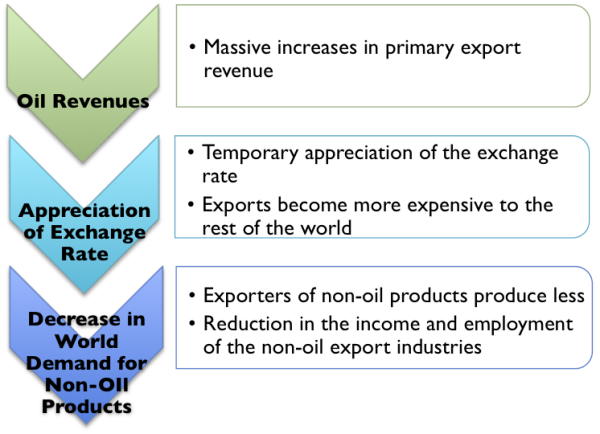
    The inflow of capital leads to an appreciation of the currency, making imports cheap and export expensive. The name comes from the Netherlands experience following the discovery of gas in the north sea. Natural gas sales drove Dutch currency up, seriously hurting the country’s other expdutch-diseaseort industries.

    In late 50’s Netherlands found huge source of natural gases. This resulted in 1. investments (largely foreign direct investments) in that sector 2. decline in other sectors e.g. one example could be people moving for jobs in that sector (consider Indian IT sector as reference) 3. investments (specially foreign investments) in that sector resulted in stronger currency. The excessive investment made Netherlands currency stronger resulting in making exports expensive eventually resulting in decline of export from Netherlands. Manufacturing suffered and thus jobs in manufacturing too go to step 2.

    This convoluted – action/reaction and impact at not so obvious industries – example again suggests to us that even if industries are not linked directly they are linked in some way. This link is interdependence. This interdependence should make one value the existence.

    The  “Dutch disease” should make us once again think about the invisible connections we share with each other.

    Image source – http://globalprosperity.wordpress.com/2010/08/19/oiling-africas-gears-for-democratic-change/

  • #CoalGate, corruption, politics & economics


    A few days back I completed this book Globalization and is discontent by Dr Stiglitz, a nobel laureate. I wrote on that recently – Interdependent co-arising a macroeconoics example. Besides this macroeconomics example, I had this intra-country example of the same concept of interdependent co-arising. Stiglitz has written so many things more than 10 years back which are happening in India currently. However, here I am just interested in quoting a small part of the book which relates to the corruption of coal mine allocation in present day India. This example is from page 71 of the book –

    There is more to the list of legitimate Complaints against Foreign Direct Investment (FDI). Such investments often flourish only because of special privileges extracted from the govt. While standard economics focuses on the distortion of incentives that result from such privileges,  there is a far more insidious aspect: often those privileges are the result of corruption the bribery of govt officials. The Foreign Direct Investment comes only at the price of undermining domestic processes. This is particularly true for investments in much oil and other natural resources where foreigners have a real incentive to obtain the conversation at low prices.

    Moreover such investment have other adverse effect- and often so not promote growth.  The income that mining conversation brings can be invaluable but Development is a transformation of society. An investment in mine – say in a remote area of a country – does little to assist the development transformation, beyond the resources it generates. It can help create a dual economy, an economy in which there are pocket of wealth. But this duel economy is not a developed economy. Indeed, the inflow of resources can sometimes actually impede development, through a process that is called “Dutch disease”

    So effectively, what Stiglitz said was bribing of officials for mining in developing / undeveloped countries. Further, the dual economy this FDI may create is not best for country to develop. I would take this example of Dutch disease in my next post – “Business to the Buddha”.

    Here what I want to highlight is this – the current issue in India – #CoalGate scam is a clear example of what Stiglitz wrote more than 10 years back. Indian Prime Minister – Dr Manmohan Singh – being an economist might have been aware about this and perhaps therefore kept Coal Ministry with him. This is just an extrapolation. Otherwise why would Law ministry and Law minster would want to change parts of report? According to the Supreme Court of India, the changes are Heart of the report.

    After reading the book – Globalization and its discontents – I realized that Stiglitz is not against Globalization but against the way Globalization is happening. So, when you read the above part, you should not infer that Stiglitz is against Globalization.