Tag: Mahabharat

  • Peace second

    When the need arose Krishna told Arjuna, pick up your arms, and fight. When there is a need, you have to do this duty without thinking about the results. Krishna said you have the right to perform your duty, also you do not have control over the results. Peace comes first when we are trying to reach a peaceful solution or consensus. If the peace fails, relegate peace to second. Perform your duty by taking arms. This is what happened in Mahabharata.

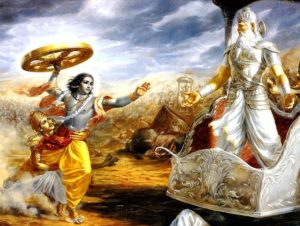
    Krishna picking up a wheel to attack Bhisma in Mahabharat. Krishna had avowed not to take weapon in the war, even a wheel was considered weapon if used for attack

    India and her culture and China from a religious perspective

    For time immemorial, India has been a harbinger of peace. India’s message to the world has been of spirituality, science, and peace. Every single message from India has been for the progressive world as a one-world family “Vasudhaiv Kutumbakam”. The examples are the first surgery or mathematical genius of Aryabhatta or the message of the Buddha. The best thing, Indian culture has never asked for recognition for any of the achievements. The world knows basic mathematics from the middle eastern name – Algebra. India developed the concepts of algebra, the message of meditation, astronomy, or peace all are open for adoption.

    Hinduism has a lot of branches. Every branch is exploration of different aspects of spirituality. Hinduism accepts every approach. Buddhism lays immense importance to meditation as a religion. Meditation is yet another path (Dhyan yog) within Hinduism. A book – Vigyan Bhairava Tantra – contemplates more than 100 meditations. You can read/listen to Osho’s commentary on the same. A better suggestion is to experience the meditations described in the book. The art of living foundation has a special course on Vigyan Bhairav. Buddhism was spread to Egypt in the west and Japan in the east. The western side of India has curbed Buddhism by force – bursting of the Bamiyan Buddha statues is a contemporary example.

    India has been a kind country for many centuries. She has to rise to the occasion and not only be a guide for a peaceful world order but also communicate clearly about its national interests too. There are multiple conflicts here such as Chinese and Pakistani occupation on its territories. Possibly, as stated, peace may have to be related to the second spot for that.

    Buddhism in China

    In the recent past, Tibet was forcefully taken over by China. There are close to 20% Buddhists in China. Buddhist and Communist approach of life is diagonally opposite. Buddhism has a concept of Sangha a community. However, it lays a lot more emphasis on an individual’s personal growth – because enlightenment is achieved by an individual. Whereas the communist approach is – an individual has no value as such. China has been trying to use Buddhism to influence South East Asia, in fact using Buddhism with forums. This is another meddling in the personal life and beliefs of individuals – a very common practice of China.

    The way China crushed Tibet (watch 7 years in Tibet), it is going to pay back. China has crushed one such uprising at Tiananmen square. China has been able to control these descents to a great extent – Google and Zoom. It is no secret more you suppress something, more powerfully it will come back. Sooner or later, this is going to happen to China.

    Chinese aggression

    Recently China has tried to push Indian boundaries on North East Doklam in 2017 and Jammu and Kashmir in 2020. This attack comes with the audacity of pushing the world into a lockdown due to Covid-19 (actually the Chinese Virus). It is a natural response for a country that feels threatened by a potential competitor. Many companies are likely to shift from China to other countries – including India. The other reason for considering India a potential competitor because India is a major economy if everything falls in place, India can grow faster. Though there is at least 5 times gap between the GDP of both the countries, however if mass exodus happens it may adversely affect China in short span.

    There are various internal and external factors affecting China. Some of the Internal factors are the aging population of China, shortcomings of the one-child policy. The external factors are abused rules of free trade, debt trap for smaller nations, etc. The world now sees a new way of colonialism from China. This has woken up the world. This aggression if taken forward, is likely to cost a lot not just to the two nations but also to the world at large.

    The economy trap of China

    If you look at the trade balance of major economies vis a vis China, you would see trade balance is 1:3. Almost every country has trade-deficit with China, in effect China sucks funds from every country! In many ways, China either flouts World Trade Organization (WTO) norms or takes unfair advantages of the same to trap countries. The worst form of trap is – debt trap – giving loans to countries at better rates (naturally these countries cannot service these debts) and later gain control over assets of these countries, Sri Lankan port is an example. Nepal will soon get into this trouble. China is trying to control the sea too. In the east, they are contesting with Phillipense.

    In a nutshell, every country, business, and economy dependent on China has a problem with China and yet it is very difficult to look at short term alternatives. This is the kind of overconfidence that anyone should be cherry about. This overconfidence has to be and will be tamed sooner or later. Probably the fear of this taming is forcing China to take aggressive steps against India. Further, in the coming time, China will face the heat of Covid spread worldwide. The whole world has suffered. Recently Geeta Gopinath of IMF wrote, that the negative growth rate is expected to be worse than previously estimated. More likely, the countries worldwide must get compensation from China for this massive loss.

    Peace second

    There are multiple problems the whole world is facing currently. Starting from the Chinese Virus challenge, economic downturn, and major control of China over many smaller countries to Chinese aggression on Indian territory. The China-India standoff is probably a warning to companies considering moving from China to India, giving a signal that India is not safe. This exposes China to many of its internal problems, suppression of its citizen, forceful control on Tibet to name a few, and external right from the debt trap, surreptitiously controlling land to the aggressiveness across sea routes too.

    At the time of Mahabharat the equation was more driven by the military power and the kingdoms aligned to a side. Now, more than military power, it is economic power that drives alignments and overall control on world affairs. In Mahabharat, Pandavas were forced to ask for their fair share of the land they had to fight for it. In the present day world when a country faces such an adversary that is powerful, manipulative, and extremely aggressive sooner or later it has to be relegated peace to the second spot.

  • Perceptions, perspectives and expectations

    I was watching Mahabharat episodes. The epic is the best depiction of conflicts we keep on going through on a daily basis. The biggest conflict and learning is the shloka of Mahabharat that teaches the value of the action and no entitlement of the results. Dhritrashtra’s perception was he is the eldest so the throne belonged to him. Bhishma’s perspective was that he has to take care of the kingdom (even if the king is incorrect). Dronacharya’s expectation from teaching Kuru prince was to take revenge from Panchal king. Many in the epic knew that their opinions are based on ideology applied incorrectly in the given situation, yet they did not amend their ways. When the battle started everyone took side not based on what is right or lawful but which side my enemy is on. This is the result of these perceptions, perspectives, and expectations. The outcome was – people were fighting their own battles at the backdrop of Pandavas and Kauravas.

    Perception

    Aurora borealis

    When I was thinking about aurora borealis (or polar lights), I thought that such a phenomenon or any other related ionization must be happening at different wavelengths that are beyond the human eye’s abilities to see. Our incapability to see does not mean some things do/did not happen. Sound below 20 Hz and above 20,000 Hz exist, we humans are unable to hear it. Our senses and perceptions create our realities. I wrote last week “our past experiences – Sanskara – condition us”. We need to go beyond the conditioning to change our perceptions.

    http://business2buddha.com/2011/02/15/no-judgement-its-all-about-perception/

    Perspective

    In some of the satsangs of Art of living, I heard a few romantic Bollywood movie songs. Earlier when I had heard these songs I felt ok it is a romantic song sung by the lover for the loved one. However, when I heard the same song in a different setup it was as perfect in Bhakti too! These presentations of songs change my perspective, examples are in the below videos –

    The perceptions made these songs to be romantic songs however when I looked at these songs from a different perspective the meaning of the song itself changed.

    Expectations

    कर्मण्येवाधिकारस्ते मा फलेषु कदाचन ।

    मा कर्मफलहेतुर्भुर्मा ते संगोऽस्त्वकर्मणि ॥

    You have a right to perform your prescribed duty, but you are not entitled to the fruits of action. Never consider yourself to be the cause of the results of your activities. Bhagavad Gita, Chapter II, Verse 47. Effectively, we must do our actions as per need of the hour and do not be feverish about either the actions or the results.

    Conclusion

    http://business2buddha.com/2010/08/19/playing-golf-work-and-meditation/

    In Mahabharat, each person was living his perceptions, defining his stand in his own’s perspective and having different expectations. These three things blinded people. Isn’t it true that we live in the cage of our perceptions, perspectives, and expectations? Meditation can help change in all these three.

  • Time


    In the war of Mahabharata, there were days when one or the other side was looking at the sun to set as soon as possible. The rules of the war were set that war will happen between sunrise and sunset. When Arjuna took oath to kill Jayadrath before the next day’s sunset or immolate himself, Kaurava’s were waiting for day to end sooner.

    On the other hand when Bhishma was the supreme commander of Kaurava’s army everyday was a mayhem for Pandava’s army. Bhisma killed thousands of soldiers and hundreds of chariot warriors everyday. Krishna’s frustration (though frustration cannot be the right word here) was at peak, when he felt that Arjuna isn’t fighting with Bhishma with all his capabilities and took weapons in his hands to kill Bhishma – Krishna had vowed not to fight from either side, but was a Charioteer for Arjuna.

    At this Arjuna requests to Krishna not to break his vow, and he promises to fight with his full might to not just defeat Bhishma but also end the war today itself “only if the sun does not set (as fast for the day)!” Arjuna even if was a great student yet had missed occasionally – Krishna’s loudest message to him in the whole of Geeta was perform your duties, do not think of results. Arjuna kept on missing this during these 18 days. Once here and other time at Jayadrath’s killing, Arjuna wanted the sun to be bit slow – Time to stop. I wish he had remembered the beginning of the war when Krishna was teaching him the Geeta – time must have stopped at that time, how can time fly when the god himself is speaking about the truth. Perhaps time must have not even existed when the Bhagvad Geeta was narrated.

    Time is a difficult concept to explain, oxford dictionaries define it as – “the indefinite continued progress of existence and events in the past, present, and future regarded as a whole.” What is the start and end of time? There seems to be none. In Indian philosophy time is defined as Kala. Kala has a lot of small to large measurements, that is for some other day. However when I thought about Time as a topic for LBC I could think of two things – one commentator of was Old Hindi TV Serial Mahabharat, and other a consultant saying – time is the commodity I sell. It is the most precious commodity I have, I cannot get it back once it is gone.

    The commodity is really very important and extremely perishable plus nontransferable, it cannot be restored once gone or consumed. The best thing is each one of us have the same amount of it – unlike any other commodity. What use we make of it is something to be decided by each one of us.

    We all want the time to move slowly when we are happy and to just vanish when we are in trouble. However, we always feel that when we are elated time elapses fast and vice-versa. Isn’t it? The following I wrote long back when I was doing my engineering (about 2 decades back, 1998-99 – my god I am old!) Hindi and English translation side by side

    स्वर्ग भी है यहाँ, नर्क भी है यहीं Heaven and Hell are ‘here and now’
    तुमने जैसे जिया जो पल The way you pass each moment
    तुम ही परिभाषित करोगे, कि तुम जो स्वर्ग याकि नर्क मे You define whether you are in Heaven or a Hell.

    Ramana uncleji suggested this topic for the weekly LBC blog posts. You can see what the other writers perspective is on this topic at their respective blogs Maria, Ramana and Shackman uncleji.

    Image source – http://sathyasaiwithstudents.blogspot.in/2013/06/bhakti-part-1-story-of-bhishma.html

  • Dalits in India, Dividing work, birth or none?


    Perhaps in middle school (6th to 8th), we learnt a lesson on why crows are our best friends and what we can learn from them. They eat dead animals and therefore keep our surrounding clean. We need to learn from them that whenever they see something to eat they always invite their fellow crows and all of them eat it together – what camaraderie, isnt it? But alas! as we grow we forget these small things we learnt as kids.

    Perhaps Krishna knew it all, he suggested Draupadi (Panchali) to reject Karna and thus Panchali said – Karna is a son of lower caste and I wont accept him as my husband. This – for my readers who have not heard of Mahabharat or know the context – was an India where girl (if not all, at least daughters of Kings), had the freedom to decide who she wants to marry. This was called Swayamvar – or a competition – where husband was selected by his capabilities by the girl. This kind of Swayamvars are recorded in history – be it Rama or Prithviraj Chauhan (12 century AD). Compare it with arrange marriage system of say two generations back when such decision was not that easy to offer to girl. This was an India where even if Krishna (God in human form as per Indian scriptures) was alive, abilities of Karna was proved secondary than caste (family’s profession).

    We have heard many such incidents in Indian history when a untouchable became center of discussion – be it Shabari who fed Rama only sweet berries by tasting those first. Here untouchable was first tasting the fruit and than offering it to Rama. Or be it a story of Eklavya. He approached Dronacharya (Drona) who refused him, later asked him to chop off his thumb to offer it as fee of teaching. Or the story of Sunita during time of the Buddha.

    I dislike the concept of caste system of India to the core. Slowly I moved away from the ritualistic religion to spiritual part of religion. I read parts of Bhagavad Geeta too. When I read Chapter 4 verse 13 of the Geeta I interpreted it in my own way, thank god at least Hinduism offers differing with the pandits; I can have my owns interpretation of the scriptures (ref recent controversy of Irrfan Khan).

    (Sanskrit) चातुर्वर्ण्यं मया सृष्टं गुणकर्मविभागशः । Sunita “Lord, I do not dare come closer. I am an untouchable.”
    तस्य कर्तारमपि मां विद्धयकर्तारमव्ययम्‌ ॥

    (Transliteration) catur-varnyam maya srstam, guna-karma-vibhagasah
    tasya kartaram api mam, viddhy akartaram avyayam

    I infer this as follows – “I created four sub-division of society based on work and attribute. Even after doing this I am above and beyond this division.” Remember Krishna does not say that the division is based on birth, it is based on work and attribute of work.

    Listen to other language translation here, I cannot say it this translation reflects my opinion.

    In whatever ways Indian society has misinterpreted the concept completely. This whole caste system implementation has gone awry. I believe the concept could have been, teach kids and when they grow up their abilities will put them to different works and thus their work in society will be divided in four sub-divisions! Even if this sounds justification of the caste system, I still dislike the caste system. Everyone must have his/her fair opportunity to learn and try what and how one wants to work in the society. I hope the capitalistic economics and current open access to opportunities will offer an evolved society. Currently it is just a hope, as we read the news about atrocities against Dalits. It has been close to 70 years, but if we still see these news in media either there is something wrong with our society or media is giving coverage to it only now!

    Just fresh graduate from college and I’d just joined my first job, where I was selected through campus interview. I resigned within few weeks stating I’d have done this work after my 10th, if I were to do it. My brother taught me at that time – “no work is bad, low or menial. Do not look at your resignation from your first job as an ego issue. Accept it ‘you would not have enjoyed doing it.‘ If you want to start a company, it is upto you, if you want to study further, be into R&D be it. Even if you are gardening, be the best of the gardener you could be. Do it to the best of your abilities, no work is low or menial and never forget this lesson.

    I could relate to his lesson in many sense, be it a crow’s nature to clean our surrounding inadvertently or our society having different people performing different acts, we have to balance and accept that everyone does what best he/she can do for the society. There may be instances when one’s abilities are not utilized (as was in my first job); at that time he/she has to decide to move on and do what makes more sense to him/her. In today’s world when a person makes competitive strategy – he/she is Kshtriya (warrior clan in Indian caste system). When the same person presents his concept or shares his knowledge he/she is Brahaman (Pundit, teacher clan in Indian caste system). As a startup CEO (Chief Everything from dusting room to meeting clients to executing tasks) when one cleans his desk, prepares tea, drives somewhere or designs product/service he/she is Shudra or Vaishya (lower caste or businessman clan in Indian caste system). In current social and economic setup we cannot rely on the definition of works of previous times. We need to either define things in newer manner or perhaps just get rid of the division itself.

    There may have been roads paved with good intentions (by dividing work & caste system), but could not have lead to heaven at least. We started dividing society not on work but on birth. We decided one work is better than the other – but this is be good.

  • …because there are only means!


    On Saturday I read a twitt of Paulo Coelho – renowned author – “A warrior of the light knows that the ends do not justify the means. Because there are no ends, there are only means”. I inferred from the statement that – means are values on which we base and live our life. Some time back I had written on integrity as one value for organization and individuals. Another article I glanced through in Outlook India – “How Not To Court The Law” by Uttam Sengupta. At the end of the article Mr Ranjan Mondal commented – “…where is our Ethics in law?”

    Recently, I happened to meet and discuss the same with Mr Abhaynath Mishra. He is a trainer, consultant and is extensively working on value system of individuals and organizations.  He said, sustainability of an organization is based on values and ethics it follows. In short run there may be loss but the long run success of an organization is assured by the belief and sticking to the values. Also, I had a few telecon with my MBA Professor Ms Mala Kapadia – we too discussed on Values and Business. Mala Ma’am suggested “…somewhere I feel interpretation of Bhagwat Gita too has been wrong, in saying that war for Dharma is justified.”

    I asked this question to myself – do ends justify means? and What are the values business follow, do the businesses really follow these, values? I stopped at a very good question – where is ethics? We seldom talk about it in debates, in our closed rooms and perhaps in boardrooms. Ethics are there in closed door – safe, not touched by anyone! In practice – well, we practice everything except ethics because for a long time we have imbibed lessons such as “ends justify the means.” Now is the time when we – as a community – are questioning the means used to achieve goals, ethics in business and values of individuals. The reason to ask such questions is the problems we face today – recession, political unrest and other personal problems. The biggest identified cause for these problems is  ‘greed’. The problems can be resolved when we learn what Paulo Coelho twitted recently – ends do not justify the means. Because there are no ends, there are only means. Be ethical …because there are only means!