Tag: macroeconomics

  • Solutions…


    The security guard welcomed with this question साहब, आज रविवार है! आज दफ्तर मैं? (Sir, its Sunday today! You came to office?)

    With a sigh I looked at the guard, asked him if someone is around ask him to give me a cup of coffee and some water. I’d not tell him – my wife and I fought, nothing new happens in almost all families. We were struggling with our personal relationship and there came another dispute of her relatives and my relatives. I could not stand that problem, came to office thought it would be a change and I can catch up with some of my deliverables.

    Neither coffee came nor water, it made me little annoyed adding fuel to fire. Well, I understand office boy was not in office on weekend. A couple of days went by, same thing happened next weekend. Again no water or coffee came in. Now I was very furious. No solace here too. I decided to join our office’s team which has organized a recreation trekking event the next weekend. My wife wanted a change she had already gone to her parents home.

    For a first timer like me the trek was tough. An accident happened and I sustained fracture and few bruises. I had to spend some days in hospital. My wife rushed to the hospital however there were same issues at the back of the mind. Those few days at hospital gave me time to think.

    I was running away from problems. I avoided one problem, just to meet with another. Running from this other problem, ended up in being hospitalized.

    How often this happens that we run away from one problem instead of solving that problem, just to bump into other. Solutions require patience and a serious thought. Why the problem occurred? What are the possible reasons, can we fix the reasons? In Operations Management these fixes are called – preventive actions and corrective action. According to ASQ corrective action deals with a nonconformity that has occurred. A preventive action addresses the potential for a nonconformity to occur.

    I observe short term quick fixes – patchwork (in Hindi – थूक पट्टी) everywhere. Look at the reaction to 2008 financial crisis. We should have strictly handled the responsible however some of the culprits made millions and left the world tattered. No action taken against them. We’re fixing the economies by pumping money, those who could not game the system earlier, came and made their millions. Now once things seem hunky dory, QE may going to put us back in trouble.

    The solutions we device in our desire for quick fixes are – avoid the problem. The same happened in above example at micro level, same is happening at macro level in national and international levels.

    Post Script – Author is unmarried. Story narrated is a work of fiction, any resemblance to living/dead is merely a coincidence.

  • Special situation needs special solution


    Crisis unites, for how long? I was thinking about Quantitative Easing of Fed in the US. While thinking undoubtedly read G20 communique of 2009 e.g. London Summit here. A prologue about this communique. In 2008, US financial market collapsed. This resulted in domino effect across geographies. Every country, its financial system and thus citizen of the country were adversely affected. Do not ask me – what happened to those who were responsible for this collapse? Many of them made huge money and (almost) vanished! as – according to the books – they earned legitimately. Coming back to the point – otherwise a competitive world became a co-operative world. The mindset changed like this –

    “…We will conduct all our economic policies cooperatively and responsibly with regard to the impact on other countries and will refrain from competitive…” (source – London Summit communique para 12).

    I am forced to think – do we need crisis to unite the world and people?

    The thought is in the mind because now, when things seem to be fine with the US economy or may be just because US Fed wants to reduce burden on its balance sheet they came up with a solution of QE and rest of the world feels US is renaging the agreement/communique.

    I assume, we may go in another set of moderate crisis in coming time, we have not come out of the crisis completely. However, perhaps, this time world would have lesser belief on Govts, financial system and the cooperation as agreed by the leaders, economists and Financial Organizations.
    The trust deficit we live in – or we will live in – requires special measure. A special situation demand a special solution. Since, I am more of an spiritual person I feel the solution is moving towards spirituality. This can be done two ways – bringing spiritual lessons in corporate life or making corporate values resonate, implemented and executed spiritual life. Signing a document does not solve problem in long term – we are seeing that happen through tapering of quantitative easing by USA.

    Disclaimer – Author doesn’t intent to criticize QE, author is of the opinion of looking at the basics of the problem – Greed. Author has written few blogs on Greed earlier here.

  • Keynes


    I enjoyed learning economics in my MBA, thanks to Prof Mankad for teaching Macroeconomics as a well narrated story of History of the world. He taught it so brilliantly that we all used to sit, go through the roller coasters up and down the history lane by-lanes and learn the development in economics and policy making.

    Being an average engineer, I too was unaware (still am) about economics before taking the course with Prof Mankad. This was the class where I came to know about John Manyard Keynes and keynesianism. I buy into his theory of Govt intervention (which wont go down well with many capitalists); however the way I have seen recent past is – challenges and largely corruption in implementation. In India, Govt has launched Food Security, Employment schemes – seems good as Keynes suggested, but the money is not reaching the right place.

    Well, I thought to write on Keynes because something moved me deeply in Prof Mankad’s class. That statement itched profoundly, whenever I thought about future that sentence resounded. Prof Mankad talked about Great Depression in his lectures. He introduced us to the Keynes and his idea, opposition to his idea and so on. In the lecture Prof Mankad said – what Keynes was – “in the long run we are all dead”.

    This statement is right however we can think on this two ways –

    1. (bad one) Anyway I will die one day – why worry, indulge and enjoy. [may be Tarun Tejpal (recent Tehelka sexual harassment case) and many others think this way]

    2. (Good intentions) Yes, if I am going to die, everyone dies, so what is the purpose of my being here? Am I like any other animal or plant, or I have some brain, who gave it to me? And so on…

    So, if …in the long run we are all dead… why all this drama (delusion)? in Hindi – यह प्रपंच क्यों?

  • Interdependent co-arising intra-country example


    In previous blog “Coalgate…” I touched on the topic of Dutch Disease. The concept of Dutch disease rebounds me to the interdependent co-arising once again (interdependent co-arising means – we are all dependent on each other.). This concept of Buddhism is applicable in every walk of life. If we (each individual) do not understand it we are going to remain in the problems we face. Check previous blogs on the same below.

    Interdependent co-arising farmers example (ground level example) – this blog is about how interdependent co-arising relates to a smaller level of activity of one businessman / farmer. This could be you or me in our regular work environment.

    Interdependent co-arising macroeconomic example (world level example) – this blog is about how interdependent co-arising relates to macro-economics.

    This blog is a country level example of interdependent co-arising (Pali original concept – Pratītyasamutpāda – at Wikipedia).

    What is Dutch disease?

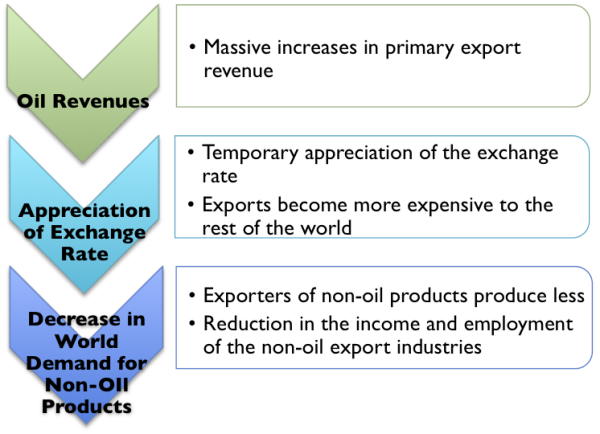
    The inflow of capital leads to an appreciation of the currency, making imports cheap and export expensive. The name comes from the Netherlands experience following the discovery of gas in the north sea. Natural gas sales drove Dutch currency up, seriously hurting the country’s other expdutch-diseaseort industries.

    In late 50’s Netherlands found huge source of natural gases. This resulted in 1. investments (largely foreign direct investments) in that sector 2. decline in other sectors e.g. one example could be people moving for jobs in that sector (consider Indian IT sector as reference) 3. investments (specially foreign investments) in that sector resulted in stronger currency. The excessive investment made Netherlands currency stronger resulting in making exports expensive eventually resulting in decline of export from Netherlands. Manufacturing suffered and thus jobs in manufacturing too go to step 2.

    This convoluted – action/reaction and impact at not so obvious industries – example again suggests to us that even if industries are not linked directly they are linked in some way. This link is interdependence. This interdependence should make one value the existence.

    The  “Dutch disease” should make us once again think about the invisible connections we share with each other.

    Image source – http://globalprosperity.wordpress.com/2010/08/19/oiling-africas-gears-for-democratic-change/

  • Interdependent co-arising – macro-economics example


    I hae written on Interdependent co-arising (older blogs at the link) earlier.  The concept simply means – we are all dependent on each other.

    Those who want to know the concept in layman term follow this blog – interdependent co-arising example of a farmer.

    Definintion of interdependent co-arising is below with a macro-economics example. In late 90’s the East Asian countries faced a very serious economic challenge of decades. The financial system came down like a house of cards. Dr Joseph Stiglitz – Economics Nobel Prize winner of 2001 – shares the concept of interdependent co-arising (dooming in otherwords) in his book  – “Globalization and its discontent“. On Page 106-107 he invariably – and inadvertently perhaps – explains what is interdependent co-arising. Hope economists would understand this lesson, if not from the Buddha then from Dr Stiglitz.

    Beggar-Thyself Policies

    Of all the mistakes the IMF committed as the East Asian crisis spread from one conuntry to another in 1997 and 1998, one of the hardest to fathom was the Fund’s failure to recognize the important interactions amont the policeis pursued in the different countries. Contractionary policies in one country not only deepened that country’s economy but had adverse effects on its neighbors. By continuing to advocate contractionary policies the IMF exacerbated the contagion, the spread of the downturn from one country to the next. As each country weakened, it reduced its imports from its neighbors, thereby pulling its neighbors down.

    The beggar-thy-neighbor policies of the 1930s are generally thought to have played an important role in the spread of the Great Depression. Each country hit by a downturn bolster its own economy by cutting back on exports and thus shifting consumer demands to its own products.A country would cut back on export by imposing tariffs and by making competitive devaluation of its currency, which made its own goods cheaper and others countries’ more expensive. Howeer, as each country cut back on imports it suceeded in “exporting” the economic downturn to its neighbors. Hence the term bagger-thy-neighbor.

    Solution to all these economic, social, personal, spiritual or other problems?

    Its interdependent co-arising itself. We all need to help each other grow – grow the pie and share it well, if not equally!

  • Euro! is it dead?


    For some time I did not write. I was considering writing either on “Utopia – the Dream world” (in Hindi – Ram Rajya) a type of communism in my opinion or on economics. A news item of yesterday made me select economics the later one. This news read “Deutsche Mark set for comeback instead of Euro in Germany”. I thought that Euro may die soon, so first thing I wrote to Prof Mankad (he is an expert of Macroeconomics) for his opinions on my fear of disintegration of European Union or dilution of the currency Euro.

    I believe that the concept of EU is very interesting and appreciating. However the question to ask is – who would tame the monkeys, those who are more interested in personal gains rather than collective wisdom? I read a book on similar concept of being individually wise and collectively dumb – “Games Indians Play“. The same is happening with different economies. Austerity measures – why there is so much of hue and cry? Because as per my understanding of austerity measures – “maximum of expenses to be controlled by austerity measures are on usage of tax payers money”.

    Earlier, when I read the Financial Times often I used to wonder about the crisis in EU. And I wrote about Germany as probable next super power. I had few reasons to think that way. However, later and now when I see economic crisis in EU (Greece, Spain, Iceland, Ireland and Portugal the list may become bigger in future) I changed my mind. Even further, when I read the news yesterday about ‘Deutsche Mark’ I felt more compelled to think of bigger consequences – could EU disintegrate? Is Euro dead?

    The other reason to dwell on my fear was another discussion with Prof Mankad some time back. He said UK has foreign debt in multiples of its GDP, what could happen to UK? UK has 400% of external debt to its GDP. So, are we seeing Euro as dead in future or Germany would have two currencies running in parallel – Euro and Mark? only time will tell us.

  • Double dip!!


    “There seems to be high likelihood of double dip!” When we heard our professor of macroeconomics Prof Mankad say that we could not believe it. I recently thought to plot some charts and realized that human sentiments are also equally responsible for this. The following is a graph, here we see an increase in the center yet once the peak is achieved there is a drop and no gain. Some call it correction. Well, frankly speaking these are my semester-wise undergrad scores.

    When I had a quick look at the graph I said – ok! I did ok initially, and then my performance dropped, it hurts I improved myself and went down back somewhat. Alas! My undergraduate was over therefore I could not extrapolate things. Yet, if you sem one to two movement there seemed some similarity.
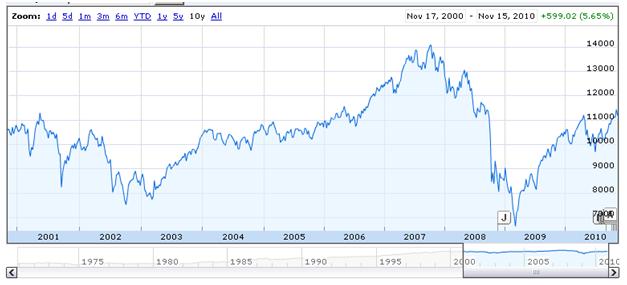
    I tried relating it to the last 10-years NYSE performance. There were phenomenal similarities. I took 10 year performance because it seemed to me that post DOTCOM bubble burst would be a good point to start from, and some other logics. See sentiments are again at work.

    Then I thought about the statement of Prof Mankad, double dip, what about that? There could be a possibility of double dip, why, how and when? Yesterday I was reading Financial Times front page news – Ireland resists bail-out pressure, and viola I got a hint. If nothing is done at this time perhaps the other bottom is not far.
    I recalled another part of macroeconomics class. “Essentially all banks are bankrupt.” Though for self satisfaction we may call them BANKS, on which we bank. Nonetheless banks are sitting eternally on a time bomb ready to explode any time. The bomb of Debt!
    If Ireland does not accept the support from EU perhaps we all would be doomed to see the second dip. The situation is a double edged sword – the world needs an enhanced banking system yet what I read somewhere “if you actually tried to manage according to the regulatory measurements, your bank would fail.” At such times I resort to TRIZ – the theory of inventive problem solving. I would comment on the SYSTEMS in general and TRIZ in next posts.