Tag: life

  • Autumn Leaf

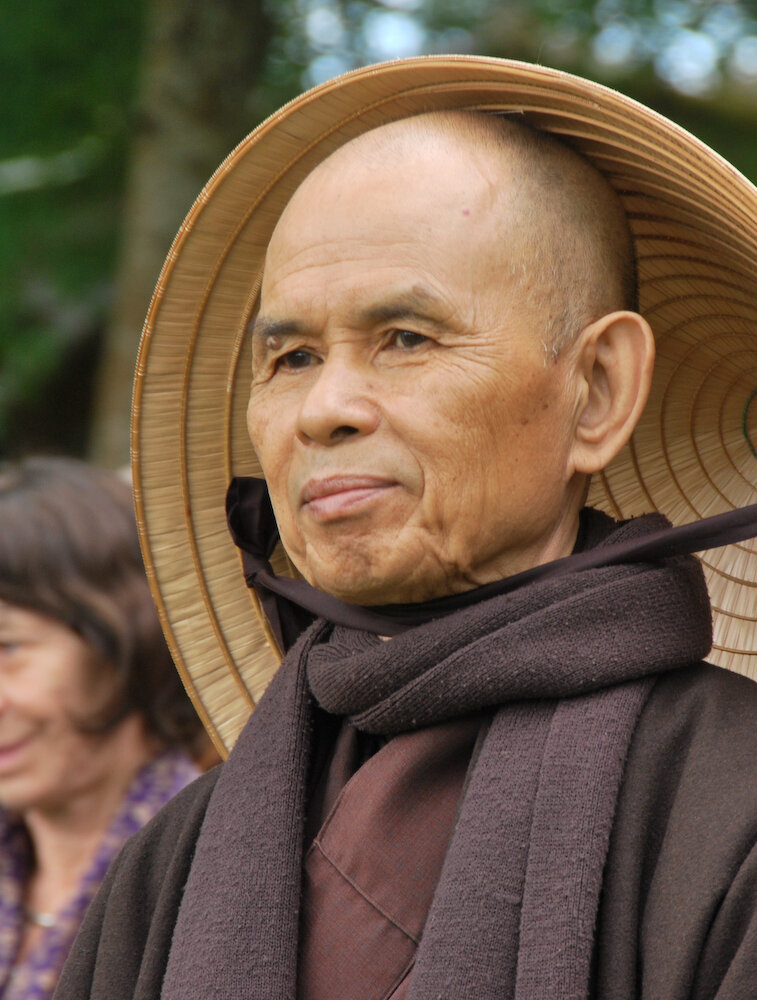
    I received this story Autumn leaf on WhatsApp from my sister. According to the message this is by venerable Thich Nhat Hanh. He is a very famous Buddhist monk from Vietnam. In fact my blog is inspired by his book Old path white clouds. Without any further ado, here is the story.

    Thich Nhat Hanh

    Autumn leaf

    I asked the Autumn leaf if it was frightened because it was autumn and the other leaves were falling.

    The leaf answered, “No. During the whole spring and summer I was completely alive. I worked hard to help nourish the tree, and now much of me is in the tree.

    I am not limited by this form. I am also the whole tree, and when I go back to the soil, I will continue to nourish the tree. So I don’t worry at all.

    As I leave this branch and float to the ground, I will wave to the tree and tell her, ‘I will see you again very soon’.”

    That day a wind came blowing, and a while later, I saw the leaf leave the branch and float down to the soil, dancing joyfully, because as it floated it saw itself already there in the tree.

    It was so happy. I bowed my head, knowing that I have a lot to learn from the leaf.

  • Decision making


    One can make a decision or gets into a situation of decision making only when one has choices. Choices at times spoil us or confuse us.

    I would not want to write much when I have a great video to share in relation of this topic – it is about life, choices and decisions.

    Decision making is (LBC topic) Loose Bloggers Consortium topic where MariaRummuserAshokShackman and I write. You can visit their blogs and read their thoughts on the topic.

  • Everything is ephemeral


    Water was boiling, I stared at it for a while, brought sugar and tea powder. We make tea/coffee rarely at home, mostly on weekends. Soon I was adrift with many thoughts and boiling water started evaporating. I quickly added more water to the kettle, added sugar, tea powder and grated some ginger. Again the same oblivion cropped in. This time around the thoughts were about effervescent boiling water into steam vapors. So suddenly water was lost everything the kettle was empty. I could add more water here, how about us? We die!

    [Tweet “Whatever has a beginning has an end too.”]

    Drop meeting OceanOur life – similarly – is also ephemeral. You take a lot of time to understand and by the time you feel you are getting a hang of it, it is over! Wonder how many people even get to understand or even give it a try to understand. Though I am not an expert, but think about life. At times when I see no clue, it comes in mind as if the end (death) itself is the ultimate truth when everything of what we perceive as “reality” ends. Perhaps there is some meaning beyond these perceptions. When we hear enlightened masters, they say everything is “here and now”.

    When a person dies, does the world become useless for him/her or the person become worthless for the world? The question was weird going through this little mind. The other point in this small complicated thing was with so transitory life, we have so many things to be proud (arrogant) about. I ranked this, I did that great thing, increased revenue by X% and traveled around so many places. In fact the Indian postulate on life/death is, we come back – rebirth. That is even more interesting, convoluted and thinks of even higher mind.

    In all these thoughts, the tea was ready, thankfully this time around I was bit alert. I poured it in cups. We sat on the dinning table sipping our tea. You know this cup of tea will end soon. At times it happens such that by the time you are aware that this tea was awesome, it is over! Whatever has a beginning has an end too – the Buddha said it. It is true, be it being a Chairman of Tata Groups or a note of 500/1000 rupee in India. How long can one hold on to position? How long can the currency keep its value? Everything changes with time, some end some improve some extinct. Why worry? If things are improving why interfere? There were hiccups in Infosys recently, it looks like it is going back on track. One shouldn’t be too attached to anything. My water evaporated, my tea finished in some time. The currency notes of 500 and 1000 are out! Instead of attachment or being possessive one must know that things are evanescent, life is ephemeral, if something has a beginning, it surely will have an end too.

    [Tweet “Flow is the name of life, stagnation is end.”]

    Flow is the name of life, stagnation is end.

    All this rambling started with boiling water of tea, ended up at Tata group and currency notes of India. The tea was over, but thoughts were not. Though I could add water in my boiling kettle, whats the use of adding more water in our life?

    We witnessed end of currency notes, we see people dying, but unfortunately we keep on thinking that we are immortal. My question is, if we accepted that “I will die some day”, what next? What we should search for, what we should strive for? What is the quest? What is that, that keeps one up at the night, and pushes you out of bed every morning? What is that?

    Sadhguru on Things We must do every Morning


  • Bhavachakra – the wheel of life


    On this buddha Poornima (Sunday 6th May), came across detailed explanation of Bhavchakra. I thought to share it on blog.

    Life seriously is a wheel, is not it? For individuals – Wheel of emotions, wheels of personal development and wheels of social interactions. For organizations and society too this wheel goes on – growth, development and destruction. Check any Indian Soap of prime time, you would come to know what we are surrounded with. It is up to us to learn about this wheel and help ourselves to get out of this – app dipo bhava (be a light unto yourself).

    The following content as well as image on bhavachakra is from this link, which explains it well.

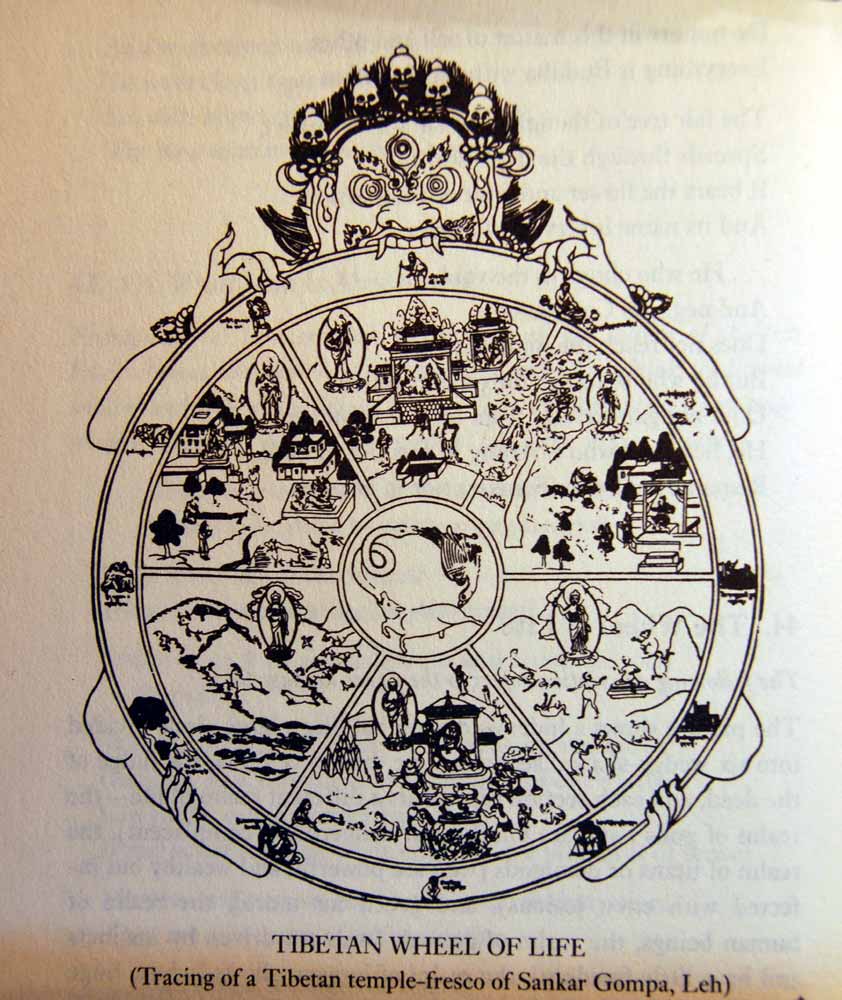
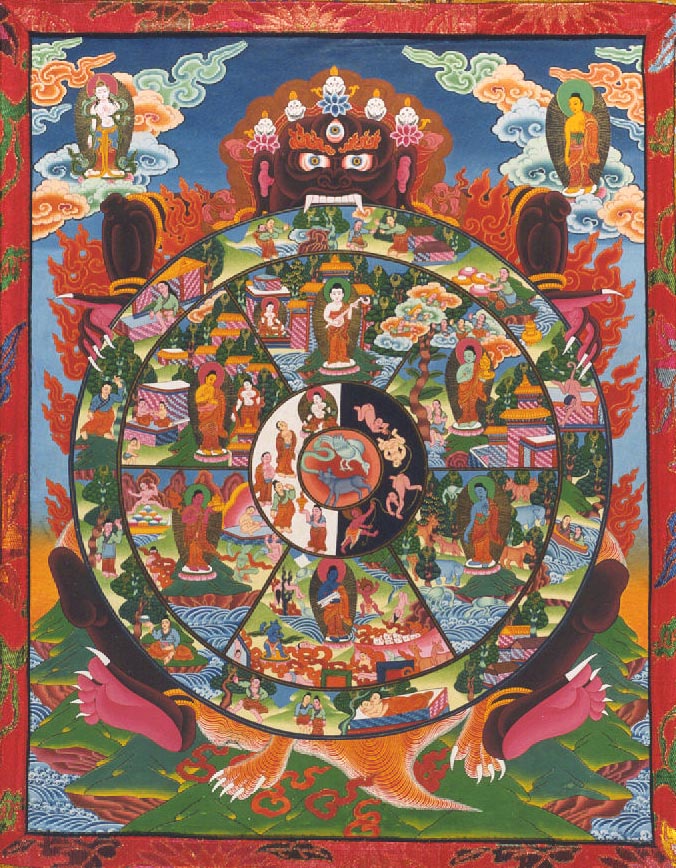
    Bhavacakra or Wheel of Becoming/Wheel of Life is a form of a mandala or tanka (painted wall hanging), used primarily in Tibetan Buddhism.  The painting of a tanka is itself a form of mediation.  Its meaning is very complex, and can be read to represent at least three different realms of manifested effects ofkarmic actions.  It can be read as a diagram for the six different kinds of existence into which one may be born into during the middle rounds of samsara.  It can be read as symbolizing each of the different realms of human existence, lived out by certain kinds of people according to their karmic fortunes of personality type and socioeconomic status.  Or it can be read as a description of situations or states of consciousness that everybody passes through again and again in the course of a single day.
    Its iconographic meaning is correspondingly complex as well.

    In the background are varied Buddhist symbols, such as the moon, clouds in shape of swastika, and always a representation of at least one Buddha orBodhisattva, seen attempting to help sentient beings to find their way to Nirvana.

    The wheel is held by the jaws, hands and feet of the demon, Yama, the judge of the dead, who turns the wheel.  Yama represents the ignorance that comes from greed and “selfhood,” that keeps the wheel of suffering turning.

    The outer rim of the wheel is divided into twelve sections, called the Twelve Interdependent Causes and Effects – 1. ignorance, 2. volitional action or conditioning, 3. consciousness, 4. name and form, 5. six sensory organs (eye, ear, nose, tongue, body and mind), 6. contact or touch, 7. sensation, 8. desire, craving, thirst, 9. grasping, 10. becoming or existence, 11. birth, and 12. decay and death.

    The areas between the six spokes represent the six forms of unenlightened existence.

    There are six wedged-shaped sections, with each representing a different realm of life –

    1. realm of the Gods – Devas (who are blissful but dangerously complacent; always at the top of the wheel)

    2. the realm of the titans, demigods and fighting demons – Asuras (lowest rank of gods, who are powerful and wealthy but infected with envy, jealously, and greed for more; always in the upper half of the wheel)

    3. the realm of “human beings” (always in the upper half of the wheel)

    4. the realm of “animals” (sentient beings, less intellectually advanced than humans, driven by instincts and have little freedom, but can still experience suffering and project karma; always in the bottom half of the wheel; inclusive of birds, fish, and even a worm)

    5. the realm of “hungry ghosts” – Pretas (whose huge bellies but pinpoint mouths and eyes suggest insatiable craving; always in the bottom half of the wheel)

    6. the realm of “hell beings” (who are consumed with relentless rage; always at the bottom of the wheel; beings brought to hell for  past karma, but beings who can escape it through good deeds and reincarnation).

    At the center or hub of the circle is a smaller circle containing the Three Poisons, within a rim of binary demarcation of black and white. The black section represents the Dark Path on which sentient beings are moving downward to the hellish realms. The white section represents the Path of Bliss on which beings are moving upward to the Godly realms. The Three Poisons are personified as a rooster or fowl, a pig or boar, and a snake, chasing one another around and around. They symbolize the forces that keep people caught up in the samsaric round of existence: the rooster stands for greed, the pig for ignorance or delusion, and the snake for hatred.

    The wheel can thus hold distinct meanings, each speaking to different sensibilities.
  • Life is trouble. Only death is not…


    Wait, wait, wait… well the title has to be understood completely. I was reading something by J. Krishamurti (JK), liked the following and posting here. JK was a philosopher of last century, more on wiki or just search on net….

    When we close
    the windows and doors of our house
    and stay inside, we feel very secure, safe.

    But life is not like that.
    Life is constantly knocking at our door,
    trying to push open our windows that we may see more;
    and if out of fear we lock the doors, bolt all the windows,

    the knocking only grows louder.

    The closer we cling to security in any form,
    the more life comes and pushes us.

    – Life Ahead. p 54

    I recall the following statement of Zorba a character in Book – “Zorba The Greek” a novel by Nikos Kazantzakis.

    Life is trouble. Only death is not. To be alive is to undo your belt and *look* for trouble. – Zorba the Greek

    Think it over, life is a trouble only death is not… take challenges, uncover yourself, open the doors of possibilities and fly as high as you can. As much as I try to explore myself and push the envelop I realize I can go even further… it is all about getting to know oneself.

    Therefore take trouble, undo your belts and open the doors to possibilities.