Tag: Lessons

  • Deepavali, rangolis and a lesson

    Diwali is the biggest festival in India. As a kid, I used to love Rangolis the most besides other interesting stuff such as sweets. During Diwali season, making Rangoli was a morning and evening ritual for about a month from the beginning of Dussehra till Bhaiduj. I used to ask my elder sisters to make one Rangoli each that too twice a day – in the morning and the evening. Those were some days! Recently, watched a video rangoli and a lesson dawned on me.
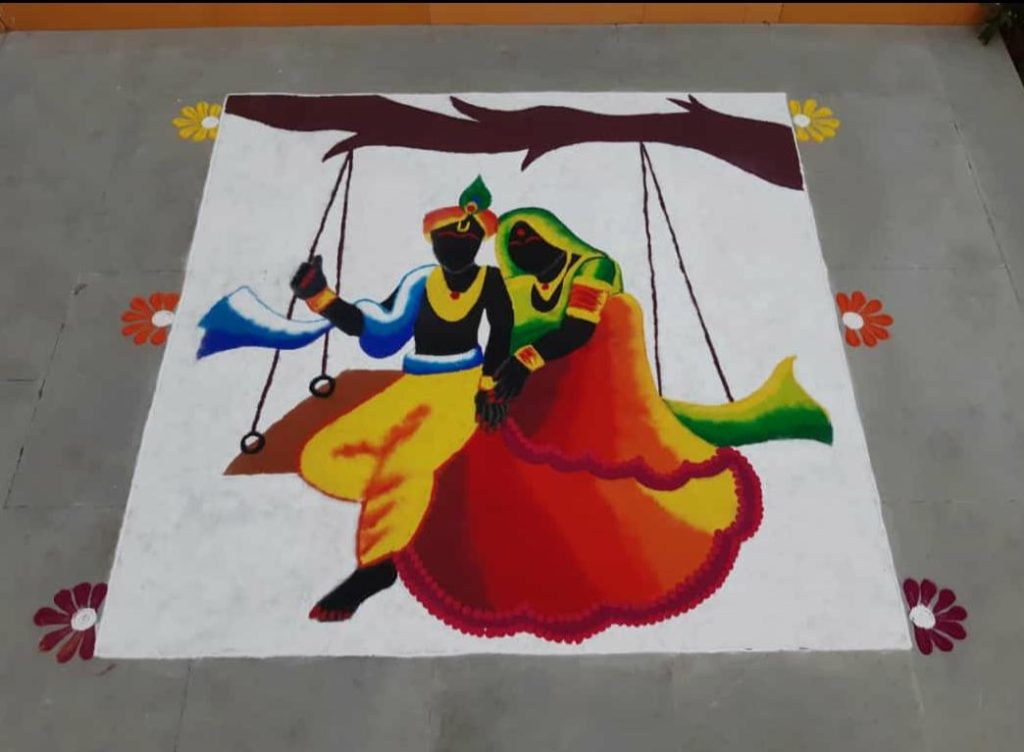
    Source – Rangoli by my friend’s niece

    Rangoli making was an elaborate process. First, bring some bricks and arrange them in a square or rectangular format. Second, fill it with mud, mostly made using cow dung. Let it dry. This is our platform for making Rangoli. We bought different colors, sample Rangoli design books, and some stationery. Further, the creation of dots required another list of activities. We bought a large piece of paper, an A0, A1 or A3 size. Then we made horizontal and vertical lines on it. Once this table or grid-line is prepared made holes on intersections with incense sticks. This paper becomes our grid-line or ruler. During the festival, clean old Rangoli every time, spread cow dung mud on the platform, let it dry for some time and start Rangoli making. Rangoli making started with making dots using the grid-line.
    About a month back, Youtube gave this link on my timeline. It is a famous Rangoli channel with millions of views for many videos. I watched one of the videos. I still like Rangolis though we do not make it in our apartment as we used to in Dhar.

    Yesterday happened to go for my yearly health check up in a hospital. This is a big hospital and during Covid, it is designated hospital too. The staff there was full with energy and making Rangoli, wearing traditional cloths, and after decorating their department they lit diyas too. In such a tough place they were full of life, and enjoying the activity. All this while, I went to different departments for check-ups and was happy to see the staff engrossed in the celebration. Even during such tough time and treating Covid patients these people were celebrating. I was very happy to see that.

    Deepavali, Rangolis and a lesson

    I was watching one Rangoli on the channel, staff in hospital, and my childhood. A thought struck me instantaneously. Rangoli making can teach life lessons. Every day morning, you clean your verandah. Sprinkle water and make Rangoli. In the evening, clean the same Rangoli that you made with a lot of interest, and love. This is a daily chore at least in many rural areas in India, especially in south India. If one has to clean it in the evening, why make it? Or why make it so beautifully? The creator knows it; in the evening after making it, within a few hours no one will be there to watch it. Still, the creator makes it with interest. The creator also knows that tomorrow morning it will be cleaned. The lesson is – even if you know you have to leave the elevator, and everything is impermanent whatever you do, do with interest, love, and full devotion.

    Happy Diwali

  • 3 small lessons from a leader

    This incident turned into 3 small lessons for all of us from our boss. Leaders make learning effortless and yet impactful when you read the story you may realize the 3 small lessons were not rocket science. Yet, how often we implement such small things in our daily life when dealing with situations and people?

    3-small-lessons-from-;leader

    It was a late morning in our office, the day had just started a few hours ago. There was tension in our small office. Our office was small. A slightly higher voice in one corner can be heard on the diagonally opposite side of the office. Generally a very calm, composed, motherly and one of the most silent persons of the office was upset. It had been more than 10 minutes since our admin and accounts person was furiously shouting to our office boy. She was asking questions, pointing errors, and suggesting the impact of all these. Irresponsible behavior and mistakes were causing a significant impact on our daily work, and costing office.

    The accounts manager continued her monologue – “it is common sense isn’t it?” For a few other things, she said “I had explained this to you earlier too”, how can you make similar types of mistakes (not exactly the same) repeatedly? So, some things were straightforward errors of judgment by the office boy. The office boy was making these errors for some time; we all had been impacted some time or the other.

    After it was enough for our boss, he called the accounts manager, who used to report to the boss. He requested the office boy to bring an early lunch. The office boy knew and generally used to collect bosses’ lunch from a nearby restaurant.

    3 small lessons

    The boss turned to the admin cum accounts manager and said I heard some parts of your conversations. This is my suggestion to you –

    • you cannot expect everyone to think the way you think
    • had our office boy been as intelligent as you are, he probably wouldn’t have been an office boy
    • you have to think from an individual’s level of intelligence and instruct him accordingly

    After these three-suggestions, he further added – “I am not saying your observations are inaccurate.” Now, when you have thought about these three points, look at the past 10-15 min, our office has been stressed out.

    http://business2buddha.com/2020/03/managing-emotions/

    The way he explained his point of view was such that the accounts manager had calmed down and the tension in the environment defused. His teachings were so good that I remember this lesson even after more than a decade. I may have failed in explaining the heat of the situation that was there. Probably, it is difficult for you to understand what difference between those three small statements made to the situations.

    When I revisit the incident, I take a few takeaways from the incident, one we have to be compassionate. Second, we have to understand the point of people. Lastly, we should start thinking about what should be our response later. These lessons can help in managing situations. I am still learning and trying to implement these and others. How do you handle tough situations?

    Image source – The Coach Space from Pexels

  • Single word sentence that changed me

    It was year 2000, I was doing my Engineering away from home. This session was stressful; I had never failed in any academic exam until that year. I failed in one subject of my engineering. The result was about 5% for that subject for our batch – across the university. There were various discussions on the results in University, colleges and among students. Some toppers or top 10% student have also failed in the exam. Disclaimer: I was not a topper during Engineering. Once, professor who taught, set paper and evaluated the subject had openly said in classroom – “I had passed few students because I knew their parents!” It was a shock to many.

    The above mentioned was kind of first of my academic failure. Though one was inability to make it to IIT, however it was mixed feeling that time, as I had made it to State Pre-Engineering test (with rank). There are shocks and failures that teach you biggest lessons in life than any success.

    Single word sentence that changed me

    With the grievance, I went and spoke with a professor of our department. He was also aware about the whole incident of this particular subject, exam, teacher and batch. I was immature, outspoken and outraged. When you are away from home, no family support and just crossing your teens, you may become very aggressive or meek. The young age also gives you extra bit of adrenaline. With full of anger, I spoke with him– “<a lot of story>. Does the institute want me to ask my parents to come and network with professors? They are also teachers; they too have responsibility of teaching students to make their future. I never failed, had been a bright student academically, who is responsible for this result? How can I secure only 22 marks when my mathematical equation based solution worth 20 marks was correct? Who is responsible for this?” I was venting out like anything!

    He heard me carefully, looked at me patiently, and responded – “Situations!” This one word sentence I don’t know how, made an immense impact on me. Probably, the reason was not that one sentence alone, it was the countenance, the manner, care and concern. It was said with compassion that made the difference. That one word resonated with me for a long time. Perhaps, it is difficult to understand what I am saying, however this interaction left a mark on me.

    Lesson for life

    We get carried away by results, we many a times, consider ourselves something probably we are not. In this particular case – I thought of myself as a failure, though I was not. There were circumstances where someone fail, that does not prove that the person is a failure. It is like seeing a steam of water flowing. You be an observer, water keeps on flowing, as Lao Tzu said – “…grass grows by itself.” Our life situations are like this, most of the times we get carried away, the way I was. We get wet in the stream of water. However, when we become an observer, our perspective and paradigm changes for many things.

    Our problem is that we get carried away by people, situations, results and many things around us. These things make us vulnerable. When we become an observer life changes multifold. My professor’s answer “situation” somehow changed my paradigm of thinking. It was difficult to understand what has changed within at that time, now when I look back I realized that one answer changed me and involuntarily made me an observer, that time I had not practiced any meditation either, that one word somehow moved me towards spirituality.

    I did not apply for revaluation; I had lost faith in the examination system – where a teacher wanted my parents to network, rather than me study or teacher doing his duty diligently. Next semester I passed the subject, which had to happen anyway. The biggest positive for me was I became mindful, spiritual and aware.

  • Learn Non Stop, continued…


    In continuation of my earlier blog on the mistakes I made in my MBA and what I learnt, I received responses from my friends specially would want to mention two here – Sanjan and Prof Subba Iyer. Thank you both for taking time and responding to me. I talked to Sanjan and here is what he wrote to me (I liked it and asked if I can post that on my blog?), so here is what he write – …I have always believed that every mistake you make in your life is like a beacon which guides you constantly on to the right path; the only condition being you got to interpret that beacon in a correct way and bingo! There comes into play your prudence and judiciousness.

    Thank you Sanjan for the kind words. So here are next few mistakes and what I learnt from them.

    7. In management nothing is black and white (especially in marketing, the engineering mind with numbers always thinks in binary); learn to differentiate between gray and grayer (Prof Lopez, had a tough time teaching me – an engineer – this thing)

    8. Try to do the most challenging thing. I always thought since I didn’t watch TV for many years now, I cannot help making good advertisements. In the class of Prof Sohan Shah (Marketing Communication) making advertisement concept used to be a challenge and I used to shirk by doing other team assignments. The very next week of the end of Marketing Communication course our team (Ankit Jain, Kaushik Deb, Sandeep Shukla and I) was adjudged second-runner in Ad Mad competition.

    The reason I believe is, there was just one thought in our mind, we have to do this no matter what. We saw other teams making far better videos and we knew our team does not stand a chance in terms of videos, yet there was only one thought in our mind – we will stand there and present what we have in our mind. Thanks to the Branding Club (Swyl Saksena, Sahil Lihala and Neha Saini) you helped me imbibe a lesson.

    9. Consistency, this was the reason for being judged as the second runners in the event. Consistency matters in day-to-day life too. It does not mean that one has to be consistent wherever he/she is, consistency means improving consistently

    10. However small is the idea, stay with it, nurture it and try to explore possibilities. Our team (Neha Om, Murtaza Bakir, Shafaat, Tarun Kushwaha and I) worked on a business plan which prima-facie was “hum!”, “ok”, “yes we can think of this” at last won best business plan in an open competition

    11. Whenever something goes wrong; review, review and review what went wrong? Mistakes are the best tools to learn.

  • Journey itself is the destination, so learn non-stop…


    As a ritual which every B-school aspirant has to perform, I also wrote B-school essays before joining my MBA program. I remember one of the phrases of one essay the most – “…making mistakes that will cost nothing in a classroom environment…”. I knew I will learn from the mistakes as well. I feel, a failure teaches long lasting lesson then a success. I have learnt a lot from the mistakes during last couple of months. I am sure, I am going to live with and implement these learning in coming time.

    With a lot of disappointment I started writing this blog after my exam of Pricing Strategy. Then I realized thank god I did not commit the mistake in business; one incorrect pricing and revenues and profits take a beating. I started writing my mistakes and learning, so that I can revisit what I should not do and what I learnt. This would remind me that the Journey itself is the destination, so learn non-stop. Here are few of the lessons –

    1. Never believe in the forecasts, forecasts are correct hardly 15-20% of the times. I bet Murtaza and Avanii would agree with me 100% on this.

    2. Start early (in B-School simulation too), starting early and keeping the momentum going; it helps

    3. Always have a “to do list” and prioritize work – for this I wrote funny statement which only a few could understand “Tomorrow is your exam (sense of urgency), day after tomorrow you will die (prioritize your work, before dying what would you do?)”. I used to do this but here in my MBA this has been reinforced to an even greater extent

    4. Failing to score well in exams is alright, but failing to learn a concept and missing to use concept is a punishable offence – “a crime”. I learnt pricing strategies concept, explained the same to my friends and yet in the exam forgot to apply that. There is no ifs and buts for this crime

    5. I always write my blog on one concept ‘collaboration’, I observed this in outside world, I used it a lot in my MBA and that is the way for the future of businesses

    6. Ask questions, better to be stupid for some time. I have been stupid in some classes (recently, in class of Prof Lopez and Prof Ram Kumar) but that is better than assuming something incorrect

    To be continued in next blog…

  • There is no substitute…


    My brother taught me playing Cricket; he introduced me to my Football and Basketball club. I played and represented club and division. I achieved some good accolades in athletics. He was the one who abusively told me when I was in class 5th that let us see if you can pass mathematics of class 10th either. And to his surprise I improved so much that I could solve MSc Physics problems when I was in 12th. He was All India Ranked 16th in GATE and had many PhD offers. He plays flute, he is an artist acts in theaters too. Well, why am I writing all this? The reason is – My brother taught me “there is no substitute to hard work”. He is right he has proved it always. And I recalled the lesson when I saw the following on facebook.

    One of my friends, Rahul Krishnan, recently said – every professor of operations management seem to be fascinated with Japan or Toyota. To this I said, perhaps 10 to 20 years down the line Japan would be replaced by China.

    I started thinking – what is the reason? The reason seems to be – there is no substitute to hard work. Japan did this post World War II, China did in late 70’s to present. In 80’s manufacturing started following Japanese systems, and I think in next few years we will start looking at what does China do differently that it is so economic, so efficient and so competitive?Our professor of Macroeconomics Prof Mankad shared with us how economy changed and Japan became an economic power to reckon with, now it is China. The currency of Japan was undervalued, they became manufacturing super power and export experts. See China, the same is happening now once again – history is repeating itself. Perhaps it will repeat again when we move from TPS to CPS (Chinese Production System) in future. In fact many Japanese companies outsource their work to China. So it is time to learn what China is doing differently.

    No doubt Japan is a nation of hardworking people and so is China. And I come back to the lesson – there is no substitute to hard work.

  • Finger is not the moon…


    In one of the discourses the Buddha taught the bhikkus – ‘The finger is not the moon.’ Simply put when he tried teaching the bhikkus he said when I point to the moon with my finger the ideas is to give you direction where the moon is. You cannot hold on to the finger. Learn the lesson, get the direction and move on your own path. Since everyone is different and every situation is different therefore the path taken will be different.

    The Cases are the means, not the end –
    Lately, I did a course International Management with Professor S Rajagopalan. In the course we did about ten cases and all were from different industries, countries and situations. In such cases, the learning becomes more challenging yet practical. What I learnt from the different cases is – the finger (case) is not the moon (methodology to solve every situation – magic wand). Learn the lesson, understand your situations and create your own path. The same used to happen in marketing cases. Constant challenge for Professor Lopez used to be ‘class of engineers is used to models and formulae’, models and formulae do not fit at every place. Prof Mankad taught us in Macroeconomics class – management is art and science together.

    As the finger is not the moon, the cases are not the end in themselves and one should not try creating models for everything.