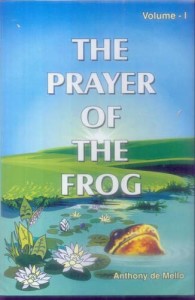
I have been reading one or the other story of Father Anthony De Mello’s books – The Prayer Of The Frog Vol. I and Prayer of The Frog Vol. II and share the same here occasionally. The books have small and very interesting stories. One of the story I read was on Prayers, here it is –
Late one evening a poor farmer on his way back from the market. He was a religious person and when he found that he has missed his prayer book at home. The worst fear he had was he has misplaced it. This was the most disheartening thing that could happen to this pious and religious person.
The wheel of his cart had come off right in the middle of the woods and it distressed him that this day should pass without his having said his prayers.
With this disappointment, he was worried that he is missing something very important today. So he did something interesting. This is the prayer he made: “I have done something very foolish, Lord. I came away from home this morning without my prayer book and my memory is such that I cannot recite a single prayer without it. So this is what I am going to do: I shall recite the alphabet five times very slowly and you, to whom all prayers are known, can put the letters together to form the prayers I can’t remember,”
And the Lord said to his angels, “Of all the prayers I have heard today, this one was undoubtedly the best because it came from a heart that was simple and sincere.”
I have heard that Jesus said, “The kingdom of the Gods belongs to people who are like child-like.
We all must do our prayers and any other works – personal or professional – with such sincerity and simplicity, isn’t it? Do share your thoughts.
It was 2010, I was completing my MBA. We friends went to watch a movie ‘Tron‘, a movie by Disney. I was wondering about a few things while watching the movie. One, everyone is trying to make the world a perfect place and two, there is a fight leaving the place as it is or worse than what it was earlier. Why?
I believe the reason for this is everyone has his/her own definition of ‘perfection’.
Matrix was destroyed 7 times (in the movie The Matrix). What was the reason for creation of the Matrix?
To make the world a perfect place. Why destruction?
In terms of chemistry and dialog of The Matrix Revolution – whatever we do entropy increases. Entropy means “uncertainty of outcomes”.
The next question arises – why is the trouble with increased entropy and a perfect place?
On conceptual levels of any reasonable human being, perfection would result in definitive outcomes. The trouble with that ‘reasonability’ is – perfection is a relative term. Relative concepts create conflicts. What is perfect for me could not be so for you.
I learnt it from Prof Lopez. I asked for answers and once he told me – “Pravin, exactness is a cage/prison” once you are exact you would not move.
Trust, this makes the idea simpler.
The life loves simplicity! How many of us must have felt this. Be it relationship, be it conversations or understanding anything.
Jesus said the kingdom of god belongs to the children; why because they do not have any filter to make opinion about the world. They see things ‘as is’. The lesson is about 2000 year old, alas! we are struggling hard to make the world a perfect place to live in. Result we making the world more complex, more sophisticated and therefore we are increasing its entropy. Moreover, on a philosophical level, peace lie within us and once someone is peaceful with oneself the place becomes perfect without any chance outside. Kingdom of God lie within us.
It takes a lot of time for courts to offer a judgement, there are argument and counter-arguments. Logic and intuition fails if you do not have proof. That’s why Indian courts take 20 years even for high profile cases (e.g. Mumbai bomb blast), small cases are either solved out of court or not at all during the life time of an accused / plaintiff. Galileo died and hundreds of years later (in 1992) Churches exonerated him of the heresy – of saying Earth if not flat. People do not think logically and thus recently I have been bothered by fanatics on Twitter (follow me on Twitter @krdpravin). So, I feel petty on some things. Well, today I want to write about whether Yoga is secular or not?
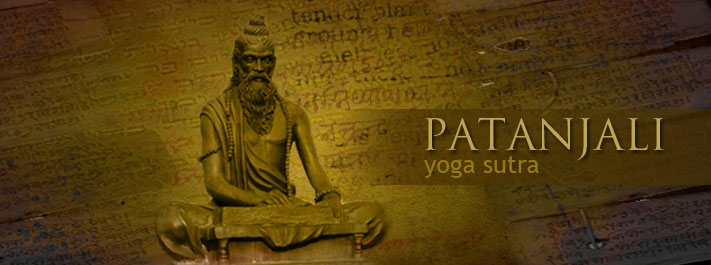
Disclaimer – I am discussing Yoga as PatanjaliYoga Sutra I am not an “authority on Yoga”.
There was a case filed in California- “Yoga can not be taught in schools as Yoga is not secular”. Effectively the contention was Yoga is actually Hindu religion. California Judge rejected this claim. Yet there is little more discussion needed on this.
Think – is breathing secular or not? In yoga Patanjali has talked about Pranayams – breathing exercise. Is remembering (concentrating, meditating on) any God or whether Jesus or other prophet related to only “Hinduism”? Yoga talks about meditating on deity too. Is speaking truth not secular? I can list few more food for thoughts, however let me instead brief on Patanjali Yoga Sutra. Patanjali was a sage, he existed before Christ and had written Yoga Sutras. The sutras have eight limbs –
In today’s world we need all these virtues, very importantly non-covetousness, non-possessiveness. Financial crisis is result of covetousness
2. Niyama – 5 observances – cleanliness, contentment, austerity, reading scriptures, surrender to god.
Here one may argue – reading scripture is religious. Did Patanjali say do not read Bible? Even in Surrender to God it is not mentioned that the God has to be only HINDU God!
3. Asana – Discipline of the body and body posture.
Largely – people all over the world (include many Indians and Hindus) think Yoga means Asana. Asana is just 12.5% (e.g. 1 part of 8 fold path of Patanjali) of what Patanjali said about yoga. Also, can you say that whatever games played in Olympics are religion? In this context – Hinduism? No! right?
4. Pranayam – Control of breath
Common we call breath and this would be idiotic to call breathing non-secular.
5. Pratyahar – withdrawal of senses from their external objects.
Well, many of us would not understand this. This is not talked in many religions – this helps in being non-covetous, non-possessive and being content. This is where I think Yoga is far more evolved and different than any Western religion. Though Yoga is not a religion.
6. Dharana – concentration of the Chitta upon a physical object (say a photograph of Jesus, a frivolous example – Computer mouse). Take an example of Rosary (a bead) and remembering any mantra / God. Use of bead is common in Islam too. Who says Dharana is about only one religion? It can be followed by any person whether following a religion or not.
7. Dhyan – Meditation. It is largely professed by Indian religions e.g. Jainism, Hinduism and Buddhism. So, meditation is also not specific to only Hinduism. Additionally if someone prays with complete devotion that can become meditation.
8 Samadhi – oneness with the object of meditation.
Yoga is a very evolved science, of course developed and practiced more than 2000 years ago. But yes Yoga is science, there is no religious seal on it. My Indian and Hindu friends may argue against me saying – it is Hindu practice with various arguments. Foreigners may argue on same lines and state Yoga is religion.
Well, I am of the opinion – religion is very personal matter and not a group matter. So, if I follow yoga practice (which I do not) I may say Yoga is my religion. But otherwise yoga is a way of life beyond and above all the so call religions of the world – which effectively are cause of troubles, war (include terrorism), fundamentalism and superiority complexes. And yes, Yoga is above the courts and laws too.
Most importantly – Now do you follow what religious fundamentalism is? I am putting Yoga above everything which is what happens when fanaticism creeps in making a suicide bombers. I did the same in above para (by stating Yoga is above all).
Yet please remember – 1st step of Yoga has first abstinence – non-violence. This includes not having superiority complex also.
When I was in my teens, I wanted to change a lot of things. The political system, the education system and even the social system of India. This was furthered by the program – the Big Fight of Rajdeep Sirdesai. Once my father told me – “world will remain the same, it was same at the time of the Buddha (people pelted stones on him, conspired against him), it was same at the time of Kabir. Jesus was crucified, Mira poisoned and so was Osho. The world still, is the same and would remain the same. Why do you want to change the world? Look at yourself and why do not you think of changing yourself.”
My father is right the world is the same and will remain the same. The need of the hour is to change oneself, because everything starts with ‘I’ and surprisingly everything ends with ‘I’ (earlier blog on Forbidden word). Is not it an irony? I did not understand the deeper level of my fathers message for a long long time. Many ‘I” create the world, and each single ‘I’, has its own definition of ‘perfect’. Interestingly, the definition of perfect keeps on changing and therefore, the single definition of a perfect does not remain intact within the mind of ‘I’. This starts one conflict then the other and so on. The conflicts are -at least – as many as the ‘I’ in the world.
The world is imperfect, the world will remain imperfect or perhaps we – as individuals – are not attuned to accept it and live with it. Effectively, perhaps we – as individuals – are not perfect. I think this is why we suffer and perhaps this is where the Buddha started on the four noble truth – there is suffering, there is cause of suffering, there is a solution and lastly ‘the path’. I believe, the suffering is not because of the world, but because we see things as we want to see and when something does not work according to our logic we feel the world is imperfect.
This was a very candid question Prof Mankads asked once – ‘What is money?’ and he answered – ‘Money is what is accepted a money.’ True, money is what is accepted as money. Humanity needed some tangible measure so we deviced various forms of money at various time. For example at the time of barter system ‘everything’ was weighted against the other. So everything was acceptable in trade as money. Then came matels and now paper and plastic money (credit cards).
I started thinking if we needed something tangible as money what if we made something like Camay (soap) a currency? If some other things be made money what would happen? Take an example of age – everyone would gradually get money. Fun or being funny – comadians would have maximum money in the world. Seriousness – patients in extremely intencive care units. Trust – Indian politicians or politicians in general would stand nowhere. Spirituality – the spiritual masters would be at the top, one I know is Sri Sri Ravi Shankar.
Now if we ask ourselves – who is rich? The simple answer is one who has ‘more’ money. ‘More’ is contextual (adjective). Now, if we take money as fun, being happy or being funny. How many of us are rich today? Kids in school are competing, people are jealous or many of us have only instant gratification and long term sorrow. Not many of us are rich! Has money made anyone happier?
Assume Trust be the currency. How many have earned it? Yes trust is hard earned currency, right? Bankers have lost their trust of 100+ years (see the occupy wall street movement), politicians have lost it. Citizen vote because they think someone will improve the systems. On the contrary we all still remember Jesus, the Buddha and other Masters. Plato, Aristotle and Chanakya. We named unit of force on the name of Newton we say Da Vinci was genius. Were they ‘RICH’ in terms of hoarded money? So, what if we measure richness on different factors now and in future. See this engineer mind thinks of formulae (which is not correct, yet I am writing it) –
Richness = [{(money + Happiness)*Trust/greediness}^(1/greediness)]*(peace of mind)*spirituality
and other important stuff
Range of the variables
0 > Money, Happiness and Trust > 1
Greediness > 1 upto infinite
peace of mind and spirituality> 1
^ stands for raise to the power
I think everyone of us has to identify what we want from our life and that one or few things would be The thing(s) which would make each one of us Rich (not necessarily Money). Of course, this richness should not come at the expense of others or harming others.
I remember an opening of Prof Mankad’s class. He asked ‘What is money?…’ and so on and so forth. Money is what is accepted as money. The trust of acceptance gives value to money. Irony is this TRUST. This concept e.g. money creates maximum MISTRUST. The concept which, I believe, we think gives power, empowers us, creates fear of losing it. Money which should give us some security creates insecurity. Is not it an irony?
I heard someone (If I recalled correctly it was Osho) saying – opposites are always together, if opposites are not together their value is nothing. White is white and does not hold much value if Black does not exist. Lord Rama and his values were/are magnified by none other than the existence of Ravana. If Jesus were not crucified we might not even have found records of him or might not have bothered about his greatness. For safety and security of our ‘Nation’ we buy/make arsenals and prepare for wars, is not it an irony?
We avoid
WAR by aggrandizing weapons
Trust on Money, which creates lots of, perhaps maximum, Mistrust
Good people are good because their are bad one’s out there.
 Late one evening a poor farmer on his way back from the market. He was a religious person and when he found that he has missed his prayer book at home. The worst fear he had was he has misplaced it. This was the most disheartening thing that could happen to this pious and religious person.