Tag: Japan

  • Did Keynes fail in Japan?


    It all started in 1990s when Japan took the step to deflate its economy – Yen devaluation, lower interest rate, money supply etc. The effect is observed till today and in fact we may get into another slowdown in 2015-16. Actually, that’s what is the fear. Some experts are forcing Euro-zone not to make the same mistake Japan made in 1990s. If one sees debt of the developed countries one may be forced to conclude – we are sitting around next slowdown. Take Japan – about 250% debt to GDP ratio! Surprising right? Nope, situation is not better in US either, USA is also at 100% debt to GDP. Many are already blaming Quantitative Easing for the next likely downfall.

    I happened to read a news last month on Keynes failing Japanese economy. Well, I agree with the concept of Keynesian economics; you may even call me anti-capitalistic – though I am not. I am more in the league of following the middle path. May be Japanese have become too devoted of Keynes’ concept – so I started questioning myself on many fronts i. Is Keynesian economics the problem? ii. Did Japan over do it? iii. How things work around here? Etc These questions may be comforting to those who are against the Keynesian economic theory.
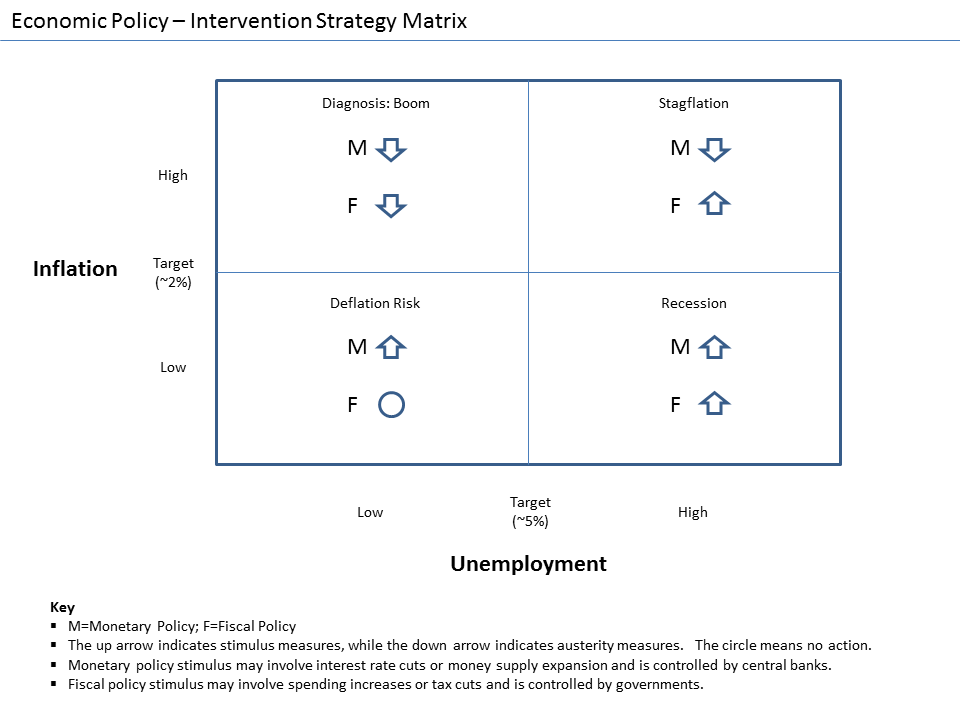
    Economic_Policy_-_Intervention_Strategy_MatrixSince, Keynesian economics had worked in relatively less connected world of 1930s I dismissed the question 1 for future blog. Japan’s overdoing it and how the system works were somewhat related questions. So, that question became central in my very tiny analysis.

    The question I had was – how does Govt issue bonds and how does it get circulated in the market? Well, that is done through the banks and the bankers. Aha! did I hear bankers? Those bankers who went to the President (USA) and said – “we would buy Jet for our executives?” Ok! If those who still blame Keynes, would you ask with each slow down who makes the most money? Is not it the same – bankers? At least the Govt is putting money in the system in the hopes that this method will work to keep the economy afloat. I was checking Wikipedia article on Economy of Japan. An external states that – Japan possesses 13.7% of the world’s private financial assets (the second largest in the world) at an estimated $14.6 trillion [2010 data]. This data states that – Keynesian economics is doing more services to the Capitalism than otherwise!

    [Tweet “Japan has 13.7% of the world’s private financial assets! #Keynesian #economics does more service to #Capitalism than otherwise”]

    Who is playing with the hopes and cheating the system? I am little too critical when I say “cheat” because some people are in the profession of making investment decision and those decision at times counter intuitively work against the basic premise (hope) on which at the first place Govt had put money in the system. I think a solution for the problem of Japan or for that matter world economy (likely next economic burst) lies in answer to the question(s) – who has actually hoarded the money? How to make amend for this workaround of Keynesian method of boosting economy?

    I asked Prof Mankad about his opinion on Japan. He shared this – “One of the real reasons for Japanese stagnation through the last decade of twentieth century had little to with Japanese policy. It was caused by two important external forces viz., depreciation of dollar (and hence default appreciation of Yen) and rise of ‘low cost’ China which deprived Japan of its traditional export markets. The fault of Japanese policy makers was absence of policy response to the changing situation and rise of China.”

    So there is seemingly an emotional explanation [which questions the other side] from my side. There is another more analytical, logical and thoughtful explanation from Prof Mankad. Whichever you want to ponder upon – Keynes did not seem to have failed Japan.

    Yet at the same time, every generation needs a revised look at things & our generation too! Keynesian Economics was successful when the world was not that connect, now QE of USA is invested in India/China which did not happen in 1930s.

    Image source – http://upload.wikimedia.org/wikipedia/en/a/a7/Economic_Policy_-_Intervention_Strategy_Matrix.png

  • The Machine that Changed the World


    I read this book recently “The Machine that Changed the World“. It is indeed a good book every businessman should read it. “The business is run on trust” or “the business will be run on trust”. When we hear this statement it seems odd, however it is true Trust is the factor. I wrote often about ‘interdependent co-arising‘ (Blog 1, Blog 2 and Blog 3). When I read this book I realized that it is practiced in Japan for many years. Toyota has substantial equity share in its suppliers and the suppliers of suppliers. This is a complete mesh of cross-locking equity structure. They trust each other decide a profit margins rather than hiding the cost structures. According to the book “…This system has replaced the vicious circle of MISTRUST into VIRTUOUS circle of COOPERATION…”.

    The cross linking equity structure goes to a deeper level and different competitors also own each others share. This shareholding pattern is to help each other raise funds. Reference to this is – “The Machine that Changed the World” page 194 perhaps it is edition 1.

    What I found interesting (page 151 of the book I think first edition) – when the volume of demand changes and assembler gives notice to the supplier and in case the volume (demand forecast) fluctuates “…The assembler will work with the supplier to look for other business…”. This is not only interesting but also a surprising and welcoming effort to build trust. One more thing I found very impressive and useful – “…we (suppliers) work without safety net, so we cannot afford to off the high wire…” and thus suppliers maintain the quality not only for their own sake but also for the assemblers.

    The other interesting fact is not just production but also product development is done in cooperation. We hear “crowd-sourcing” as a means for innovation however, a crude system has been used by Toyota for years now. New product development at Toyota involves the suppliers and major work of NPD is done by the suppliers.

    One more interesting factor I realized while reading the book. When we say “one customer at a time” and “managing customer relation in Marketing”, this concept was far more ingrained in the Lean system of sales even in 60s. So beyond Operations the Lean system has been a pioneer in Marketing and Sales too.

    Still after praising the book I am of the opinion that there would be some method which will change the game even further. The question to ask is when and how (which I contemplated earlier)?

  • Fruit will arrive in its season…


    We talk about long term sustainability, but want to gain in short term. Shareholders want quick dividends as well as long term performance of the company. If reserves and surplus (R&S) are given in dividends where would company get money for growth. In such cases our actions and desires conflict. I initially thought about the Japanese currency crises in similar fashion (common cause Vs individual gain). Though later Prof Mankad told me that the reason of the appreciation of Japanese Yen could be the computer triggered buying/selling, the way people put stop loss trigger in share trading.

    In operations, different departments try to optimize their performance, what happens to the overall performance? It is synergy that matters rather than the individual performance. Thats where ‘Theory of Constraints’ plays an important role to achieve global optimum against the local optimum.

    I was thinking about the same for some time in a different fashion. What is long term goal of an organization and an individual? How do both the goals meet and how to build synergy between individual’s aspirations and organizations perpetuity? Why did the question arise at the first place? A branding expert told us that marketing managers want to start new brand building exercise (to gain in short term for writing on their resume – ‘I started this initiative’) and move to next level. New manager comes he/she too does the same. Short term gains are there for the marketing manager; yet for long term the brand is diluted perhaps no one knows what would the brand stand for in future. I believe, Sataym fiasco started similarly – to show the investors that Satyam is growing, numbers were made up.

    Effectively, the question to ask is – how many times we look at the bigger picture? The question goes back to Why are we doing what are we doing? I recall Prof Lopez digging deeper and probing us to the fundamental reasons and the importance of asking right questions. Where does the bug stop?

    In school we learnt couplets (termed as Doha in Hindi) of a mystic Kabir, one of them was –
    धीरे धीरे रे मना धीरे सब कुछ होय
    पानी सीचे रे घणा ऋतू आये फल होय
    Literal translation (courtesy) of the same is –
    O mind! everything happens at its own pace, slowly
    Gardner may water a hundred buckets, fruit arrives only in its season.

    I am hopeful that some day those questions would be answered and we individually and collectively would balance between the long term Vs the short term perspective. there would not be much (if not any) of opportunism. We as human beings will evolve. I am optimist, “…fruit will arrive in its season…” and we are nearing the season.

  • Next super power?


    Germany? Is that… few days back President Obama was in India, he supported India’s candidature for permanent seat in UN. Germany and Japan the other contenders raised their voices on that. Germany is one of the two elected countries to serve as member of Security Council for two-year terms that begin Jan 1. Germany is also the protagonist for Unified Europe e.g. European Union (EU). Germany is the strongest economy of EU. And the trouble starts here – Germany being the protagonist and the strongest economy faces challenge of saving the EU and the cost could be cases against Government of Germany. Reason? German people were promised two things –
    1. Euro would be as strong as Deutschemark
    2. There would be a “no bail out clause”

    These clauses seem to fail. Euro is struggling because of exposure to stupidity of investment banks and naivety of European countries for example Iceland. Next to show domino effect was Greece in first half of the year, Ireland now and perhaps –Spain, Portugal next to face economic doldrums. “With Great power comes great responsibility” said Uncle Parker [to Peter Parker – Spiderman]. Germany needs to understand it, they need to change their promises or the spiral of over exposure and unified economy [not only of EU but also the whole world] would eat half of our generation.

    Balancing this would make Germany either very strong worldwide or make it pauper.

    China, is that? According to the recent FT news by 2014 China would roughly touch 20% of world manufacturing production and has already equaled US. As I earlier wrote [reference Macroeconomics class of Prof Mankad] China is replicating Japan on many fronts and is doing it phenomenally well. China hold Treasury bonds of US in effect it can twist arms of USA any time. Yet it faces a few challenges –
    1. for a strong economy of China, US and other nations importing Chinese products should be economically strong or China needs to increase consumption of its produce in China itself
    2. growing % of population in old age e.g. less working population.

    There could be many ways to tackle this issue –
    1. Work Visas to people of different nationalities
    2. Automation
    3. A least unlikely one is mildness on communism to attract foreign nationals

    India, is it? Perhaps, yes! I may be biased yet the economic, demographic and intellectual capital it posses, this country seems the contender for coming 10-20 years. The secret lies in the leadership, current duo of Dr Singh and Mr Chidambaram is a good combination. However, India needs to be cautious building next leadership line is the need of the hour.

    Coming back to the troubles in EU, I strongly see a solution in applying TRIZ (the Theory of Inventive Problem Solving) for the situation. As far as the super power is concerned, only time will tell us who the super power is, I would bet on India and China, more on India ten years from now. Cast your vote…

  • There is no substitute…


    My brother taught me playing Cricket; he introduced me to my Football and Basketball club. I played and represented club and division. I achieved some good accolades in athletics. He was the one who abusively told me when I was in class 5th that let us see if you can pass mathematics of class 10th either. And to his surprise I improved so much that I could solve MSc Physics problems when I was in 12th. He was All India Ranked 16th in GATE and had many PhD offers. He plays flute, he is an artist acts in theaters too. Well, why am I writing all this? The reason is – My brother taught me “there is no substitute to hard work”. He is right he has proved it always. And I recalled the lesson when I saw the following on facebook.

    One of my friends, Rahul Krishnan, recently said – every professor of operations management seem to be fascinated with Japan or Toyota. To this I said, perhaps 10 to 20 years down the line Japan would be replaced by China.

    I started thinking – what is the reason? The reason seems to be – there is no substitute to hard work. Japan did this post World War II, China did in late 70’s to present. In 80’s manufacturing started following Japanese systems, and I think in next few years we will start looking at what does China do differently that it is so economic, so efficient and so competitive?Our professor of Macroeconomics Prof Mankad shared with us how economy changed and Japan became an economic power to reckon with, now it is China. The currency of Japan was undervalued, they became manufacturing super power and export experts. See China, the same is happening now once again – history is repeating itself. Perhaps it will repeat again when we move from TPS to CPS (Chinese Production System) in future. In fact many Japanese companies outsource their work to China. So it is time to learn what China is doing differently.

    No doubt Japan is a nation of hardworking people and so is China. And I come back to the lesson – there is no substitute to hard work.