Tag: innovation

  • Living in the moment, how?

    Have you been disturbed by the outside environment? Is it that you lose your temper when some external factor influences you? It is nothing new, isn’t it? I too face the same time to time. Recent observations helped me look at these incidents little more carefully. Thus, I could question myself – How can one be centered and focused from the outside distractions? How can one live in the moment? Here I’m with some of my own’s answers too.

    Incident

    I’ve been associated with the Art of living since 2004 and practicing the practices taught there. This involves some yoga asanas, pranayam, Sudarshan Kriya (A breathing exercise) and meditation. I’m continuing with my practice after marriage and my daughter Adviti‘s birth. The only difference now is that Adviti comes and sits on my laps occasionally. It is kind of distraction. Though it was good that it happened, now I’m more aware and question myself, how can one be a saint in professional life? The saint in professional life thought came to mind because there are multiple distractions and problems we face daily, how can one be focused even after so many distractions?
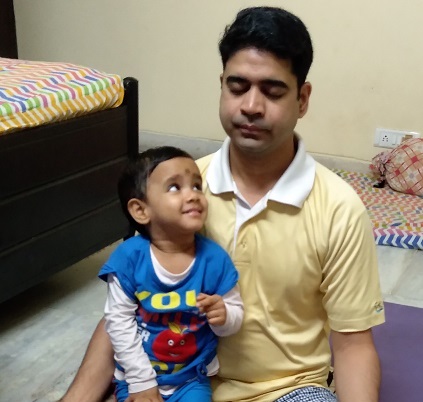
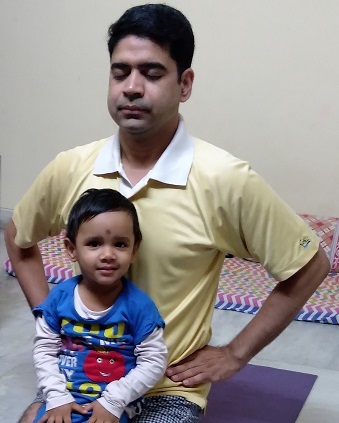
    Initially, I was bit uncomfortable that Adviti is disturbing me. Somewhat worried when doing asana if my hand or leg may hurt her. It is said that when someone is meditating or doing his/her spiritual practice you must not disturb the person. In fact it is said that you must not even touch the person. Here this infant is sitting on my laps, holding my hands and asking me to join her to play something. It happens rarely to me that I’m in a meditative state when I’m “doing” something.

    Long back I had a blog draft, in which I had contemplated what must be going in the mind of a sadhu (monk) who has left everything and gone to the Himalayas. He must have achieved the peace of mind he might be looking for. I had lot of questions to this fictional sadhu about he lessons. A thought cropped up when Adviti started sitting on my laps during my practice. Will a sadhu – who has attained peace at Himalaya – remain the same peaceful person in the world where there are distractions? The distractions can be traffic to office or noise of road construction or for that matter, your daughter wanting you to play with her, when you’re meditating.

    Learning

    My daughter has been a great learning to me. She is a cute little doll who enjoys moment to moment she lives in the moment. In fact she is so full in the event that if she is crying “she is crying” period. This is the case with every infant and kid, they are in “the now” all the time. Adviti does not know what I am doing or if she should stay away from me during those 30 min or so. She is fully involved, perhaps she is not aware that it is called awareness and still she is completely AWARE of her action.

    How to live in the moment?

    Almost for all questions my answer ends with spiritual practices. There is nothing wrong in this, I think. At the end of the day we all are spiritual being in various levels of evolution. There can be few simple to do points to be aware –

    1. Becoming aware of our thoughts, many a times we are doing one thing and thinking another. This distraction should be minimized. Keep an eye on the distractions.
    2. Do any activity with full awareness, it is difficult in the beginning. Why – read point 1 above. Keep aside your mobile, stop all notifications (except calls perhaps). This is how babies are, fully involved in the now
    3. Meditate, sit silently for some time and make it a daily practice. It helps. I know there are a lot of meditation techniques (Vigyan Bhairav talks about 100+ such techniques)
    4. As a professional, whenever you are doing an activity – know what is the outcome expectation from this activity. By the way outcome expectation is an innovation method too. When you are aware about the outcome, your actions should “ideally” be directed towards the outcome. It sounds contrary to the most famous guidance of Krishna (paraphrase) – “You do your duty, fruit of duty is not in your hand.” Though, here the guide is your actions should be directed towards the outcome. It implies here that plan for the result, and act in the moment.

    Results of action with awareness are better than just actions. We get distracted by event. The ability to respond to the activities around (and inside) with awareness improves us as an individual.

  • From spoiled trouser to organization culture


    It happened a couple of years back when I was on vacation. I received an invitation for speaker engagement over a weekend. Who take formals on vacation? It was an eleventh hour request from a very respected business association on organization culture and innovation. I could not reject that invitation. I borrowed a trouser from my friend for attending this event.

    While washing the borrowed trouser, it was spoiled by color of my father’s trouser. I was on vacations and markets were closed as weekly closure. I had no choice but to wear this borrowed trouser for this presentation. On a lighter note – I am not such a bad friend who will borrow your cloths and spoil them ;). I do not do such things often.

    Since the presentation was on a short notice, I had been thinking for examples on my toes. This peculiar situation helped me understand a trait of organization culture. In fact I used this to make a point about organizational culture as well as my weird dressing; yes I wore that trouser for presentation.

    Organization culture

    For explanation let me call these trousers – borrowed trouser as T1 and my father’s trouser as T2.

    The original color of T2 was washed away easily. However; when the same color stuck on T1 the color did not wash that easily. I had no choice but to wear the spoiled pant – T1. My father’s trouser – T2 was not my size. Well what I learnt about organizational culture from this incident was this –

    1. Building a good organization culture takes time and this cultural habit needs to stick with the organization. As the color should have stuck to the trouser T2.
    2. If the activity of culture building is not taken seriously, the wrong habits may stick more often than the right habits. Wrong habit here relates to the color on T2 that spoiled the borrowed trouser T1. The bad habits leave a bad impression, make amendment difficult, time consuming and in worst case impossible.

    Right organization culture is very important for any organization, but it does not get built overnight. Once the culture is built, it is difficult to change it.

    If the color on the trouser T2 were strong, it would not have spoiled the borrowed trouser T1. It is easy to mold new employees to the organization culture. It is possible for new employees to get molded to the existing organization culture like my borrowed trouser T1 got spoiled.

    If an organization wants to maintain certain culture it has to depict this culture everywhere in its dealings. Be it treating its employees, clients, vendors and the whole society. The way an organization executes its business –operations, policies, analytical thinking, innovation and following laws of the land et al sets the tone.

    Coming back to the trousers, it was later impossible to wash away the spot of colors on T1. I did two things –

    1. Bought a new trouser for my friends
    2. I got trouser T1 colored in dark color. Trouser became like new, I gave it back to my friend.

    Alas! this is not possible for an organization.

    Learning

    Just imagine had the trouser T1 been an organization, what would have been the situation, impact and performance of the company. I was in an easy situation, solution was quick and effective. Imagine the management of the organization if they get into a bad organizational culture, it won’t be that easy to change the culture.

    Paint employee in the organization cultureIt is said that old habits die hard. It is better to form good habits in the start itself. However, it is never too late, sometimes organization needs to make tough choices, change is always fought by the established norms, and therefore it becomes difficult to bring change. If senior management wants the change to become a norm they need to lead by example. Say for example if management wants to inculcate data driven culture in organization, management has to make it clear to everyone – “every decision should be backed by data, no decision will be made by gut feel or random idea”.

    Bottom line for startups and entrepreneurs – if you color trouser T2 well, trouser T1 wont be get spoiled. If you take care of the organization culture from the start it is easy to maintain it.

    Image sourcehttp://www.actiongroup.com.ar/cambio-cultural/

    Thanks to Nilesh Yeram, my colleague who suggested using the above image.

    Originally I have published this article on LinkedIn here, this article is modified here.

  • Broken pail


    Once upon a time in India, there was a farmer – Ram. In those days there were no facilities of having water in nearby areas. So, Ram used to go long distance to bring water for farming. He used to tie one pail (Ghada in Hindi) each on two corners of a stick and used to take it on his shoulders to the nearest water body. He used to fill these pails and bring them back to his farm.

    FarmerOne of the two pails was broken and Ram was poor so he wouldn’t afford to buy new one. He used to fill both the pails but by the time he is back, the broken pail used to get empty. It kept on happening for long time. The other pail used to feel proud of himself.

    These were old times, when non-living things too used to have sentiments – now even humans seem to have lost the emotions. Much to his chagrin, the broken pail used to feel because it is broken, Ram’s efforts get wasted.

    Once, out of compassion, the broke pail told to Ram – yes those were the days when people could hear murmur of non-living things too. Alas we dont listen to ourselves and fellow human beings – “I feel bad for you that I am broken and your hard-work goes in vain when by the time you reach home, I am empty. I am sorry for that.

    Ram too felt bad for the pail, however he said to the pail – today When we come back with water, look around en-route, there are a lot of flowers dont worry about water.

    The pail followed, there were a lot of different colored flowers with many different fragrances. it was happy seeing the flowers allover the route. When the famer reached his farm the broken pail was empty. Pail again felt sorry for loss incurred by Ram because of him. He again asked for apologies to him.

    Ram laughed this time around, he said to the pail. You know what? Those flowers exist because of you, I know you are broken, and water spill out of you all over the route. Knowing this I had put seeds of the flowers in the route. These flowers have made the road beautiful. People pluck the flowers to confer it to gods during prayers. You are broken but see, this helped a lot of people.

    In my innovation consulting engagements, we used to talk about – utilization of available resources. This was a good example of utilization of resource. Can you learn from Ram how to utilize the shortcoming of his resource to his benefit, or society’s benefit?

    Is it the case of strategic decisions – get rid of loss making or less profitable business and utilize the resources on other higher RoI projects? Does our Farmer in this case looks like Mr Ratan Tata?

    No, no, I have my opinions on the corporate (mis)governance, recent development in Tata group and Mr Dholakia of Shri Ram Krishna Exports. I hope to write on these some other time.

    Source of this Jataka Tale – http://www.hindisoch.com/jataka-tales-in-hindi/  (translated with freedom by KRD Pravin)

    Image source – http://mindry.in/blog/2011/05/29/civil-society-asks-government-to-acquire-highways-and-make-them-arable-lands/

  • Question your Assumptions


    This is a repost of author’s article on LinkedIn – Question your assumptions.

    In 2008, in the winters of Pune, I along with one of my friends were having sumptuous buffet dinner in a restaurant of the hotel. In the candle lights and gentle music of the restaurant we discussed the lighting of the hall. This hall was lit with yellow colored lights not so bright, neither dimly lit. My friend asked me why the height of this restaurant room is more than the rooms of the hotel rooms upstairs? That was an interesting question I never asked this question to myself or to anyone else.

    Next day we were sitting in a meeting for exploring possibility of licensing some IP of my friend with another interested professional group. We finished the meeting late in the evening. After the meeting we had some snacks and went out for a walk. We were speaking on various issues right from our meeting and way forward to how is his business going and what are my plans, I was planning to do my MBA at that time. It was evening, therefore in a while street lights lit up. The moment these lights lit, he suddenly asked me – “have you ever thought why these streetlight pole are this tall? Why these poles are say X meters and not 2X meters or X/2 meters in length? Can you think of possible reasons for the height?” I tried some possible answers as per my knowledge. However I didn’t know the actual reason, so I requested if he can tell me.

    He said, the length of the poles have not been change for almost a century. In old days there were some type of streetlights that gave best illumination (light rendering) on road if the bulb is kept at a certain height. Though in the whole century technology of bulbs have evolved not the length of the poles (specially in India).
    I asked him, so why not change the length of these poles? Is it a rocket science to find out best illumination for current street bulbs? He said, now for the current technology length of pole can be reduced to about 70%. Just imagine if we save 30% of steel on each pole how much we can save? That was an interesting idea.

    This dinner, meeting and walk as a whole taught me a lot. My friend was so thoughtful that he questioned many assumptions. He could convert these questions into useful opportunities. I realized that an innovator is always on a lookout to question the assumptions. Why are we doing this thing or that thing? Why are we doing this in a particular way. He is always looking for some workaround, solution or better way of doing it or multiple ways of doing the same thing. Occasionally this results in breaking the assumption themselves.

    In past I – along with some of my colleagues – was working on a business model, we had thought of some possible monetization approaches. These approaches included what assumptions we have in our mind, what is the target market et al. When we went to the market our prospective clients (partners) started giving us more options, create more slice and dice of the services, customization of offerings/schedule of charge. Initially, we were somewhat restrained we were reluctant to consider the ideas / service offering charges with reservations. Slowly we started accepting this. It was interesting to see these slicing and dicing by prospective clients. They were creating more opportunities for us. They were unwittingly helping us explore more possibilities.

    There were learnings in these experiences. The challenge we face many a times are not outside, the challenges are our owns assumptions. When we start looking at things in a different perspective, when one starts questioning assumptions new opportunities emerge. An open mind provides opportunity for innovation as well as doing business in a better way – so Question your assumptions.

    Image source – http://s20.postimg.org/bmt4ul5ot/IMG_20140216_WA0000.jpg

  • Death is inevitable


    For Humans – Death is inevitable; there is no hiding from this truth. For Companies – Only the paranoids survive!

    Well, it was a coincident that my previous blog was on death and the season of Ganesha festival (an Indian festival) arrived.  This Ganesh festival I had seriously thought about the Indian culture, festivities and the small – often overlooked – lessons. In India every good work starts with invoking Lord Ganesh, even prayers, pooja etc starts with first invoking lord Ganesh and then the other “main” pooja’s.

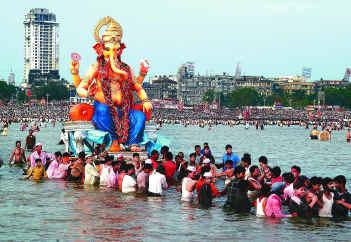
    The festival of Ganesha is a period from Ganesh chaturthi to Ganesh Chaturdashi a ten day period often in September month. During this festival, families and societies bring idol of lord Ganesh, worship the idol and within a couple of days immerse the idol in water. Similar to what happens to us – we are born one day and would be cremated one day.

    (source - http://www.thehindubusinessline.in/2004/09/28/stories/2004092802271700.htm)
    Visarjan procession in Mumbai

    Every year we follow this cycle of birth and death with our God. A God revered so sincerely that every things starts with his name – Shri Ganeshay Namah. Hats-off to this culture which has this concept of death embedded in its roots so truthfully. I think we should understand that death is inevitable and learn some lessons. (The Buddha saw this once and started his quest.)

    I started looking beyond my grieving moments and towards businesses. What I realized is that ‘the reality‘ of death applies to even companies too! As innovation consultants we used to share statistics on survival of companies. Out of Fortunes list of 1920’s and 30’s many companies do not exist now. Take an example of Kodak – a very innovative company –  filed for chapter 11 recently. If we just take Kodak as an example – Xerox was born out of Kodak’s lab. Xerox created such brand image that Photocopy became synonyms to Xerox. HP with its printing challenged Xerox. So the cat and mouse run of companies is on. The conclusion I made was if companies do not reinvent themselves, those are likely to die over a period of time.

    Last weekend I was attending a course meant for board members or to make people capable to contribute to boards. In the course (Retd) Maj Gen Mhaisale shared some HBS and McKinsey reports about shrinking life time of companies. Earlier average life of companies used to be about 40 years now it has shrunk to 16 years (in some countries 6-10 years too). Take the same example life span of Kodak was about 100 years, Xerox about 40 or so (please don’t take these life span as sanctity numbers)!

    Interesting part is a contradiction that human life expectancy is increasing and average life span of a company is decreasing. There is a lesson to learn – either be paranoid (as Andrew S Grove said in his book – Only the paranoids survive) and keep on reinventing your company or – death is inevitable!

    Related blogs – Death

    Source – BMG India training material on innovation (created and referred as a trainer) and IoD training sessions

    Image source – Business Standard

  • We need pessimists!


    I was thinking about the middle path and two types of people came to my mind – optimists and pessimists. I went back in the memory lanes. As an innovation consultant, I was a part of a Summit on Innovation. Few of the workshops in the summit were on “Culture of innovation” in organizations. Everyone agreed that we need diverse team for innovation, however, everyone agreed that we need to engage only energetic and optimist members in teams. I asked myself; Why are we categorizing people as optimist and others? Does innovation require labeling people and then creating teams? In other words why we – as innovation consultants – are agreeing not to have diversity in team? Even in systematic innovation drives, we need people of different thinking styles and opinions.

    I asked myself let me define ‘pessimists’, to see if my questions make sense in team composition for innovation efforts? According to Merriam-Webster online dictionary, pessimist is one who has an inclination to emphasize adverse aspects, conditions, and possibilities or expectation of worst possible outcome. Pessimists are those who negate or say no to anything because of their experience, knowledge, logical, old understanding or mere negative thoughts. Does it mean that they shouldn’t be a part of any team on say innovation efforts? I have heard somewhere – if an optimist makes an airplane, pessimist makes a parachute. Pessimists could be extra-cautious and introspective people, isn’t it?

    We need pessimists!
    Why we need pessimists too in innovation drives?

    In fact, pessimist is needed at places, because he/she may help improve solution with a “no” for many solutions. For example extra-cautious people help device seat belts in cars, safety values in pressure cookers, exit strategy in project/business plan. This “no” trigger teams to look beyond the horizon and ideate. Pessimists are the people who can be a great part in defining the problem and creating more challenges around the problem by questioning and negating. They endow the team with a new dimension to assumptions. It is well said – a problem clearly defined is half the problem solved. So do we not need pessimists, in defining problems? Pessimists can be a good help in exercises like heuristic redefinition and forward and backward thinking of the team because when they drive their thought process they also have an eye on the rear view mirror. I have heard – “Ideas of pessimists have saved more lives then ideas of optimists”, do we not need a balance in innovation teams?

    Pessimism is one face of a coin, other is optimism and a coin cannot exist without two faces. A good leader and an innovation team is one where best out of pessimists is utilized for improving its performance. Isn’t it right that we need pessimists… too!
    Copyrights KRD Pravin

  • The Machine that Changed the World


    I read this book recently “The Machine that Changed the World“. It is indeed a good book every businessman should read it. “The business is run on trust” or “the business will be run on trust”. When we hear this statement it seems odd, however it is true Trust is the factor. I wrote often about ‘interdependent co-arising‘ (Blog 1, Blog 2 and Blog 3). When I read this book I realized that it is practiced in Japan for many years. Toyota has substantial equity share in its suppliers and the suppliers of suppliers. This is a complete mesh of cross-locking equity structure. They trust each other decide a profit margins rather than hiding the cost structures. According to the book “…This system has replaced the vicious circle of MISTRUST into VIRTUOUS circle of COOPERATION…”.

    The cross linking equity structure goes to a deeper level and different competitors also own each others share. This shareholding pattern is to help each other raise funds. Reference to this is – “The Machine that Changed the World” page 194 perhaps it is edition 1.

    What I found interesting (page 151 of the book I think first edition) – when the volume of demand changes and assembler gives notice to the supplier and in case the volume (demand forecast) fluctuates “…The assembler will work with the supplier to look for other business…”. This is not only interesting but also a surprising and welcoming effort to build trust. One more thing I found very impressive and useful – “…we (suppliers) work without safety net, so we cannot afford to off the high wire…” and thus suppliers maintain the quality not only for their own sake but also for the assemblers.

    The other interesting fact is not just production but also product development is done in cooperation. We hear “crowd-sourcing” as a means for innovation however, a crude system has been used by Toyota for years now. New product development at Toyota involves the suppliers and major work of NPD is done by the suppliers.

    One more interesting factor I realized while reading the book. When we say “one customer at a time” and “managing customer relation in Marketing”, this concept was far more ingrained in the Lean system of sales even in 60s. So beyond Operations the Lean system has been a pioneer in Marketing and Sales too.

    Still after praising the book I am of the opinion that there would be some method which will change the game even further. The question to ask is when and how (which I contemplated earlier)?

  • Connecting the dots – innovation


    This is the third blog in the series of Connecting the dots… which started from way off the track blog on cricket.

    You see how things and ideas connect to one another. I was wondering about cartoon channels. These channels show many foreign based cartoon series and the characters are very famous amongst children. Ask kids – “Pokemon, who is this?” and see their reaction as if you are an alien, ‘oh! you don’t know Pokemon?’ And “world becomes their stage” they would show all the trademark actions and dialogs of the key characters of the series. Well, I don’t see any issue to this however it made me think on a tangent. The tangent resulted in an earlier blog on Cricket… another on “Amar Chitra Katha” and finally here I am writing on innovation. I connected the dots and here I am. The dots are as below –

    Cartoon Channel -> Blog on Cricket -> Amar Chitra Katha -> an article by Darrell Mann -> Blog on Innovation.

    Darrell Mann

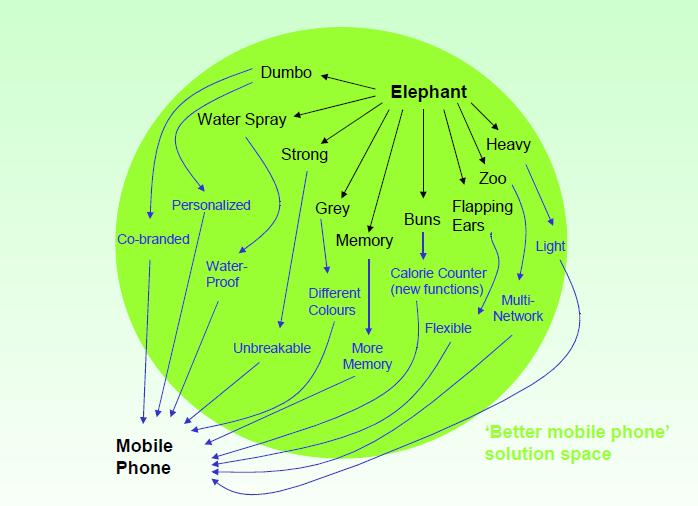
    Once in a tutorial Dr Darrell Mann (a renowned TRIZ expert and professional) created a solution space for Better Mobile Phone starting from an Elephant. Surprised! Yes he did that in 2006 in a tutorial session. And if one knows how to connect dots one can design/formulate or conceptualize faster and better.

    I started thinking in the following fashion –
    ‘why we do not have any local Indian Character?’ I asked myself. Then answered to myself – ‘Hello! do people know that Chess and Badminton are conceptualized in India? Well in India Cricket is a sport rest are time pass. Perhaps true! How many notice, that the first archery competition in world happened during the time of Mahabharat, when Arjuna hit the eye of a fish. Oh! Olympics, from 1996 onwards in each Olympics India brought at least one medal home’.

    1996 – Peas
    2000 – Karnam Malleshwari
    2004 – R S Rathore and
    2008 – a few… who were they? Let me ask people if they recall names of these sports men/women

    Mahabharat, cartoon characters and kids not knowing about the Indian Mythologies – wow! that was what was the premise on which Amar Chitra Katha was born.

    Innovation requires flow of thoughts, flow of thoughts from different directions to a solution or an offering (Product/Service). However, we cannot rely on random thought and free-will for solutions. We need solution better and faster. Innovation requires open mind, ability to connect dots and think and look beyond obvious. At the same time it does not mean innovation is a play of experts, if someone is open and willing to learn one can learn approaches to be innovative. All the freewheel thoughts were the random stimulus and I connected them in the form of blogs – Cartoons, Cricket and Amar Chitra Katha.

  • A tree is only as strong as its roots


    Have you heard this saying before?

    This is the second blog in the series of … wait for it… (updated on Jan 2013) Connecting the dots – innovation

    Well, to continue from the earlier blogs – Cricket… here I am to write the next in one which takes off from the Amar Chitra Katha.

    Why Amar Chitra Katha? Because it relates to me on two levels. One on Business and the other the Buddha… As an innovation consultant I observed that innovative ideas not necessarily become successful revenue source. There could be many reasons for the same. One most important point for constant innovation and healthy top/bottom line is understanding the customer, understanding their overt and covert needs. That is what Uncle Pai could do with the concept of Amar Chitra Katha. No doubt he had a noble cause at the center. However, he also knew the need gap and could fulfill the same. So effectively, he was one who could understand the consumer insight and voice of the customer.

    I loved reading the comic and magazines by him and I was unfortunate that even though I lived in Dadar for a long time I could never meet him and when I heard about his sad demise I was not in India.

    Part two of Amar Chitra Katha is the Buddha. Again reiterating the fact that when I say “the Buddha” I do not restrict myself to the Buddha only. This relates to every possible concept which connects us more on a higher plane above our made so called ‘religion’. Amar Chitra Katha was born for all round development of kids. Read any story it would be either for knowledge, imparting some lesson or last but not the least to develop the habit of reading. Uncle Pai took this root as an obvious path – stories are easy to remember, kids (at least that time – 60s-70s) used to hear stories (Dada Dadi ki kahaniya) – when Jatak tales were used by the Buddha why reinvent the wheel?

    A to Z mysteries 1A to Z mysteries 2A to Z mysteries 3A to Z mysteries 4A to Z mysteries 5, A to Z mysteries 6,


  • TRIZ in sales and channel management


    Contradictions! We live in a world of choices, conflicts and trade-offs. The following idiom says it all – “you can’t have your cake and eat it too!” In this regard, there is an approach to solving such problems wherein you are faced with contradictions. The theory is named TRIZ – the theory of inventive problem solving. By way of example, let me introduce a contradiction in simple terms.

    Let’s say you want to increase pressure in a vessel and the result of that also reduces temperature, which you do not want. The conflict in this case is clear: increasing one parameter affects the other parameter negatively, or, changing a parameter positively affects another parameter negatively, which creates an undesirable outcome. The idiom used above “you can have your cake and eat it too!” implies a potential physical contradiction- You want a cake but you cannot eat it!

    TRIZ is extracted from the field of engineering. This methodology helps resolve the contradictions without compromise. Lately, I tried applying concept of TRIZ in class of Prof John Davis (Dean SP Jain Center of Management, Singapore/Dubai) on Sales and Channel Management. There was a company which had acquired many diverse companies and thus had a dilemma of structuring its sales force differently to increase efficiencies. The range of organizational options included – letting the sales force be as they were (independent), merge the sales forces, using distributors, or a unique combination of these or alternative structures.

    The solution of merging or having independent sales forces had their own positive and negative implications. This type of issue can be termed as “physical contradiction” in the language of TRIZ. To solve physical contradictions separation principles are applied. So, when applying the principle of separation on condition and space, we can identify that the sales force could be geographically separated (separation based on space). The conditional separation in this case was manifested in determining big account vs small accounts for both distributors and an in-house sales force. Additionally, the conditional separation was represented by a merged sales force (one bag) vs a separate sales force (silo) for product offerings.

    Thus, though TRIZ was distilled from field of engineering but we can apply principles of TRIZ to solve problems in different functions (e.g. sales in this case) and other non-technical fields. I am trying to apply TRIZ in different fields and I have also identified application of TRIZ in marketing, strategy planning and areas where conflict appears, though I feel there is a lot more to be done in terms of making it easier to apply.