Tag: FT

  • Why are you doing what are you doing?


    In an interview with FT a renowned entrepreneur and hotelier Ian Schrager said that ‘…prison gave me time to think’. He was imprisoned for evading taxes.

    JailWhile reading this I started asking myself – Are not we so busy with our work that the best place to sit and think could be a place where we do not want to be. Is not it an irony?

    The biggest difference between animals and humans is the ability to think. However, we are so busy with our ‘work’ (daily chore) that we do not have time to think, we do not pause. How many times have you sat in a coffee shop and thought for your actions? How many times have you sat in balcony of your apartment with a cup of tea just doing nothing? ‘We are very busy for that’, right?

    What we can expect a person to do in a prison? (On a lighter side – when verdict is not ‘rigorous imprisonment’). Think for yourself – when you are sitting in a place where you do not have anything to do, no TV, no Internet, and no mobile you are all by yourself. It is difficult to pass time like that. And so when we hear a statement ‘…prison gave me time to think’ it seems to make perfect sense?

    Long back I read a book by Steven Covey – Seven habits of highly effective people. In that book there was an example for habit 1 – being proactive. The example was of Victor Frankl a Jewish German psychiatrist who was interned in a Nazi concentration camp during World War II. He realized that he has the power to respond to the situation he was in. He could think of this in a very adverse condition, we occasionally thing about it even after receiving forward mails regarding the same (I received a mail forward which says – …life is 90% how we respond to situation).

    How many times have we thought – why am I doing what am I doing? What do I want to do in life? What is the purpose of my life? Do we question ourselves for reason of our existence? This is what the Buddha also thought when he left his family…

    Effectively, I had a question to myself and to all of us in general, what does it take to stop and sit down and think. Do we need to go to jails to have time for ourselves to think? When are we taking a leave from our chore for at least few hours in a week, get out of our rut and think something beyond the daily chore?

  • Ideate – Save the sinking ship


    Prof Mankad said in our class ‘there seems to be possibility of double dip’ while teaching us macroeconomics. I have written on this in my blog at times. At times question comes in mind, why not using concepts of one field to the other the way we do it in TRIZ (The theory of inventive problem solving). I recalled a news shown on NDTV (it was shown in 2008 somewhere in Aug-Nov). I remember this news because it was unique and I rarely watch TV(:)). So, here comes use of TRIZ to tackle the economic crisis in a non conventional way. I am sharing the idea with a hypothetical scenario.

    As an everyday ritual Vijay logged on to his mail box, amongst others the mail from HR stared back at him. Feeling the heat of economic crisis the company was in process of layoffs. How many Vijays have the same stories to recount? How this time can bring us together and make us more innovative to reckon with the challenge – this challenge is not questioning us only on one front of economics but also on cultural and creative fronts?

    Employee-employer relations are unlike marriage where a pair takes an oath to live together, and share all the grief and joy. In this tough time each should support other for survival and future growth and say – “yes! We are for each other”. It has been proved important and useful in the Japan after the World War II. Lately, a group of ex-workers of a mill bid to revive a dead mill; Garware Nylons Ahmednagar. All the workers joined hand for revival of the mill. In this successful bid the sense of belonging was such that the families of ex-employees even-handed over their jewelery and large sums from their provident fund. Way back in 1996 instead of shutting the mill down, if the management and the workers had come together and decided to make a plan to save the mill on a model of a marriage by surviving in the tough time, they might have come up winning and everyone might have lived happily.

    In recent week there was news in FT that EU is considering bailout in some forms. Bailout is a ‘self-mutually exclusive’ option that is – bailout is needed in the toughest time but it is ill-advised as it is ‘passing-the-buck to taxpayers’. Government needs to bail out various industries; however, the companies may misuse the amount. In such case questions are asked that – How to make companies accountable for the same? When to loan, how to loan and how to gauge the performance of the waived organization?

    Bailout can be tackled when government separate this option of bailing-out upon condition of time and space i.e. conditional separation of amount of money offered, accountability of use of money, time-to-time checks and balances. Separation of assets and liabilities can be one more initiative and offering incentives other than monetary could be other.

    Additionally, if we attentively look around we can learn from nature too. Birds fly in flocks, why? Because flocking helps conserve energy, defends against predators and facilitates orientation and communication. Energy is everything involved in the business – various resources, money and time – it needs to be conserved. Instead of salary cut and layoffs companies can take loans from employees, offer shares or bonds to the employees to generate money. This not only can engender trust in teams but also can invigorate teams to work for their own company. Are you keeping those many Vijays in your team? Are you willing to take on the challenge by sticking together, being creative and innovative to carve success over the slump to ply in the present to fly in the future?

  • Double dip!!


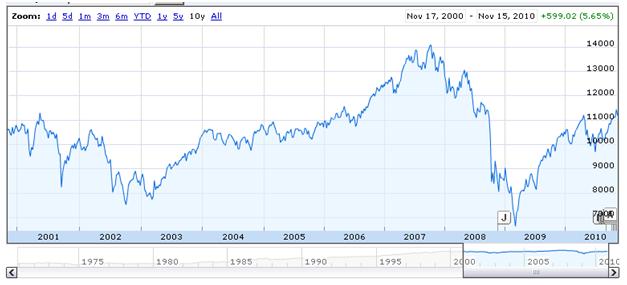
    “There seems to be high likelihood of double dip!” When we heard our professor of macroeconomics Prof Mankad say that we could not believe it. I recently thought to plot some charts and realized that human sentiments are also equally responsible for this. The following is a graph, here we see an increase in the center yet once the peak is achieved there is a drop and no gain. Some call it correction. Well, frankly speaking these are my semester-wise undergrad scores.

    When I had a quick look at the graph I said – ok! I did ok initially, and then my performance dropped, it hurts I improved myself and went down back somewhat. Alas! My undergraduate was over therefore I could not extrapolate things. Yet, if you sem one to two movement there seemed some similarity.
    I tried relating it to the last 10-years NYSE performance. There were phenomenal similarities. I took 10 year performance because it seemed to me that post DOTCOM bubble burst would be a good point to start from, and some other logics. See sentiments are again at work.

    Then I thought about the statement of Prof Mankad, double dip, what about that? There could be a possibility of double dip, why, how and when? Yesterday I was reading Financial Times front page news – Ireland resists bail-out pressure, and viola I got a hint. If nothing is done at this time perhaps the other bottom is not far.
    I recalled another part of macroeconomics class. “Essentially all banks are bankrupt.” Though for self satisfaction we may call them BANKS, on which we bank. Nonetheless banks are sitting eternally on a time bomb ready to explode any time. The bomb of Debt!
    If Ireland does not accept the support from EU perhaps we all would be doomed to see the second dip. The situation is a double edged sword – the world needs an enhanced banking system yet what I read somewhere “if you actually tried to manage according to the regulatory measurements, your bank would fail.” At such times I resort to TRIZ – the theory of inventive problem solving. I would comment on the SYSTEMS in general and TRIZ in next posts.