Tag: Foreign Direct Investment

  • Interdependent co-arising intra-country example


    In previous blog “Coalgate…” I touched on the topic of Dutch Disease. The concept of Dutch disease rebounds me to the interdependent co-arising once again (interdependent co-arising means – we are all dependent on each other.). This concept of Buddhism is applicable in every walk of life. If we (each individual) do not understand it we are going to remain in the problems we face. Check previous blogs on the same below.

    Interdependent co-arising farmers example (ground level example) – this blog is about how interdependent co-arising relates to a smaller level of activity of one businessman / farmer. This could be you or me in our regular work environment.

    Interdependent co-arising macroeconomic example (world level example) – this blog is about how interdependent co-arising relates to macro-economics.

    This blog is a country level example of interdependent co-arising (Pali original concept – Pratītyasamutpāda – at Wikipedia).

    What is Dutch disease?

    The inflow of capital leads to an appreciation of the currency, making imports cheap and export expensive. The name comes from the Netherlands experience following the discovery of gas in the north sea. Natural gas sales drove Dutch currency up, seriously hurting the country’s other expdutch-diseaseort industries.
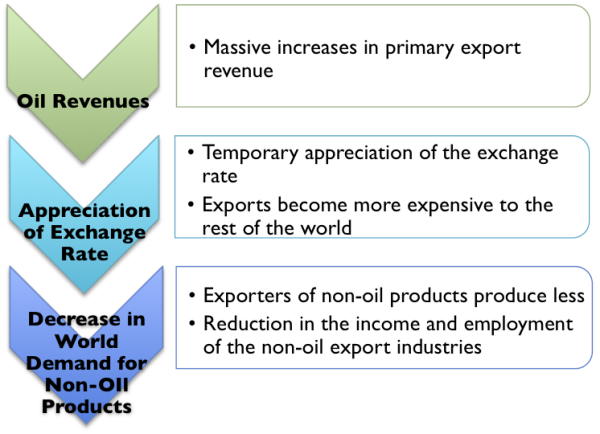
    In late 50’s Netherlands found huge source of natural gases. This resulted in 1. investments (largely foreign direct investments) in that sector 2. decline in other sectors e.g. one example could be people moving for jobs in that sector (consider Indian IT sector as reference) 3. investments (specially foreign investments) in that sector resulted in stronger currency. The excessive investment made Netherlands currency stronger resulting in making exports expensive eventually resulting in decline of export from Netherlands. Manufacturing suffered and thus jobs in manufacturing too go to step 2.

    This convoluted – action/reaction and impact at not so obvious industries – example again suggests to us that even if industries are not linked directly they are linked in some way. This link is interdependence. This interdependence should make one value the existence.

    The  “Dutch disease” should make us once again think about the invisible connections we share with each other.

    Image source – http://globalprosperity.wordpress.com/2010/08/19/oiling-africas-gears-for-democratic-change/

  • #CoalGate, corruption, politics & economics


    A few days back I completed this book Globalization and is discontent by Dr Stiglitz, a nobel laureate. I wrote on that recently – Interdependent co-arising a macroeconoics example. Besides this macroeconomics example, I had this intra-country example of the same concept of interdependent co-arising. Stiglitz has written so many things more than 10 years back which are happening in India currently. However, here I am just interested in quoting a small part of the book which relates to the corruption of coal mine allocation in present day India. This example is from page 71 of the book –

    There is more to the list of legitimate Complaints against Foreign Direct Investment (FDI). Such investments often flourish only because of special privileges extracted from the govt. While standard economics focuses on the distortion of incentives that result from such privileges,  there is a far more insidious aspect: often those privileges are the result of corruption the bribery of govt officials. The Foreign Direct Investment comes only at the price of undermining domestic processes. This is particularly true for investments in much oil and other natural resources where foreigners have a real incentive to obtain the conversation at low prices.

    Moreover such investment have other adverse effect- and often so not promote growth.  The income that mining conversation brings can be invaluable but Development is a transformation of society. An investment in mine – say in a remote area of a country – does little to assist the development transformation, beyond the resources it generates. It can help create a dual economy, an economy in which there are pocket of wealth. But this duel economy is not a developed economy. Indeed, the inflow of resources can sometimes actually impede development, through a process that is called “Dutch disease”

    So effectively, what Stiglitz said was bribing of officials for mining in developing / undeveloped countries. Further, the dual economy this FDI may create is not best for country to develop. I would take this example of Dutch disease in my next post – “Business to the Buddha”.

    Here what I want to highlight is this – the current issue in India – #CoalGate scam is a clear example of what Stiglitz wrote more than 10 years back. Indian Prime Minister – Dr Manmohan Singh – being an economist might have been aware about this and perhaps therefore kept Coal Ministry with him. This is just an extrapolation. Otherwise why would Law ministry and Law minster would want to change parts of report? According to the Supreme Court of India, the changes are Heart of the report.

    After reading the book – Globalization and its discontents – I realized that Stiglitz is not against Globalization but against the way Globalization is happening. So, when you read the above part, you should not infer that Stiglitz is against Globalization.