Tag: Experience

  • Open you mind, experience beyond your beliefs

    Alexa play “bum bum bole”. This is a Hindi film song. The song teaches opening you mind, thinking, experiencing, and dreaming specially beyond your belief or knowledge. The song made me think in different dimension, questioning few things and conclude – experience beyond your belief.

    Source Youtube, original – from Movie Taare Zameen Par

    Alexa started playing bum bum bole song, Adviti was happy. Slowly she learned the lyrics of the song, for her the lyrics are not that very meaningful, yet she learnt singing few lines. She keeps on mumbling them while listening to the song.

    She started saying “bhala machhaliya bhi kyu udati nahi? Socho, socho na.

    The above line is in Hindi, it means “think why the fish cannot fly, just think”. Somehow it came to my mind that fish can fly if we start calling a bird a fish ?

    I asked Adviti, how about it? She didn’t understand. I reiterated Adviti let me explain

    1. a bird can fly
    2. if I start calling a bird. a fish
    3. so the fish will start flying isn’t it?

    A creative answer to a question that asks you to think.

    I’m answering your question Adviti, you are calling a fish a fish so you are asking the question why can not a fish fly? If you start calling a bird a fish it will start flying 😀

    I think she will need some time to figure out this logic.

    Well this is on a lighter side however in reality our perceptions actually create our realities and whatever we think is based on our beliefs.

    The formless

    Recently a big public, judicial and political debate started in India. The row is of a Shivling in a mosque. Before we proceed further – Shivling is a representation of formless. It is a symbol of energy.

    Gyanvapi Mosque Banaras
    Gyanvapi Mosque Banaras Source Sunday Guardian

    One group – Hindus – is saying that it is Shivling and the other group – Muslims – is saying it is a fountain. Let the competent authorities respond or prove to what exactly it is. The point I want to make is – this is how our belief systems are, we see what we want to see there may be some different reality out there.

    If you dig deeper, Muslims theology states that the God is formless. Hindu’s Worship the formless in the form of Shivling. If you try to connect these dots conceptually the idea is same – formless. Method of praying or bowing to the same concepts of “formless” are different. This underling concept is still not clear to masses. Why create a fight for one upmanship? There are many more dimensions to the debate. I do not want to digress.

    Belief system

    Our beliefs blind us. In Ashtavakra Geeta, Ashtavakra says – you are seeing the rope as the snake because your mind is saying that it is a snake. this belief is making you feel the rope as a snake. Until you open your eyes and mind, you will feel the rope is the snake.

    Our religions are also the same, some people believe in something, other people believe in something else. What is correct or what is true can only be proved when we become more objective, think, open-up and willing to experiment.

    This is the reason I like Indic religions – specially Buddhism and Hinduism to a great extent. After reading few philosophical texts of Hinduism I see Buddhism as a subset of Hinduism.

    Experience beyond your belief

    Hinduism has given philosophy of Yoga, Meditation, Bhakti (devotion), Karma, Gyan etc. There are many ways to experiment and experience. The best part is no one asks you to follow a certain path or approach. You follow or practice what you feel comfortable with. In one family you may find members of the family following different paths Bhakti (Devotion), Yoga, and Meditation in some cases questioning everything and not following any. This chaos is perfectly fine in the family.

    Prayer beads - Experience beyond your belief
    Experience beyond your belief

    Out of all these methods, the key is – “experience”. Some paths gave recipe of experiments too.

    Patanjali discusses Yoga Sutra, Shiv Sutra discusses 100+ meditation methods, Narad Bhakti Sutra discusses Bhakti (Devotion), Ashtavakra Geeta tells open your eyes see it, Krishna summarizes everything in Bhagvad Geeta. There are Upnishads, the list is very long to complete, contemplate, try everything and experience. Pick your options.

    If I were to say something, here is my approach pick one in the beginning. I will recommend read Bhagvad Geeta. It gives you a wonderful summary of different paths. Try one or the other path for experience. Whatever suits you from within, go deeper in that path with additional text!

    Interestingly, what the end results is? It is experience. All these paths proposed by the Indian theology are science. They do not want you to believe what is written. In fact, all the titles written above most have question between a speaker and listener. Do not just blindly believe what is written, ask what you have in mind.

    Open your mind

    What every human-being needs to do is – keep aside the belief system and move towards the experience system.

    The takeaway is – open you mind, put aside your battle of belief, and fasten your seatbelts for the journey of experience.
  • Half knowledge

    We learn things slowly. Slow learning is ok, however continuous learning is important otherwise the knowledge becomes half knowledge. The baby steps we take make us learn, yet at the same time, if we stick to the only what is written in the book without using our brain, we may get constricted and end up knowing only what we read – result – half knowledge. It is detrimental.

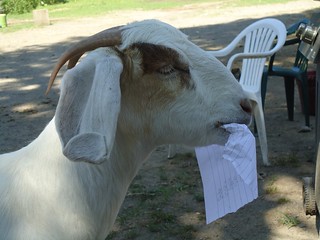
    Half knowledge is lie goat eating a piece of paper
    Source Flickr

    Half knowledge is equivalent to goat eating a piece of paper that had information. Goat would digest the paper but not the knowledge on that paper. I will share some examples.

    H for Hen ‘and much more’

    My daughter – Adviti – is learning alphabets – both Hindi and English. She has difficulty in saying ‘R’ and few other Hindi alphabets so she mixes up few things. In alphabets, she says E for Hathi. Because she knows the photo and she knows the name of the animal in Hindi. She used to say H for Tap tap (for horse). She found pronouncing Horse difficult so she said tap tap because horse runs with that kind of sound. We found it funny, but we wanted to correct it. Now we teach her H for Hen. Once we were teaching her and for something I said Hand. She got confused H for Hand or H for Hen! This is a learning process, we slowly understand that H for Hen was just for us to learn the alphabet H. H has many more alphabets be it a noun or otherwise. Imagine Adviti restricting herself to H for Hen alone! She will miss a multitude of things in life (more than 33000 words starting with H included). Half knowledge can restrict one’s horizons.

    Knowing book by page number is not knowledge

    The second incident is about half-knowledge but knowing some stuff to the T. I loved Chemistry subject, in standard 12, and especially a textbook ‘Comprehensive Chemistry’ the most. My special liking was Organic chemistry. I read the book multiple times such that I remembered the page number, the image of the page, and the content of the pages. Even after a year, when someone asked me a question, I responded – open Comprehensive Chemistry, go to page 236, it is on the left side of the book, in the center, there is a picture just below the picture read 2nd para (say the last para) you will get the concept. The answer to your question is – “XYZ”. Do not search for the book and pages now – I am talking about 1998, many things might have changed by now in the textbook :).

    Knowing such details of the book (One book precisely) did not make me an expert in Chemistry for sure. Because all that was mostly bookish knowledge with few experiments in Chemistry lab of School. At best, I had a photographic memory – not expertise in Chemistry, isn’t it? Even a Ph.D. may not say (s)he knows the fundamental subject line Chemistry / Physics completely.

    Hathiphant

    The other incident happened with my cousin brother and my eldest sister. They were talking about the education system of India. My cousin brother said there are downsides to teaching kids a medium (language) that is not the mother tongue. He recalled a neighbor who used to call an elephant – ‘Hathiphant’. This coined word is a mix of two words; Hathi a Hindi word for Elephant and part of Elephant – Phant. Merge these words and you will get Hathiphant. This confused toddler learned both words at home and in confusion made the Elephant a Hathiphant. Half knowledge can make one jumble multiple things and make a conclusion that may be incorrect.

    This has happened to me too when I was a student. We learned something and later that something became another thing (Hathi to Elephant). Let me tell you how can q kid get confused. I learned – I live in Dhar (a small city in India). Later, I learned- I live in Madhya Pradesh, lastly, I learned- I live in India. How is that possible? A 6-year-old cannot understand why and how can one person be in three different places? Later it was clear what living in three docent paves meant?. In 3rd we had nine planets, later Pluto was removed from the list, funny isn’t it?

    Half-knowledge

    Well, no it is not funny. We keep on learning. If we stop learning and improving our knowledge becomes half knowledge. This half-knowledge is harmful. Our learning makes us understand that our knowledge is limited and we are consistently adding to our body of knowledge. Alas! Some people, knowing one book, feel as if they’ve known everything. Reciting few books by page number and chapter plus paragraph didn’t make us intelligent or omniscient.

    I had a photographic memory of the Chemistry book, but I wasn’t fully aware of the field of Chemistry, isn’t it? Well, but why am I talking about it here? This applies to spirituality too, have you heard people reciting verses from books? Do they have the knowledge, mostly no? They at best have a photographic memory to vomit words from a reference book. Knowledge and experience on the spiritual path are pristine, once you hear those enlightened masters you quickly get connected. I have met a few of such masters in person, I have that first-hand experience of witnessing the presence.

    Similarly, in businesses too, not all business grads become successful managers or entrepreneurs. Becoming a successful business person requires more than the degree, knowledge, isn’t it?

    The point is, be it the path of spirituality or business, or a toddler learning language, we keep on learning and experiencing new things. Every experience is unique and thus, if we assume that photographic memory of any certain book is the knowing everything; it is – in effect – detrimental to not just one person but everyone around. On the path of spirituality and religion it a disaster for sure.

    Every situation demands a unique set of tools. I think that is why Krishna was needed on Pandavas’s side during the Mahabharat war. Yudhisthir – and all Pandava brothers were – (was) predictable. They went by the book, defeating Pandava’s won’t have been tough for Kaurava’s because they knew Pandava’s would go by the books all the time, besides having a bigger army. That is where unpredictability and Krishna’s intelligence came in handy. Experience of bending the rules could play in the hands of those who understand the situation and learn from experience. Those who learn from and are ready to learn from the experiences do not have half the knowledge. Be ready for learning, implementing, experiencing, and continuing it lifelong.

    Image source – Flickr