Tag: Dalit

  • Dalits in India, Dividing work, birth or none?


    Perhaps in middle school (6th to 8th), we learnt a lesson on why crows are our best friends and what we can learn from them. They eat dead animals and therefore keep our surrounding clean. We need to learn from them that whenever they see something to eat they always invite their fellow crows and all of them eat it together – what camaraderie, isnt it? But alas! as we grow we forget these small things we learnt as kids.

    Perhaps Krishna knew it all, he suggested Draupadi (Panchali) to reject Karna and thus Panchali said – Karna is a son of lower caste and I wont accept him as my husband. This – for my readers who have not heard of Mahabharat or know the context – was an India where girl (if not all, at least daughters of Kings), had the freedom to decide who she wants to marry. This was called Swayamvar – or a competition – where husband was selected by his capabilities by the girl. This kind of Swayamvars are recorded in history – be it Rama or Prithviraj Chauhan (12 century AD). Compare it with arrange marriage system of say two generations back when such decision was not that easy to offer to girl. This was an India where even if Krishna (God in human form as per Indian scriptures) was alive, abilities of Karna was proved secondary than caste (family’s profession).

    We have heard many such incidents in Indian history when a untouchable became center of discussion – be it Shabari who fed Rama only sweet berries by tasting those first. Here untouchable was first tasting the fruit and than offering it to Rama. Or be it a story of Eklavya. He approached Dronacharya (Drona) who refused him, later asked him to chop off his thumb to offer it as fee of teaching. Or the story of Sunita during time of the Buddha.

    I dislike the concept of caste system of India to the core. Slowly I moved away from the ritualistic religion to spiritual part of religion. I read parts of Bhagavad Geeta too. When I read Chapter 4 verse 13 of the Geeta I interpreted it in my own way, thank god at least Hinduism offers differing with the pandits; I can have my owns interpretation of the scriptures (ref recent controversy of Irrfan Khan).

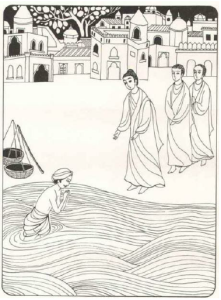
    (Sanskrit) चातुर्वर्ण्यं मया सृष्टं गुणकर्मविभागशः । Sunita “Lord, I do not dare come closer. I am an untouchable.”
    तस्य कर्तारमपि मां विद्धयकर्तारमव्ययम्‌ ॥

    (Transliteration) catur-varnyam maya srstam, guna-karma-vibhagasah
    tasya kartaram api mam, viddhy akartaram avyayam

    I infer this as follows – “I created four sub-division of society based on work and attribute. Even after doing this I am above and beyond this division.” Remember Krishna does not say that the division is based on birth, it is based on work and attribute of work.

    Listen to other language translation here, I cannot say it this translation reflects my opinion.

    In whatever ways Indian society has misinterpreted the concept completely. This whole caste system implementation has gone awry. I believe the concept could have been, teach kids and when they grow up their abilities will put them to different works and thus their work in society will be divided in four sub-divisions! Even if this sounds justification of the caste system, I still dislike the caste system. Everyone must have his/her fair opportunity to learn and try what and how one wants to work in the society. I hope the capitalistic economics and current open access to opportunities will offer an evolved society. Currently it is just a hope, as we read the news about atrocities against Dalits. It has been close to 70 years, but if we still see these news in media either there is something wrong with our society or media is giving coverage to it only now!

    Just fresh graduate from college and I’d just joined my first job, where I was selected through campus interview. I resigned within few weeks stating I’d have done this work after my 10th, if I were to do it. My brother taught me at that time – “no work is bad, low or menial. Do not look at your resignation from your first job as an ego issue. Accept it ‘you would not have enjoyed doing it.‘ If you want to start a company, it is upto you, if you want to study further, be into R&D be it. Even if you are gardening, be the best of the gardener you could be. Do it to the best of your abilities, no work is low or menial and never forget this lesson.

    I could relate to his lesson in many sense, be it a crow’s nature to clean our surrounding inadvertently or our society having different people performing different acts, we have to balance and accept that everyone does what best he/she can do for the society. There may be instances when one’s abilities are not utilized (as was in my first job); at that time he/she has to decide to move on and do what makes more sense to him/her. In today’s world when a person makes competitive strategy – he/she is Kshtriya (warrior clan in Indian caste system). When the same person presents his concept or shares his knowledge he/she is Brahaman (Pundit, teacher clan in Indian caste system). As a startup CEO (Chief Everything from dusting room to meeting clients to executing tasks) when one cleans his desk, prepares tea, drives somewhere or designs product/service he/she is Shudra or Vaishya (lower caste or businessman clan in Indian caste system). In current social and economic setup we cannot rely on the definition of works of previous times. We need to either define things in newer manner or perhaps just get rid of the division itself.

    There may have been roads paved with good intentions (by dividing work & caste system), but could not have lead to heaven at least. We started dividing society not on work but on birth. We decided one work is better than the other – but this is be good.

  • Cast(e)ing doubt – What’s your (last) name?


    In a lift one person, an old 70-75 year or so, looks at the other, smiles and thinks – New guy in the building! Looks educated ‘I can talk to him’. He asks – What is your name?

    Other person responds – Pravin

    Old man – Pravin what?

    2nd person – Pravin is my name.

    2nd person looks at the old man with a question mark on face, what does that mean?

    Old man – I mean your last name?

    2nd – I call myself KRD Pravin and my friends call me KRD (at times KRD P).

    Old man stares with a complete blank (!) and question on face?

    2nd person continues – Does not it sound like JRD (Tata)? One step ahead, that is in alphabet “K” comes just after “J” right? Smile!

    Old man – what does KRD mean?

    2nd person – KRD stands for my last name and father’s name.

    2nd person smiles and the old man insists on an answer.

    Old man – Ok! But what is your last name?

    2nd person (possibly getting the hint of apparent insistence now) – so you wanted to know my last name and not the name, is that right?

    Old man completely taken aback by such question, because he was only interested in the last name. What goes on in the mind of old man is – ok lad looks educated, but does not have manners, arrogant!

    Perhaps the old man is thinking – “I have a suitable girl for him in my mind?” Wait without knowing if 2nd person is married or not, how can one think like that? Anyways jokes apart.

    This is the reality, of few discussions (elevator talks). People are more interested in what someone’s ancestors did than what this young lad is doing? This is the problem of our caste system.

    I writing a series (on and off) of blogs on – against – the caste system of India (include black skin for other parts of the world). This is another installment in the series.

    One of my school friends (this is not a fiction he was indeed like this) used to make friends based on last name, he at times used to ask “what are you people? (that is you belong to what/which caste?)” If the other person does not fall in “his choice of category” he wont make friends with them. His selected types were – Hindus (in religion), Vaishya, Brahman and Kshatriyas (in caste). In the language of Indian quota system – he wont make friends with SC, ST or OBCs. I was surprised but well I made a note of this!

    I think we all were forest dwellers, once farmers. A blacksmith and mason is nothing but present day engineer. The more we developed the more we regressed actually! Even before the baby is born – he/she is black/white/sub-continent dweller. The day a baby is born we tag him/her as Christian/Hindu/Sikh/Muslim etc. Next tag is more clarification – You are a Shwetambar Jain, Or Saryuparayan Bramhan etc.

    What is this – why we do differentiate on caste? In India there are temples where even Hindus (shudra/Dalits/Untouchables) can not go. All over India this is widespread.

    Dalits give ‘donation’ to enter temple 2013 – The Hindu

    Dalits told to keep distance from temple 2013 – Times of India

    Dalits enter TN temple first time in 100 yrs – Times of India

    Below two news are almost same difference is the year. News from The Hindu newspaper site (by far the most respected and authentic newspaper in India)

    Dalits enter temple amid tight police security 2013

    Dalits enter temples with police protection 2009

    Tera Bhagvan (khuda) mere bhagvan (khuda) se alag hai!
    तेरा भगवान (खुदा) मेरे भगवान  (खुदा) से अलग है!

    Thy God is different than mine!

    When the creator is different there certainly is comparison – whose God is better?

    Meri Kamiz teri kamiz se safed hai

    मेरी कमीज़ तेरी कमीज़ से सफ़ेद है

    My shirt is brighter (better) than your shirt

    As if God is a trifling shirt or trouser! Who (which) can be better or worse.

    Related blogs –

    Cast(e)ing doubt –  everyone’s tears are salty

    We the societies

    When Buddha dies schools are born

  • We – “the Societies…”


    I read a book on the Buddha – Old Path White Clouds. Really, the path is very old. We are still struggling after many centuries. The book starts with a young Bhikku – Svasti a buffalo tending boy. The Buddha had tried hard to bridge the gap pervading in society at that time. During the time of Mahabharat (even before the Buddha) Karna had to face it (as son of a charioteer, check Wiki). I am talking about the societies we have formed. We are divided by race, religion, nationality, region, caste and sub-castes. Therefore we are not a society we are ‘societies’.

    I read two news items and thought to write about them. Though personally I feel religious belief is a personal matter and therefore no ‘group’ should interfere with beliefs of individuals. However, we have made religious belief system an organization which now has become a business as well as tool to discriminate. Anyways, the first news item was – First whiff of justice for Gujarat riot victims and the second was – Dalits enter Madurai temple after two long decades. In northern part of India people feel that southern states are far less discriminating, is that true? This news item shows different picture.

    At the time of the Buddha there was only four divisions of Indian society (as only Hinduism existed). Now we have many religion, languages, states, castes and sub-castes. The task of bridging gaps has become difficult in our times. Take an example of one belief system of India. The concept of this system was ‘a casteless society’, within 1000 years of its existence there are about 16 different sub-caste in this single belief system! The number is alarming because old Hindu system has only 4 castes (of course 4 are then sub divided) and this example less than 1000 year old has 4 time more sub divisions. I have heard Islam has 70+ sects, Buddhism has at least 3, Christianity has a few. Phew! how long will we divide as well as fight the so called holy wars?

    If we see at a macro level – we are divided in nation we live in, language we speak, color of skin, economic status for that matter brand of car we use. I am sure no spiritual master had meant to use his/her teachings as a tool to discriminate. We are humans and is not that enough to thrive, survive and grow physically, mentally and spiritually? ‘The path’ is really very old, we are still not able to understand it. We are ‘societies’ and we do discriminate, why?

    Related blog – Business of religion!