Tag: CSR

  • Millennials and the future


    Old days our ancestors used to communicate using sign language. Historians have found out wall painting in many civilizations and have discussed about usage of sign languages. We humans evolved, grew and became intelligent so started speaking, reading and writing when languages were born. Or perhaps the signs were difficult to remember over a period of time, thus language was born. We have evolved. With time, a lot of developments have happened. Now we communicate across the globe.

    Development happens in cycles, so now after so much of development we have again started speaking in sign language. We call this sign language – smiley. Many a times one has to refer to the ‘dictionary’ to understand what is the meaning of that smiley. Specially that is the case with older generation (I am a part of that). Millennials are different species – well that is how media, marketeer and many people think. Millennials understand these sign language with ease. Though as per definition I should be part of millennials but I dont understand the sign language.

    Many studies state that Millennials are different compared to the older counterparts. I am of the opinion that every generation is more evolved compared to previous one. Generation of my parents were busy settling down. My generation is little adventurous, millennials are freer, more connected and apparently they have more concerns for society.

    There are many studies on Millennials, because they are going to be the biggest spender & biggest target audience for marketeers. Some studies say that Millennials are more concerned about environment, more connected, driven by sharing, more inclined towards social justice & balance and are more spiritual than religious One study. Now organizations also care for CSR, however shallow that could be. Hopefully this will be true one day – let them fake CSR until they make it. I am sure millennials will make this transition sincere with time.

    When I read about millennials I thought in another direction. Sheer size of this generation is making us note these characteristics. Of course these are key traits of this generation, but still the sheer volume is making us notice this. There must have been people in previous generation who had similar thoughts but the numbers, perhaps the ability to measure was less at that time. There are very contrary analysis also done – Millennials less spiritual and less religious too, Millennials less religious but more spiritual either these are really contrary findings or it has been the norm for generations; earlier it was not measured now it is.

    Yuga – Sadhguru. Isha Yoga

    According to Indian philosophy, the generations evolve, this happens in a cyclic fashion. Yes perhaps therefore we are moving towards spirituality now. I came across an interesting video by Sadhguru on this same thought, the video is not available now but the article is, read it here.

    If I try to connect the dots of what Sadhguru said and that of characteristics displayed by the millennials, we are likely to see a more interconnected society and more compassion and empathetic time to come. Wish my this prediction comes out to be true and terrorism stops, not by guns perhaps by the power of interdependence.

    This was last weeks title for LBC, unfortunately I could not write last week as I had two sessions on IPR – one for faculty development and one for startups those two sessions took precedence over my weekly commitments. So I missed writing. Read other’s who write on LBC here – Rummuser, Shackman.
  • Inclusive growth, How?


    There is income inequality. Agree? If no check this – IMF Publication

    …increasing the income share of the poor and the middle class actually increases growth while a rising income share of the top 20 percent results in lower growth—that is, when the rich get richer, benefits do not trickle down…

    If businesses want to earn good profits in long term; businesses need to improve purchasing power of poor. Why? When people will have enough money to buy products/services, then only profits will increase at a better rate. Isn’t it? The simple explanation to this is – once poorer population gets resources (buying power) market size for companies increase multiple times. The increase would not be for one company but for every company in the market. One example of that could be involvement in CSR activity wherein poor can get good basic facilities and opportunities to earn. Once the poor can earn, they can spend too! Of course a caution here is – CSR is not charity, it should not become charity where it may lose its meaning.

    If this logic is clear – shouldn’t business be investing in making people prosperous? Once we do this we would solve a big problem – poverty. Hopefully, we will be able to not only grow the businesses but also grow every strata of society. Isn’t it? This is interdependent co-arising.

    Let me share a store, a very old & cliche, but I think that can drive home the point.

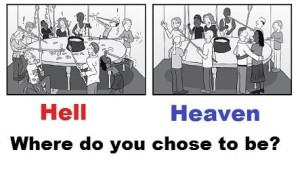
    Heaven HellLong ago a person wanted to see how heaven and hell were. An angle obliged and granted the wish. Person was blindfold and was sent to hell first.

    When the blindfold was removed, person was standing at the entrance to a great dining hall, full of round tables piled high with delicious foods of all kinds.

    The person noticed that, people seated around those round tables but their bodies were thin, and faces gaunt and creased with frustration. Each person sitting on dinning table held a spoon though their arms had no elbows and the spoons were four feet long. These people could reach the food on those platters, but could not get the food back to their mouths.

    Next the person was sent to the heaven. In the heaven the entrance to the dining hall was big, it too had round tables with piles of lavish feast as hell had. Here too people did not have elbows in arms and they were holding long spoons about same length as the hell. The person noticed that the people in heaven were plump and happy, the dinning hall was full of joy and laughter. Situation in both – Heaven and Hell were similar, however there was difference in the milieu, the reason?

    The difference between heaven and hell was – the people in heaven were using those long spoons to feed others so effectively everyone was full, plump & happy.

    Source of the story is AnomalyBeta and LinkedIn

    So, if we take the concept of interdependent co-arising as the core of growth, capitalism or communism or any economic structure we follow we will surely have inclusive growth. The catch here will be – value of money will decline, and exclusivity (as marketing or demand / supply concepts of economics) will play in different fashion. In whatever case at least the basic necessities hopefully be fulfilled.

    Other blogs on inequality – The Price of InequalityNot so trickling down!, Economics concepts and equality and Has the time for this idea come? and Inclusive growth

  • Collective Materialism – likely future of economy!


    I have written about socialistic capitalism or capitalistic socialism. When I say that I simply mean that we would move our economies and businesses in a direction where there would be a balance. It would be a kind of middle path where enterprise would exist at the same time there would be a concern for the society and social development. Take an example of corporate social responsibility (CSR), however the word CSR would become more of a practice than a statement in annaul reports. The reason for the same would be – we are all connected. If I do not earn how would bank generate savings? If banks do not generate saving how would they offer loan and so on. In terms of Buddhism it is similar to interdependent coarising.

    In more sophesticated words the tripple bottomline would be the corporate mantra in future enterprise. I thought of an example which could be the model for this concept of triple bottomline. I happen to read corporate philosophy of Sahara India Parivar – “Collective Materialism”. This company is very interesting and different – it calls itself a family and everyone is a worker first. According the the website of the company the philosophy of collective materialism is as follows –

    “In any human relationship, it becomes imperative to take into consideration the materialistic aspect of life – we do so but by giving it second priority.

    The first priority is given to emotional aspect and with perfect blending of materialism with emotionalism results in continuous collective growth for collective sharing and caring, that gives an impetus to our philosophy.”

    On a lighter note collective materialism is not what Government of India doing – filling pockets of few select few (so it is collective and materialism both) Sahara shree – Subrato Roy – deservers the credit for this philosophy.

    Related blogs

    The middle path

    Balancing act

    Cause…

  • Business Value system – Integrity


    “Integrity is very important in GE and the fastest way to get fired in GE is ‘NOT sharing knowledge/information’.”

    I have seen mission, vision and value statements of many companies. Occasionally, I have seen a word which seemed alien to me in that – integrity. I was wondering on the concept of Integrity and how it relates to business value system in the cut throat competitive world? I asked this question to Dr Ianna Contardo my professor of global business strategy and Associate Dean of the SP Jain Center of Management GMBA in Dubai. I had a brief nevertheless holistic discussion on the same. Her answers to few of my questions reinforced my approach on Business to the Buddha.

    In her opinion integrity is – unifying abstract projections of the wholeness of the identity of the being. It relates to how we behave and act in the world, align to the commonsensical approach that we are a ‘continuation of humanity’.

    This definition of integrity seemed very humane to me and therefore less business oriented. My apprehensions also echoed from the questions few people have earlier asked me, how social and commercial aspects can go hand in hand e.g. business to the Buddha. So I asked, can you please elaborate on ‘continuation of humanity’. She said – we are parts of the whole, that turns our life meaningful and transforms our existence into a multifaceted thinking, diverse interdisciplinary environments with its reach on bountiful examples of doing good through business. The statement reverberated (especially – we are parts of the whole) again to Buddha’s lessons to me. Moreover, it connected to the business very effectively.

    Then how to associate competition with integrity, how to respond to competition? There is no turning back on the values for a business and if integrity is one it also applies to fulfill expectations of all the stakeholders (including the competitors). Integrity plays a balancing role in creation and the future of business would be balance between business and humanity. CSR, social enterprises and NGOs are the initial first few steps towards the same.

    Poetically, she referred to a song and summed up – In a way, integrity represents the tipping point, the fulfillment of this prophecy whereby once you think of yourself as an accomplished ruler you will end up in the misery of solitude. On the other hand, if you walk your talk and you are that integral part of the whole, you do get to fit. Strategically, enhancing the experience of the Buddhist approach to existence is common to that of using your know-how in business. If you do engage with the rights and wrongs, learning will take place.

    What lesson I take out of this discussion was – integrity is not just a word in the dictionary of business it is actually getting into the business value system. As we are progressing in time the concept is becoming prominent and businesses are also evolving as humanistic institutions.