Tag: Cricket

  • Work, games and spirituality


    It was a pleasant evening of  summer vacation in 1996. We were playing cricket as usual. We were about 15-16 boys and kids of our colony. Few of us were in teens, me and my friend used to lead and divide team and lead them to play against each other. My friend – an all-rounder – was a very sincere, serious and fully dedicated to the tasks given and therefore respected by all friends alike. I knew his this nature because we were together in NCC too. This event happened 20+ years back. Yet I remember the day, because it taught me about work, games and spirituality. Though it took me 20+ years to learn the lesson.

    That day in the very first match of 6 overs, we’re all out at 8 runs score. This was the first match for evening, my team discussed to lose this match and we will play next better. We’d given up even before beginning our bowling. I took the first over, and bowled slow delivery to my friend. He understood our thought process, instead of playing the ball, he caught the ball and threw it at me angrily. He said – if you want to play, play seriously! If you dont, either I or my team wont continue playing with you guys. Go back bowl like you would otherwise!

    Actually it hurt my ego. I felt humiliated and realized that they too deserve a fair play. So, this time around – knowing that we are going to lose – I bowled the best I could. In first over we took 4 wickets and gave away 2-3 runs. Our team size used to be 7-8 mostly. So, we realized we are in the game! But the problem was – my friend was still on the crease and we had weak alternative bowlers. We’d no chance, I gave the ball to my bowler and went to field at boundary (long on).

    I don’t know what was going on in my friends mind, whether it was his overconfidence or desperation to finish the game quickly he hit a big shot. I ran like mad to catch and jumped to catch the ball, bruised myself but my friend was out. This was the moment – similar to Sachin Tendulkar’s wicket in 90’s for Australia – we realized even with 8 runs score and 29 balls spare, we can win. It was just a matter of few more balls and we won.

    The lesson

    I learnt a lesson when I was reprimanded to immense humiliation. Though I could comprehend the learning only now when I read an interpretation of Bhagavad Gita Chapter 4, shloka 22 by Sri Sri Ravi Shankar (Guruji). A friend of mine from The art of living shared this interpretation with me. I am sharing a select part of the message which can help identify inference.

    यदृच्छालाभसन्तुष्टो द्वन्द्वातीतो विमत्सर: |

    सम: सिद्धावसिद्धौ च कृत्वापि न निबध्यते || 4.22||

    yadṛichchhā-lābha-santuṣhṭo dvandvātīto vimatsaraḥ

    samaḥ siddhāvasiddhau cakṛitvāpi na nibadhyate (4.22)

    “Being free of jealousy, having that equanimity of mind, Arjuna, do your job!”

    …When you don’t think whether you will succeed or not, you will be able to give your hundred percent. Often it is the result which makes you not give your hundred percent… If you know you are going to lose, then you will not be sincere about playing the game... When you don’t worry whether you win or lose, or you don’t even consider its effect, you give your hundred percent, that is really playing, that is a real game.

    “It is the same with work. Work has to be like a game.”

    A yogi considers even his work as a game, so be a yogi. Yogi means ‘one who does things in perfection.’ Every little thing he does will be perfect because he has that equanimity of mind. Only when you consider your work as a game, can you ever be detached about whether it is going to be successful or not. It doesn’t matter anyway.

    My friend taught me the above lesson – I learnt and understood that lesson recently.
  • Impermenance


    Recently, I relocated from Posh South Mumbai to Suburban Mumbai. There were reasons for this move. I used to travel 2+ hours one way in different public transports (a meager 35 KM distance). Not that I cannot afford a personal vehicle (or can not drive); I do not want to buy one. Considering various issues in Mumbai (India) – parking, traffic jam and notwithstanding petrol prices.

    So, after a troublesome one year travel of 4+ hours each working day, I decided to move on from the coveted South Mumbai (SoBo) to Suburban Mumbai. Now I travel 20-25 min (walk). Considering the kind of horrible experiences I had in last one year, this was a wonderful change. Alas! it had cost associated with it. (If you want to achieve something you have to let go of something else!) One one side I was happy that I am saving more than 3 hours of travel daily but the flip side was the kind of royal life e.g. three swimming pools (one Olympic size), track (again Olympic size well maintained) Golf Course at backyard (yes you can see a hole from 1 window of my bedroom), Happening place etc etc.

    I knew since day one of shifting to SoBo that I cannot afford it and I don’t belong here (at least currently). I always knew that this is not a permanent place for me. However, when I moved out of that comfort I felt strange as if that was my permanent abode. While I am yet settling down in Suburb, I know this is also a temporary abode (rented apartment). Yet, slowly we try to settle down as if we are to stay here forever. This transfer taught me good lesson on impermanence and our inability to come to terms with life and change. Change is difficult and change makes us uncomfortable.

    As an individual I found a very important change difficult; this must be even more difficult for organizations where many do not even realize the need for change, many are not willing to change and many just can not withstand change.

    Now I remember my MBA Marketing class with Prof Lopez, even more. He told me – “Pravin Marketing is like playing golf, you need to swing naturally.” Now there is no Golf course view from my bedroom and I did not move out of SoBo Naturally! Everything is impermanent even Sachin Tendulkar (God of Cricket) playing Cricket for India.

  • Cast(e)ing doubts – Color of skin


    This blog is in the series of blogs on – against – the caste system of India. Though this blog is on a Western Social Challenge. I wish some day we would value people on their

    Capabilities and not Caste
    Action and not Ancestry
    Character and not on Color of skin

    That we all connected there is no two (non-duality) no big vs small no higher vs lower. So let us first understand what is one of the challenges before we reach there.

    We first bought National Panasonic Cassette recorder and player in 1991. I was 11 years that time, I started listening to songs specially – Mukesh, Lata and Michael Jackson. Being a Hindi medium 6th grade student English was literally a foreign language to me. But, who heard MJ for lyrics the music was enough. When I came to know about Michael Jackson’s plastic surgery I came to know about the racial issues out side of India. Well, I was young so never thought about racial discrimination. In 2007 I watched “To kill a mocking bird” and heard speech “I have a dream” of Martin Luther King Jr. That time I realized how deep rooted the problem of discrimination was. Than in 2008 Obama won, seemed as if there is a hopeful positive movement, how much? I cannot comment on that, I have never been to the US.

    Recently, I watched a movie Invictous. This movie is based on true incidents in South Africa. Nelson Mandela was elected as President of SA. SA organized rugby world cup in 1995. The idea was to bring black and white people of SA together – through the language of sport. Those who are from countries where Cricket is played might remember that in 1992 South African team again joined international cricket. Reason – in 1970s ICC removed SA cricket team due to racial discrimination “Apartheid“.

    One of my friends later told me about Muhammad Ali, that Ali was a born Christan but changed his religion. Well, I rarely enjoyed watching boxing so was mostly unaware about the greatness of Muhammad Ali, anyways. When I heard about he changing religion I went one step beyond. I felt that we humans would remain like that. Currently we are fighting on supremacy of religion. Each religion has different sub-sects Muslims has Shiya and Sunni etc, Christans have Catholic and Protestants etc, Buddhists have Hinyan and Mahayan etc. Jains has Digambar and Shwetambars. Hindus? Well we have many sects and many caste based devision. In future we would fight on supremacy of the sub-sects (currently too that happens Syria, Iraq, Caste system in India etc) What we need as humans is increasing our consciousness we all are born equal – as humans. We need to respect each other as humans. Next if you need to value someone more and other less. Value him or her on

    Capabilities and not Caste
    Action and not Ancestry
    Character and not on Color of skin

    And of course other qualities rather than somethings on which a baby may not have control e.g. color of skin and caste of birth etc.

  • Connecting the dots – innovation


    This is the third blog in the series of Connecting the dots… which started from way off the track blog on cricket.

    You see how things and ideas connect to one another. I was wondering about cartoon channels. These channels show many foreign based cartoon series and the characters are very famous amongst children. Ask kids – “Pokemon, who is this?” and see their reaction as if you are an alien, ‘oh! you don’t know Pokemon?’ And “world becomes their stage” they would show all the trademark actions and dialogs of the key characters of the series. Well, I don’t see any issue to this however it made me think on a tangent. The tangent resulted in an earlier blog on Cricket… another on “Amar Chitra Katha” and finally here I am writing on innovation. I connected the dots and here I am. The dots are as below –

    Cartoon Channel -> Blog on Cricket -> Amar Chitra Katha -> an article by Darrell Mann -> Blog on Innovation.

    Darrell Mann

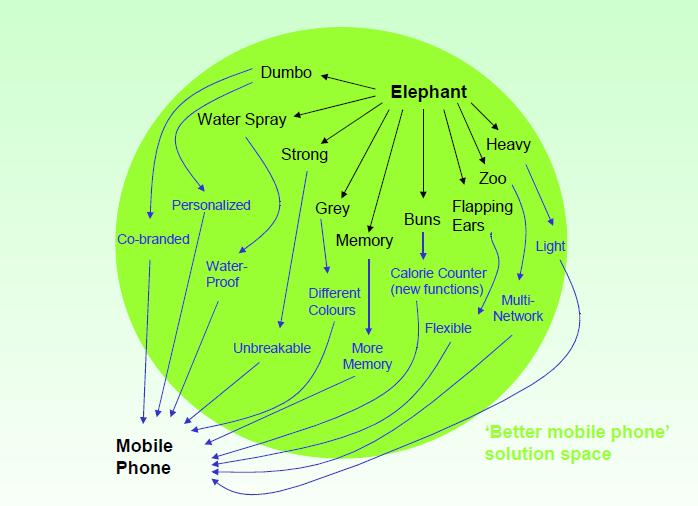
    Once in a tutorial Dr Darrell Mann (a renowned TRIZ expert and professional) created a solution space for Better Mobile Phone starting from an Elephant. Surprised! Yes he did that in 2006 in a tutorial session. And if one knows how to connect dots one can design/formulate or conceptualize faster and better.

    I started thinking in the following fashion –
    ‘why we do not have any local Indian Character?’ I asked myself. Then answered to myself – ‘Hello! do people know that Chess and Badminton are conceptualized in India? Well in India Cricket is a sport rest are time pass. Perhaps true! How many notice, that the first archery competition in world happened during the time of Mahabharat, when Arjuna hit the eye of a fish. Oh! Olympics, from 1996 onwards in each Olympics India brought at least one medal home’.

    1996 – Peas
    2000 – Karnam Malleshwari
    2004 – R S Rathore and
    2008 – a few… who were they? Let me ask people if they recall names of these sports men/women

    Mahabharat, cartoon characters and kids not knowing about the Indian Mythologies – wow! that was what was the premise on which Amar Chitra Katha was born.

    Innovation requires flow of thoughts, flow of thoughts from different directions to a solution or an offering (Product/Service). However, we cannot rely on random thought and free-will for solutions. We need solution better and faster. Innovation requires open mind, ability to connect dots and think and look beyond obvious. At the same time it does not mean innovation is a play of experts, if someone is open and willing to learn one can learn approaches to be innovative. All the freewheel thoughts were the random stimulus and I connected them in the form of blogs – Cartoons, Cricket and Amar Chitra Katha.

  • A tree is only as strong as its roots


    Have you heard this saying before?

    This is the second blog in the series of … wait for it… (updated on Jan 2013) Connecting the dots – innovation

    Well, to continue from the earlier blogs – Cricket… here I am to write the next in one which takes off from the Amar Chitra Katha.

    Why Amar Chitra Katha? Because it relates to me on two levels. One on Business and the other the Buddha… As an innovation consultant I observed that innovative ideas not necessarily become successful revenue source. There could be many reasons for the same. One most important point for constant innovation and healthy top/bottom line is understanding the customer, understanding their overt and covert needs. That is what Uncle Pai could do with the concept of Amar Chitra Katha. No doubt he had a noble cause at the center. However, he also knew the need gap and could fulfill the same. So effectively, he was one who could understand the consumer insight and voice of the customer.

    I loved reading the comic and magazines by him and I was unfortunate that even though I lived in Dadar for a long time I could never meet him and when I heard about his sad demise I was not in India.

    Part two of Amar Chitra Katha is the Buddha. Again reiterating the fact that when I say “the Buddha” I do not restrict myself to the Buddha only. This relates to every possible concept which connects us more on a higher plane above our made so called ‘religion’. Amar Chitra Katha was born for all round development of kids. Read any story it would be either for knowledge, imparting some lesson or last but not the least to develop the habit of reading. Uncle Pai took this root as an obvious path – stories are easy to remember, kids (at least that time – 60s-70s) used to hear stories (Dada Dadi ki kahaniya) – when Jatak tales were used by the Buddha why reinvent the wheel?

    A to Z mysteries 1A to Z mysteries 2A to Z mysteries 3A to Z mysteries 4A to Z mysteries 5, A to Z mysteries 6,


  • Cricket is a sport in India rest are time pass


    Spoiler alert! Answers to the question posed here are below, please do not spoil the fun of the post… Believe me I knew the answers to many of the questions asked below…  This is the first blog in the series of … wait for it… (updated on Jan 2013) Connecting the dots – innovation

    1. What is the ATP ranking of an Indian men’s singles player, after recently concluded French Open? (First tell me his name…)
    2. Who won the lone medal in Olympics in 2000 for India?
    3. What was the score of Abhinav Bindra when he won the Medal in Olympic in China? Well, can you answer when did China Olympic happen?
    4. Who are the other two members who won individual medals in Olympics for India (this post was written in 2011 June)?
    5. Which games played in international arena are originated in India?

    On the contrary if I ask questions on Cricket (which I do not follow that much after 2003 world cup Final defeat of India) –

    1. who hit 6 sixes in an over for India some time back, in an international cricket tournament, which was the opposing team? This seems easy to even me to answer. Even there would be people who would tell me name, location, scores of winning and loosing teams and even the run/wicket difference etc etc. which I didnt even ask here.

    2. Let me ask little more difficult question. What is the name of one daughter of Lara. Brian Lara named his daughter after name of a city, why? This is kind of difficult, Very difficult question.

    Do you have answer for any of the above questions? Well, without the Google Search. Mostly Cricket related questions are answered easily by Indian people. Therefore, I say “Cricket is a sport in India rest are time pass.” No offenses against other sports women/men. How many would agree with me on this statement?

    I guess the number of people able to answer the above questions on cricket would be more than the number of people able to answer the question posted in first few lines. Take a random sample. So what is the reason.

    Now let me come to the other part which relates to me and I wanted to write about. “Amar Chitra Katha” was started by Uncle Pai on the same premise. He observed that kids participating in a quiz contest were able to answer questions related to Greek mythologies however they were not for Indian mythologies.

    There is a saying in Hindi – Ghar ki murgi dal barabar meaning: Self possessions are always undermined and other’s possessions seem better. I think when I am writing this I look like a representative of political faction BUT I AM NOT. We need to learn our own culture better before looking beyond. I love Amar Chitra Katha on which I will write later…

    Answers are as follows –
    1. Somdev Devvarman ATP ranking 67,
    2. Karnam Malleshwari in Weight lifting, medal – Bronze.
    3. Find out yourself, now at least Google it 🙂 in case you do not know
    4. Leander Paes 1996, Tennis (of course) Bronze Medal Atlanta Olympics 1996 and Major Rajyavardhan Singh Rathore doubletrap shooting Silver Medal 2004.

    The sports originated in India and played internationally (at least the following two)
    1. Chess
    2. Badminton (How many of you know the fathers name of a Bollywood actress who won All England Badminton competition) – Prakash Padukone
    3. I am not sure on this (and I didnt Google Search it) – Horse Polo is also originated in India

    Cricket
    1. Yuvraj Singh, Against England in T20 2007.
    2. Sydney after scoring 277 runs in Test Match, try Google for the year (at least you can do that)

    Answering questions of sports – other than cricket  – by people of India is difficult. And therefore I say “Cricket is a sport in India rest are time pass.” I apologies for the sports people of other sports, this is just an effort to bring this to the notice of WE THE PEOPLE…

    Further blogs on – we the people and Amar Chitra Katha…

  • ‘Balancing act’


    This is one of the stories shared by Prof Mankad with me.

    Once on his tour, the Buddha was resting in the shade of a large pipal tree. Under a nearby tree a group of dancing girls was also resting. One of the apprentice musician girls asked the leader of the group, “How do I tune this string instrument?” The head of the group, a ravishing beauty of a dancing girl, obviously with limited virtue and ignominious fame said, “do not stretch it so much that it breaks and do not leave it so loose that it does not play”. Buddha hearing this went to her and bowed to her with respect. His disciples seeing him bow to a very infamous character were disturbed and intrigued. When they asked Buddha about his behavior, he said, she taught me a valuable lesson in life.

    This story tells us a very valuable lesson. The lesson of balancing act, I recalled the recent incident of Cricket test match between India and South Africa. In that match Indian player Sreesanth and South African player Graeme Smith had an altercation. For this incident Indian Cricket team captain M S Dhoni made a statement in press for Sreesanth – “…there is nothing called over aggression till you don’t cross the limit. There are guidelines which need to be followed. You need to be yourself but at the same time shouldn’t get into others’ space…”

    The balancing act also applies to businesses in terms of product portfolio, organizational behavior and a balance between business and social responsibility (triple bottom line). This also applies to individuals e.g. work-life balance.

    The other important lesson to learn from the story is – one can learn from wherever one wants to learn from and no one is old or young to learn from. This is what an earlier blog suggested – Learning… and possibility thinking.