This is a repost of author’s article on LinkedIn – Question your assumptions.
In 2008, in the winters of Pune, I along with one of my friends were having sumptuous buffet dinner in a restaurant of the hotel. In the candle lights and gentle music of the restaurant we discussed the lighting of the hall. This hall was lit with yellow colored lights not so bright, neither dimly lit. My friend asked me why the height of this restaurant room is more than the rooms of the hotel rooms upstairs? That was an interesting question I never asked this question to myself or to anyone else.
Next day we were sitting in a meeting for exploring possibility of licensing some IP of my friend with another interested professional group. We finished the meeting late in the evening. After the meeting we had some snacks and went out for a walk. We were speaking on various issues right from our meeting and way forward to how is his business going and what are my plans, I was planning to do my MBA at that time. It was evening, therefore in a while street lights lit up. The moment these lights lit, he suddenly asked me – “have you ever thought why these streetlight pole are this tall? Why these poles are say X meters and not 2X meters or X/2 meters in length? Can you think of possible reasons for the height?” I tried some possible answers as per my knowledge. However I didn’t know the actual reason, so I requested if he can tell me.
 He said, the length of the poles have not been change for almost a century. In old days there were some type of streetlights that gave best illumination (light rendering) on road if the bulb is kept at a certain height. Though in the whole century technology of bulbs have evolved not the length of the poles (specially in India).
I asked him, so why not change the length of these poles? Is it a rocket science to find out best illumination for current street bulbs? He said, now for the current technology length of pole can be reduced to about 70%. Just imagine if we save 30% of steel on each pole how much we can save? That was an interesting idea.
This dinner, meeting and walk as a whole taught me a lot. My friend was so thoughtful that he questioned many assumptions. He could convert these questions into useful opportunities. I realized that an innovator is always on a lookout to question the assumptions. Why are we doing this thing or that thing? Why are we doing this in a particular way. He is always looking for some workaround, solution or better way of doing it or multiple ways of doing the same thing. Occasionally this results in breaking the assumption themselves.
In past I – along with some of my colleagues – was working on a business model, we had thought of some possible monetization approaches. These approaches included what assumptions we have in our mind, what is the target market et al. When we went to the market our prospective clients (partners) started giving us more options, create more slice and dice of the services, customization of offerings/schedule of charge. Initially, we were somewhat restrained we were reluctant to consider the ideas / service offering charges with reservations. Slowly we started accepting this. It was interesting to see these slicing and dicing by prospective clients. They were creating more opportunities for us. They were unwittingly helping us explore more possibilities.
There were learnings in these experiences. The challenge we face many a times are not outside, the challenges are our owns assumptions. When we start looking at things in a different perspective, when one starts questioning assumptions new opportunities emerge. An open mind provides opportunity for innovation as well as doing business in a better way – so Question your assumptions.
Image source – http://s20.postimg.org/bmt4ul5ot/IMG_20140216_WA0000.jpg
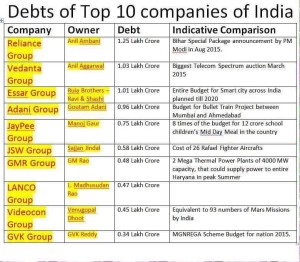 This event and the total debt (sourced from a LinkedIn post above) makes one seriously think – is it true that “The wall streets fraud” as Bernie Sanders US presidential candidate has said earlier? In India, we have very contrasting examples – one side there were many farmers who were committing suicide because they couldn’t repay loans and on the other side we have banks with NPA (Non Performing Assets) & professionals who do “Corporate Debt Restructuring” resulting in many if not all NPAs in future. At present Indian PSU’s NPA is more than their Market Capitalization.