Tag: buddhism

  • Karma


    The Endless Knot

    Associating Karma with financial success seems completely falsified way of using the doctrine of Causality.

    I was reading an article and it referred to financial success of people as the results of their Karma. Specially when we speak of “Karma” the context is effect of past life on the current one. Additionally, Karma of current life influencing the future life.

    The conceptual explanation of financial success of people to their Karma made me question the concept of Karma itself. Does Financial success mean everything and is the END in itself?

    I believe – Not necessarily.

    I have seen kids playing with mud, plastic bottles & almost without cloths very happy and kids with LEGO toys at home crying for something else. Just let the kids be little old and see adults or old aged people – they start grumbling about money! But we forget we leave empty handed. Karma in my opinion should be construed as – something that will help us progress. Progress spiritually – if finances help in spiritual progress – be it. But otherwise putting the whole concept of Karma around Financial success is not agreeable.

    Specially, when west misunderstands the concepts and tries to prove every point of their belief using concepts such as Karma – I remember Ashtavakra. I remember reading that Ashtavakara in his Geeta denied the concept of Karma.

  • Morality, who is the judge?


    There is an after life, actions in past life have decided your current birth (Prarabdha) and future life will be a function of what you do in this life time. Does this philosophy remind you of something?

    The above is concept of re-birth, of almost all religion founded in India – be it Buddhism, Jainism or Sikhism no doubt Hinduism too. So, there are many questions around this. Personally, I believe in concept of rebirth but I have not understood the concept fully. What defines morality and who defines it, who and how my actions will be judged for next life? All these questions puzzled me, for few months.

    Just to give you a perspective here are few examples. 1. Say I eat non-veg (I don’t). But I don’t kill, I buy “Godrej” packed chicken. I never killed the chicken, who would take the blame of this killing? The poor fellow who killed that chicken; did it for his survival. Who would judge this situation. 2. A company does experiments on animals comes up with a cancer drug, animals are killed but many human lives are saved (prolonged to be more precise). Who to blame – the patient who fell sick of the disease of cancer (due to his misdeeds), the company (researchers, investors) or whole humanity? 3. Now replace cancer with AIDS. 4. Extra-merital affair, who to blame, if it is consensual who would decide the “punishment” for next life? etc

    I have been wondering about this, who decides what wrong I/someone did for decision on next life etc. At times, I say to myself “forget it! we get fruits of our deeds in this life time only, don’t worry about next life.” Than what happens to the belief of rebirth? Well, these questions are currently beyond me, while puzzled, I came across this video of Sadhguru so hope this question of morality dies here! Which actually has not died yet. May be I’d write on this in future too.


  • Cast(e)ing doubt – What’s your (last) name?


    In a lift one person, an old 70-75 year or so, looks at the other, smiles and thinks – New guy in the building! Looks educated ‘I can talk to him’. He asks – What is your name?

    Other person responds – Pravin

    Old man – Pravin what?

    2nd person – Pravin is my name.

    2nd person looks at the old man with a question mark on face, what does that mean?

    Old man – I mean your last name?

    2nd – I call myself KRD Pravin and my friends call me KRD (at times KRD P).

    Old man stares with a complete blank (!) and question on face?

    2nd person continues – Does not it sound like JRD (Tata)? One step ahead, that is in alphabet “K” comes just after “J” right? Smile!

    Old man – what does KRD mean?

    2nd person – KRD stands for my last name and father’s name.

    2nd person smiles and the old man insists on an answer.

    Old man – Ok! But what is your last name?

    2nd person (possibly getting the hint of apparent insistence now) – so you wanted to know my last name and not the name, is that right?

    Old man completely taken aback by such question, because he was only interested in the last name. What goes on in the mind of old man is – ok lad looks educated, but does not have manners, arrogant!

    Perhaps the old man is thinking – “I have a suitable girl for him in my mind?” Wait without knowing if 2nd person is married or not, how can one think like that? Anyways jokes apart.

    This is the reality, of few discussions (elevator talks). People are more interested in what someone’s ancestors did than what this young lad is doing? This is the problem of our caste system.

    I writing a series (on and off) of blogs on – against – the caste system of India (include black skin for other parts of the world). This is another installment in the series.

    One of my school friends (this is not a fiction he was indeed like this) used to make friends based on last name, he at times used to ask “what are you people? (that is you belong to what/which caste?)” If the other person does not fall in “his choice of category” he wont make friends with them. His selected types were – Hindus (in religion), Vaishya, Brahman and Kshatriyas (in caste). In the language of Indian quota system – he wont make friends with SC, ST or OBCs. I was surprised but well I made a note of this!

    I think we all were forest dwellers, once farmers. A blacksmith and mason is nothing but present day engineer. The more we developed the more we regressed actually! Even before the baby is born – he/she is black/white/sub-continent dweller. The day a baby is born we tag him/her as Christian/Hindu/Sikh/Muslim etc. Next tag is more clarification – You are a Shwetambar Jain, Or Saryuparayan Bramhan etc.

    What is this – why we do differentiate on caste? In India there are temples where even Hindus (shudra/Dalits/Untouchables) can not go. All over India this is widespread.

    Dalits give ‘donation’ to enter temple 2013 – The Hindu

    Dalits told to keep distance from temple 2013 – Times of India

    Dalits enter TN temple first time in 100 yrs – Times of India

    Below two news are almost same difference is the year. News from The Hindu newspaper site (by far the most respected and authentic newspaper in India)

    Dalits enter temple amid tight police security 2013

    Dalits enter temples with police protection 2009

    Tera Bhagvan (khuda) mere bhagvan (khuda) se alag hai!
    तेरा भगवान (खुदा) मेरे भगवान  (खुदा) से अलग है!

    Thy God is different than mine!

    When the creator is different there certainly is comparison – whose God is better?

    Meri Kamiz teri kamiz se safed hai

    मेरी कमीज़ तेरी कमीज़ से सफ़ेद है

    My shirt is brighter (better) than your shirt

    As if God is a trifling shirt or trouser! Who (which) can be better or worse.

    Related blogs –

    Cast(e)ing doubt –  everyone’s tears are salty

    We the societies

    When Buddha dies schools are born

  • Cast(e)ing doubts – everyone’s tears are salty


    I am not an admirer of the caste system of Indian society. The special love affair for that (aversion) goes to the Lingayats (disclaimer – I am a born Lingayat). I am going to write a series (on and off) of blogs on – against – the caste system of India (include black skin for other parts of the world). Here is the first such blog. This story is from Chapter 43 of the book Old path white clouds by a Vietnamese monk Thich Nhat Hanh. The book is on the life of the Buddha.

    In brief – The Buddha accepted an untouchable named Sunita, to his Sangha (in India 2500 years ago). It created a lot of uproar in Kingdom of King Pasenadi (Kosala) who was a devoted follower of the Buddha.

    Everyone’s tears are salty
    When The Buddha and his bhikkus were passing by the river Ganga they saw an untouchable person – Sunita (a person carrying nightsoil). when the Buddha started walking towards him, he ran farther away from the Buddha. When Sunita could do no more, he kept the nightsoil buckets on one side and hid in the river.

    Sunita “Lord, I do not dare come closer. I am an untouchable.”
    Lord, I do not dare come closer, I am an untouchable

    The Buddha walked right up to the water’s edge and said, “My friend, please come closer so we may talk.”
    Sunita, joined his plams, protested, “Lord, I don’t dare!”
    The Buddha asked – “Why not?”
    Sunita replied – “I am an untouchable. I don’t want to pollute you and your monks.”
    The Buddha said – “On our path, we no longer distinguish between castes. You are a human being like the rest of us. We are not afraid we will be polluted. Only greed, hatred, and delusion can pollute us. A person as pleasant as yourself brings us nothing but happiness. What is your name?”
    Sunita said – “Lord, my name is Sunita.”
    The Buddha asked – “Sunita, would you like to become a bhikkhu like the rest of us?”
    Sunita said – “I couldn’t!”
    The Buddha – “Why not?”
    Sunita – “I’m an untouchable!”
    The buddha – “Sunita, I have already explained that on our path there is no caste. In the Way of Awakening, caste no longer exists. It is like the Ganga, Yamuno, Aciravati, Sarabhu, Mahi, and Rohini rivers. Once they empty into the sea, they no longer retain their separate identities. A person who leaves home to follow the Way leaves caste behind whether he was born a brahman, ksatriya, vaisya, sudra, or untouchable. Sunita, if you like, you can become a bhikkhu like the rest of us.”

    King Pasenadi was asked by his ministers to protest and reason for this act of the Buddha. The King visited the monastery, while walking in the monastery he saw a few monks sitting under a tree and one monk sharing the teachings of the Buddha. The King was impressed with the monk who was teaching. The monks face radiated great peace and wisdom. This sight was such that King stopped for a while to listen to the monk.

    The King was so impressed with the monk that first question he asked was who was the monk teaching under the tree? The Buddha replied – “Sunita, he was once an untouchable”. King was embarrassed, the Buddha continued – “In the Way of Liberation, there is no caste. To the eyes of an enlightened person, all people are equal. Every person’s blood is red. Every person’s tears are salty. We are all human beings. We must find a way for all people to be able to realize their full dignity and potential. That is why I welcomed Sunita into the sangha of bhikkhus.”

    Even after 2500 years, we still have widespread caste system. At that time there was only Hinduism now you have many religion in the world! Every religion has many sub-sub categories. You have color of skin to differentiate, what more you need?

    Related blogs –

    We the societies

    When Buddha dies schools are born

    Reference in the index of the book – Fo Pen Hing Tsi King (T. 190); Fang Kouang Ta Tchouang Yen King (T. 187); Lalitavistara.

    Image source Old path white clouds

  • Interdependent co-arising intra-country example


    In previous blog “Coalgate…” I touched on the topic of Dutch Disease. The concept of Dutch disease rebounds me to the interdependent co-arising once again (interdependent co-arising means – we are all dependent on each other.). This concept of Buddhism is applicable in every walk of life. If we (each individual) do not understand it we are going to remain in the problems we face. Check previous blogs on the same below.

    Interdependent co-arising farmers example (ground level example) – this blog is about how interdependent co-arising relates to a smaller level of activity of one businessman / farmer. This could be you or me in our regular work environment.

    Interdependent co-arising macroeconomic example (world level example) – this blog is about how interdependent co-arising relates to macro-economics.

    This blog is a country level example of interdependent co-arising (Pali original concept – Pratītyasamutpāda – at Wikipedia).

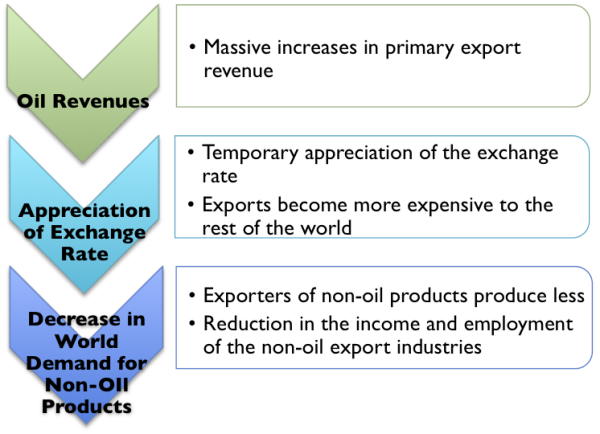
    What is Dutch disease?

    The inflow of capital leads to an appreciation of the currency, making imports cheap and export expensive. The name comes from the Netherlands experience following the discovery of gas in the north sea. Natural gas sales drove Dutch currency up, seriously hurting the country’s other expdutch-diseaseort industries.

    In late 50’s Netherlands found huge source of natural gases. This resulted in 1. investments (largely foreign direct investments) in that sector 2. decline in other sectors e.g. one example could be people moving for jobs in that sector (consider Indian IT sector as reference) 3. investments (specially foreign investments) in that sector resulted in stronger currency. The excessive investment made Netherlands currency stronger resulting in making exports expensive eventually resulting in decline of export from Netherlands. Manufacturing suffered and thus jobs in manufacturing too go to step 2.

    This convoluted – action/reaction and impact at not so obvious industries – example again suggests to us that even if industries are not linked directly they are linked in some way. This link is interdependence. This interdependence should make one value the existence.

    The  “Dutch disease” should make us once again think about the invisible connections we share with each other.

    Image source – http://globalprosperity.wordpress.com/2010/08/19/oiling-africas-gears-for-democratic-change/

  • Border-less world


    Let us imagine, a border-less world. A world where

    Source - http://praditaastarina.files.wordpress.com/2011/08/170580815_bbdabc8038.jpg
    Border-less world

    1. people can move from one place to the other without Visas
    2. goods and services can be bought and sold without import/export duties
    3. education is free (at least basic education)
    4. people would be free to do what they want to do (not taking law in their hand though)

    I believe both the leading economic “-isms” and many spiritual/religious “-isms” have been trying to do that for years.

    The economic “-ism” are capitalism and socialism. Socialists want this by making a world a single big society where everyone is working for the society. Capitalists are trying to do it through Washington Consensus and IMF. Until now the results have been failure. Russia failed, China becoming a capitalist USA (being protectionist) walking on the way to become more socialistic. Seems There could be a middle path where both these -isms are together.

    Religious groups “-ism” are Christianity, Islam, Buddhism, Hinduism etc. Christianity wants the world to be Christan, Islam talks about Universal brotherhood. I am not sure about the other two asking people to convert to their religion though. However, Hinduism talks about Vasidhev Kutumbakam. Vasidhev Kutumbakam means one world family. But the idea all over the world is unity and unifying the world in different ways.

    All this is failing because – the ulterior motives are money or fan following (I mean increasing number of followers of the religion).  Since both they ways seem not working, what if we turn to something else, no politician, no economist and no religious group to lead. People leading the people’s movement!

    Take the following case – Social media for social service, crowd sourcing based funding (crowd funding) and initiatives such as Janlokpal (India), Occupy Wall Street (USA), Jasmin revolution (Tunisia) and Tahrir square (Egypt) etc. If people are empowered yet are asked not to encroach on others freedom. What if we really become an educated world, without politics, without divisions, without borders.

    This may happen if we remove ego and greed from our society!

    Image Source – http://praditaastarina.files.wordpress.com/2011/08/170580815_bbdabc8038.jpg (Apologies for delayed update, it was updated in the image description but not visible on view)

  • The dog and the fox


    Assume (as few may not believe in rebirth) that someone died as a Jew and born again as a Muslim. The soul has only did one thing – changed sides from one HATE group to the other. Remember Jews and Muslims have conflict in Palestine, I am not an expert on international politics so please do not take these statements as expert opinions – concentrate on the moral.

    Please understand – I do not intended to hurt any particular religion or ideology, it was just a story which I read and liked the message – We have enough religion to hate but not enough to love.

    Just to make my point, here is some related story. This is a story I read today (on my old blog account), liked it so here is the story as a blog. The story is from a book titled “The Prayer of the Frog” volume I, By Father Anthony de Mello publisher Gujarat Sahitya Prakash, Post Box 70, Anand-388 001. India.

    We really have so many Beliefs to hate or create identity but rear for love – ‘unconditional love’, or sometime Humanity. We have a lot of things (and religions) – shouldn’t we have little Humanity in us!

    The dog and the fox

    A hunter sent his dog after something that moved behind the trees. It chased out a fox and corralled it into a position where the hunter could shoot it.

    The dying fox said to the hound “were you never told that the fox is brother to the dog?”

    “I was, indeed,” said the dog. “But that’s for idealists and fools. For the practical-minded, brotherhood is created by identity of interest.”

    Said the Christian to the Buddhist: “We could be brothers, really. But that’s for idealists and fools. For the practical-minded, brotherhood is created by identity of beliefs.”

    Most people, alas, have enough religion to hate but not enough to love.

    I used to blog in 2006 also. This blog is from that blog post. Though I did not continue blogging there (at that time the interface was not that evolved for me).

  • Collective Materialism – likely future of economy!


    I have written about socialistic capitalism or capitalistic socialism. When I say that I simply mean that we would move our economies and businesses in a direction where there would be a balance. It would be a kind of middle path where enterprise would exist at the same time there would be a concern for the society and social development. Take an example of corporate social responsibility (CSR), however the word CSR would become more of a practice than a statement in annaul reports. The reason for the same would be – we are all connected. If I do not earn how would bank generate savings? If banks do not generate saving how would they offer loan and so on. In terms of Buddhism it is similar to interdependent coarising.

    In more sophesticated words the tripple bottomline would be the corporate mantra in future enterprise. I thought of an example which could be the model for this concept of triple bottomline. I happen to read corporate philosophy of Sahara India Parivar – “Collective Materialism”. This company is very interesting and different – it calls itself a family and everyone is a worker first. According the the website of the company the philosophy of collective materialism is as follows –

    “In any human relationship, it becomes imperative to take into consideration the materialistic aspect of life – we do so but by giving it second priority.

    The first priority is given to emotional aspect and with perfect blending of materialism with emotionalism results in continuous collective growth for collective sharing and caring, that gives an impetus to our philosophy.”

    On a lighter note collective materialism is not what Government of India doing – filling pockets of few select few (so it is collective and materialism both) Sahara shree – Subrato Roy – deservers the credit for this philosophy.

    Related blogs

    The middle path

    Balancing act

    Cause…

  • Bhavachakra – the wheel of life


    On this buddha Poornima (Sunday 6th May), came across detailed explanation of Bhavchakra. I thought to share it on blog.

    Life seriously is a wheel, is not it? For individuals – Wheel of emotions, wheels of personal development and wheels of social interactions. For organizations and society too this wheel goes on – growth, development and destruction. Check any Indian Soap of prime time, you would come to know what we are surrounded with. It is up to us to learn about this wheel and help ourselves to get out of this – app dipo bhava (be a light unto yourself).

    The following content as well as image on bhavachakra is from this link, which explains it well.

    Bhavacakra or Wheel of Becoming/Wheel of Life is a form of a mandala or tanka (painted wall hanging), used primarily in Tibetan Buddhism.  The painting of a tanka is itself a form of mediation.  Its meaning is very complex, and can be read to represent at least three different realms of manifested effects ofkarmic actions.  It can be read as a diagram for the six different kinds of existence into which one may be born into during the middle rounds of samsara.  It can be read as symbolizing each of the different realms of human existence, lived out by certain kinds of people according to their karmic fortunes of personality type and socioeconomic status.  Or it can be read as a description of situations or states of consciousness that everybody passes through again and again in the course of a single day.
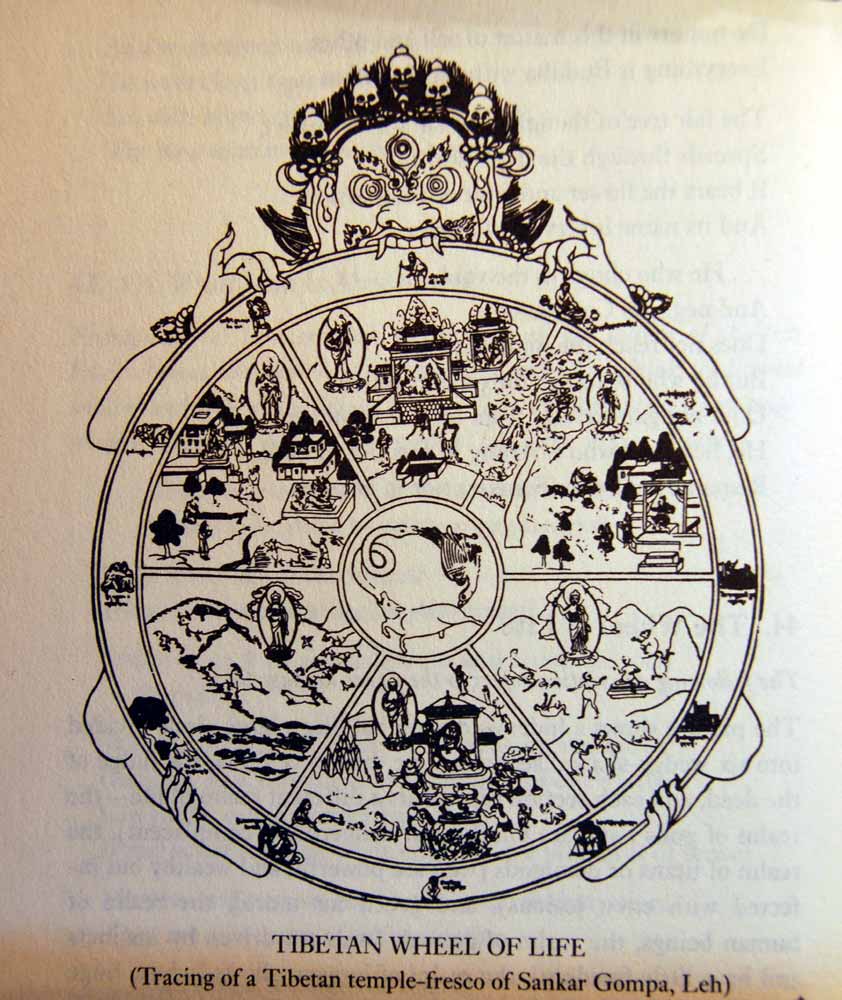
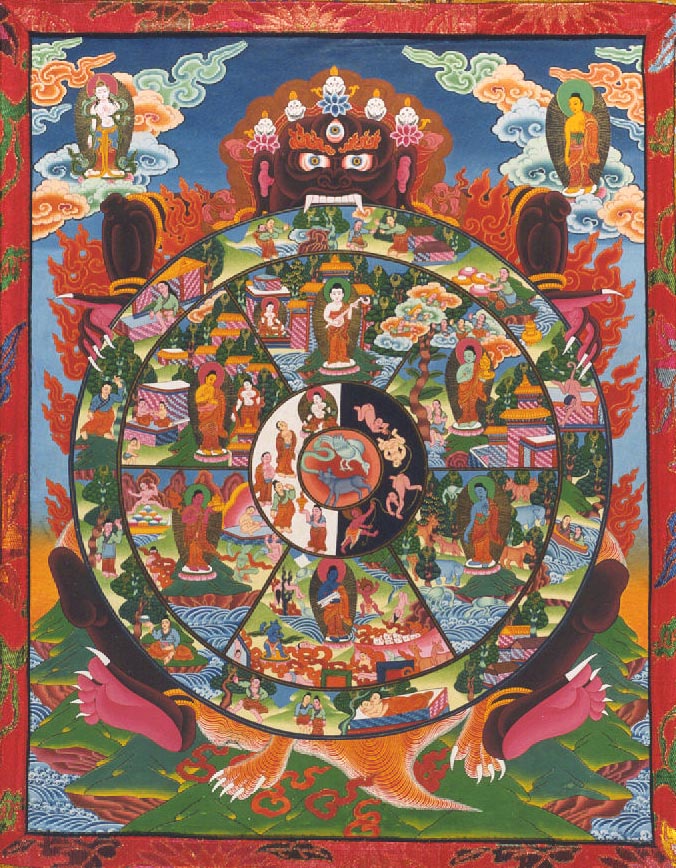
    Its iconographic meaning is correspondingly complex as well.

    In the background are varied Buddhist symbols, such as the moon, clouds in shape of swastika, and always a representation of at least one Buddha orBodhisattva, seen attempting to help sentient beings to find their way to Nirvana.

    The wheel is held by the jaws, hands and feet of the demon, Yama, the judge of the dead, who turns the wheel.  Yama represents the ignorance that comes from greed and “selfhood,” that keeps the wheel of suffering turning.

    The outer rim of the wheel is divided into twelve sections, called the Twelve Interdependent Causes and Effects – 1. ignorance, 2. volitional action or conditioning, 3. consciousness, 4. name and form, 5. six sensory organs (eye, ear, nose, tongue, body and mind), 6. contact or touch, 7. sensation, 8. desire, craving, thirst, 9. grasping, 10. becoming or existence, 11. birth, and 12. decay and death.

    The areas between the six spokes represent the six forms of unenlightened existence.

    There are six wedged-shaped sections, with each representing a different realm of life –

    1. realm of the Gods – Devas (who are blissful but dangerously complacent; always at the top of the wheel)

    2. the realm of the titans, demigods and fighting demons – Asuras (lowest rank of gods, who are powerful and wealthy but infected with envy, jealously, and greed for more; always in the upper half of the wheel)

    3. the realm of “human beings” (always in the upper half of the wheel)

    4. the realm of “animals” (sentient beings, less intellectually advanced than humans, driven by instincts and have little freedom, but can still experience suffering and project karma; always in the bottom half of the wheel; inclusive of birds, fish, and even a worm)

    5. the realm of “hungry ghosts” – Pretas (whose huge bellies but pinpoint mouths and eyes suggest insatiable craving; always in the bottom half of the wheel)

    6. the realm of “hell beings” (who are consumed with relentless rage; always at the bottom of the wheel; beings brought to hell for  past karma, but beings who can escape it through good deeds and reincarnation).

    At the center or hub of the circle is a smaller circle containing the Three Poisons, within a rim of binary demarcation of black and white. The black section represents the Dark Path on which sentient beings are moving downward to the hellish realms. The white section represents the Path of Bliss on which beings are moving upward to the Godly realms. The Three Poisons are personified as a rooster or fowl, a pig or boar, and a snake, chasing one another around and around. They symbolize the forces that keep people caught up in the samsaric round of existence: the rooster stands for greed, the pig for ignorance or delusion, and the snake for hatred.

    The wheel can thus hold distinct meanings, each speaking to different sensibilities.

  • Old path white clouds!


    I was inspired by the book “Old Path White Clouds” and learnt a lot about Buddhism and the Buddha from the same. The concept of the blog also came from that understanding. So, here in this blog I am posting what I felt while I was reading the last chapters of the book –

    When I was reading the last 3-4 chapters of the book, I stopped and was not willing to continue because I did not want The Buddha to die. I was so much connected to the book that I was not reading the book – “I was living the book”, and so I was not willing to let the time reach when The Buddha had to depart. In other words I did not want the Buddha to die (even in the book), it is worth appreciating the way the last chapters have been compiled and written. I realized later –

    1) This (what I was reading) has happened 2500 years ago

    2) The book itself says at various places (repeat various places) that

    i. the thing which has a start will eventually end, if there is birth there is death. So, why am I worried that The Buddha will die or to complete it? Or am I thinking that The Buddha will die when I read those chapters (of course when I was living the book i.e. reading the book, I was in that mindset)?

    ii. Our body is only one manifestation rather a physical manifestation and if the body dies it does not mean we cease to exist

    And I continued to read and completed the book. The book has become a treasure for me, and I have started looking at business from a different perspective. If you want to know about the Buddha and Buddhism the book is a must read.