Tag: balancing act

  • Do what is right in perpetuity


    The class was nostalgic, remembering the last couple of days of sessions of Operations Management with Prof Moradian. Today we were attending his last session of Operations Management. We all enjoyed each session, the quick wits and learnt a lot. We were attending his last session and thus all that was coming to an end for Operations Management.

    That session was very special, I could still hear his one statement very clearly that – “…in your career whenever you have to take any decision, always do what is right for your company in long term…”.

    When I recollect those words from Prof Moradian – “… do what is (make decisions which are) right for the company in perpetuity…” that makes a lot of sense to me. That one statement made me speak couple of tough truths in my career, but it feels good when you consider big picture vis-a-vis to your personal interests.

    An organizations need to learn the art of balancing between the short term sustainability and the long term growth OR short term profit and long term uncertainty. In current economic scenario short term sustainability seems the way to survive, let alone long term growth or profit for that matter. Message seems clear to me – Do what is right for the company in perpetuity.

    Actually this statement equally applies to each individual in life too – we should do whatever is right for us and others – IN PERPETUITY.

    Related blogs –

    Balancing Act – Professor Mankad shared this story of Balancing act with me earlier.

    Fruit will arrive in its season

  • Conflict of interest


    Disclaimer – Author himself is an MBA in Marketing (has been and is in the business of – kind of – selling dreams) and has worked as operations management consultant (has been and was/is/has been facing the challenges faced by operations department)

    I was comparing ourselves as an organization. I am an organization in myself, so are you and Ms Y. I was wondering about the departments Marketing and Operations. Marketing is selling dreams and Operations is capabilities. What I dream to be, could be the job of marketing department and what my capabilities are is the reality of operations.

    There is nothing wrong in dreaming, in fact it is good. At the same time knowing the capabilities is also important, that would help us realize the true potential and opportunities of improvements. Though, how often we dream then review our current potential and then think of building future capabilities to achieve potential? That’s where I think Marketing and Operations Department lock horns.

    An incident reminded me of a lecture of Prof Moradian, long term Vs short term and conflict between Marketing and Operations departments. I started seeing more reasons for conflicts between Marketing department and Operations Department.

    Marketing and Operations lock horns with each others. Because generally Marketing team communicates moon, Sales team sells the idea of “reaching the moon as a reality” to prospect and Operations finds it difficult to do that. Why? Because Operations had the capabilities and was supposed to put the prospect in the sky (not necessarily on moon). Thus, challenges faced by operations and promises made by marketing are different.
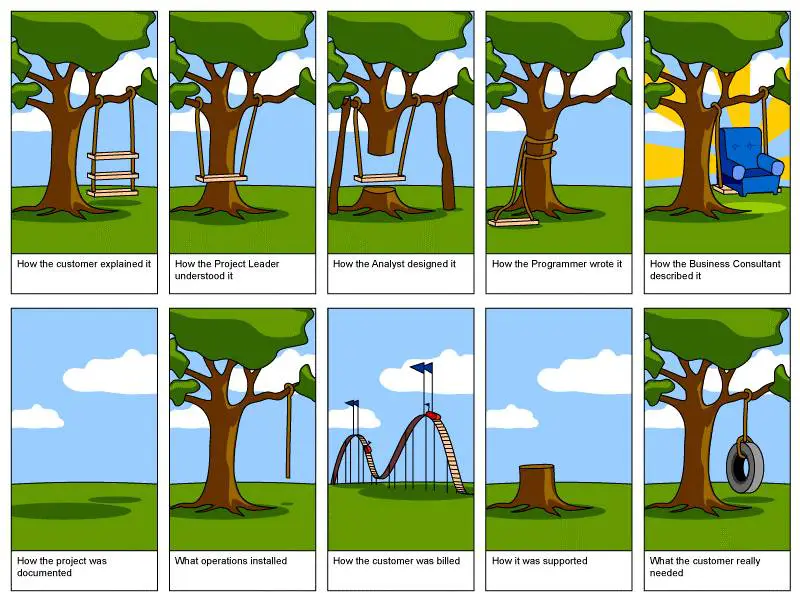
    The second issue is Marketing and Sales team lives on quarter on quarter (Q-o-Q). They have to show the revenue which is the goal for any organization. On the contrary Operations team cannot take decision for one quarter. For example – operations may not say we need infrastructure for one quarter and not in other quarter and thus make huge investment in one quarter and sell those equipment back in next.

    A branding expert told us that marketing managers (brand manager) want to start new brand building exercise (to gain in short term for writing on their resume – ‘I started this initiative’) and move to next level. New manager comes he/she too does the same. Short term gains are there for the marketing manager; yet for long term the brand is diluted perhaps no one knows what would the brand stand for in future.

    This was/is the case of 2008 melt down. Decisions were made on short term with one phrase in each agreement – “systemic risk”. BFSI industry created various certificates (CDR) etc to sell junk to make big buck in short term. Dreams were sold without real fundamentals. In other words, operations did not have the capabilities of generating the kind of returns promised – with a rider of systemic risk – to prospects.

    This is what is conflict of interest for us as individuals – our dreams Vs our realities. The same is true with Organizations – their marketing Vs operations. This is also true for us as economy – our dreams Vs the reality of systemic risk and capacity of economy to fulfill the dreams.

    Image source – http://www.cravingtech.com/blog/wp-content/uploads/2007/11/project.jpg

  • Collective Materialism – likely future of economy!


    I have written about socialistic capitalism or capitalistic socialism. When I say that I simply mean that we would move our economies and businesses in a direction where there would be a balance. It would be a kind of middle path where enterprise would exist at the same time there would be a concern for the society and social development. Take an example of corporate social responsibility (CSR), however the word CSR would become more of a practice than a statement in annaul reports. The reason for the same would be – we are all connected. If I do not earn how would bank generate savings? If banks do not generate saving how would they offer loan and so on. In terms of Buddhism it is similar to interdependent coarising.

    In more sophesticated words the tripple bottomline would be the corporate mantra in future enterprise. I thought of an example which could be the model for this concept of triple bottomline. I happen to read corporate philosophy of Sahara India Parivar – “Collective Materialism”. This company is very interesting and different – it calls itself a family and everyone is a worker first. According the the website of the company the philosophy of collective materialism is as follows –

    “In any human relationship, it becomes imperative to take into consideration the materialistic aspect of life – we do so but by giving it second priority.

    The first priority is given to emotional aspect and with perfect blending of materialism with emotionalism results in continuous collective growth for collective sharing and caring, that gives an impetus to our philosophy.”

    On a lighter note collective materialism is not what Government of India doing – filling pockets of few select few (so it is collective and materialism both) Sahara shree – Subrato Roy – deservers the credit for this philosophy.

    Related blogs

    The middle path

    Balancing act

    Cause…

  • Balancing act… continued!


    Recently, I wrote about the ‘balancing act’ based on the story of the Buddha. I started observing the concept of balance to a greater detail when I received the story from Prof Mankad, and here are few pointers in this continued blog.

    What I have realized in my studies lately is, the “engineerish thinking” (numbers all the time all the way) is not the end in itself. Marketing has long been a function requiring creative thinking. Long time back – before my joining my MBA – someone (talking to me) made a remark – ‘marketing is a bottomless pit, you do not know the return on investment etc etc. Now in the era of result orientation everything is being measured and therefore the results are key for marketing departments too’. Here again creativity should not take toll on numbers. Thus, a balance has to be made between being creative and being critical for return on investment.

    Second thing what came to my mind with reference to marketing, and in general to all of us, was perceptions. While communicating to outside world e.g. marketing companies try to play on ’emotional’ hot button of target audience yet want to be analytical of the effect of the marketing efforts. Again the balancing act comes into play based on the perspective inside out Vs outside in.

    In case of say leading teams, one needs to balance. Leader needs to involve and empower his team at the same time guide when anyone needs help (I wrote about this earlier in blog Growing and becoming leaders). Thus, a balance has to be made between giving power to take decision and taking control of situations when required. I had few things in my mind regarding the same in the language of TRIZ. In TRIZ there is a principle called separation on condition (giving control and taking control based on condition) for such cases. I would write more on application of TRIZ in marketing and sales in some other blog.

    Changing gears, in personal life we manage relationships. At times these relationships come to such a point that we need to act as a funambulist (tightrope walker) to sail through the rough patch of managing the relation. So, balancing act continues throughout the life.