Tag: balance

  • Distinctions


    prayer of frogI have been reading one or the other story of Father Anthony De Mello’s books – The Prayer Of The Frog Vol. I and Prayer of The Frog Vol. II and share the same here occasionally. The books have small and very interesting stories. One of the story I read was on a balancing act is here –

    …..or distinctions.

    A man was doing his Ph. D in philosophy. His wife realized how seriously he was taking his studies only on the day she said to him, “Why is it you love me so much?”

    Quick as a shot he replied, “When you say ‘so much’ are you referring to intensity, depth, frequency, quality or duration?”

    By dissecting her petals no one ever gathered in the beauty of the rose.

    At times you just need to live and not analyze your life – a big, very big lesson for me (perhaps many professionals) to learn.

  • Truth is really something you do!


    I have been reading one or the other story of Father Anthony De Mello’s books – The Prayer Of The Frog Vol. I and Prayer of The Frog Vol. II and share the same here occasionally. The books have small and very interesting stories. One of the story I read was on a balancing act is here –

    ————

    Truth is really something you DO

    The disciples oprayer of frogf Baal Shem once said, “Tell us, dear Rabbi, how we should serve God.”

    He replied, “How should I know?”…then went on to tell them the following story:

    A king had two friends who were found guilty of crime and sentenced to death. Now even though the king loved them he dared not acquit them outright for fear of giving a bad example to the people. So this is the verdict he gave: A rope was to be stretched across a deep chasm and each of the two men was to walk over it—to safety and freedom or. if he fell, to his death. The first of the two got across safely. The other shouted to the first across the chasm, “Tell me, friend, how you managed it.” The first shouted back, “How should I know? All I did was this: When I found myself listing to one side. I leaned to the other.”

    You don’t learn to ride a bicycle in a classroom.

    ————

    Balance is what needs to be practiced by everyone and not one or the other only, that can bring harmony & peace in the whole world.

    Tolerance Vs Being True To Yourself was the title of this weeks LBC (Loose Bloggers Consortium) where currently eight of us are supposed to write on the same topic. I have written on tolerance earlier too when India was facing with media created debate of whether India is tolerant? As usual I write by changing the topic a bit, mostly go completely awry and write; hope mostly it connects with the topic. The seven other bloggers who are expected to write regularly are, in alphabetical order are AshokgaelikaaLin, Maxi, Padmum, Rummuser and Shackman. The title was suggested by Shackman. Do drop in on their blogs and see what their take is on this week’s topic. Since some of them may post late, or not at all this week, do give some allowance for that too!

  • Interdependent co-arising in Ecosystem


    As I have been writing a lot about interdependent co-arising, I came across this video and thought to share it without delay on my blog.

    If you can understand this video you can understand the concept of Buddhism on interdependent co-arising. Please watch this small <5 min video a wonderful experiment. According to the description of the video – When wolves were reintroduced to Yellowstone National Park in the United States after being absent nearly 70 years, the most remarkable “trophic cascade” occurred. What is a trophic cascade and how exactly do wolves change rivers?

    “When we try to pick out anything by itself, we find it hitched to everything else in the Universe.” – John Muir

    An interesting way to explain interdependence. Hope we learn this sooner rather than later that ecology has to be balanced, political, social and religious ideas should also be balanced because perhaps nothing is perfect! I think therefore Mahavir used the concept of Syadvada (doctorine of postulation) and the Buddha middle path.

    Source – Youtube channel Sustainable Human http://www.youtube.com/channel/UCYv_csqWJTSfQK3vOZDJKQw

  • Do what is right in perpetuity


    The class was nostalgic, remembering the last couple of days of sessions of Operations Management with Prof Moradian. Today we were attending his last session of Operations Management. We all enjoyed each session, the quick wits and learnt a lot. We were attending his last session and thus all that was coming to an end for Operations Management.

    That session was very special, I could still hear his one statement very clearly that – “…in your career whenever you have to take any decision, always do what is right for your company in long term…”.

    When I recollect those words from Prof Moradian – “… do what is (make decisions which are) right for the company in perpetuity…” that makes a lot of sense to me. That one statement made me speak couple of tough truths in my career, but it feels good when you consider big picture vis-a-vis to your personal interests.

    An organizations need to learn the art of balancing between the short term sustainability and the long term growth OR short term profit and long term uncertainty. In current economic scenario short term sustainability seems the way to survive, let alone long term growth or profit for that matter. Message seems clear to me – Do what is right for the company in perpetuity.

    Actually this statement equally applies to each individual in life too – we should do whatever is right for us and others – IN PERPETUITY.

    Related blogs –

    Balancing Act – Professor Mankad shared this story of Balancing act with me earlier.

    Fruit will arrive in its season

  • Conflict of interest


    Disclaimer – Author himself is an MBA in Marketing (has been and is in the business of – kind of – selling dreams) and has worked as operations management consultant (has been and was/is/has been facing the challenges faced by operations department)

    I was comparing ourselves as an organization. I am an organization in myself, so are you and Ms Y. I was wondering about the departments Marketing and Operations. Marketing is selling dreams and Operations is capabilities. What I dream to be, could be the job of marketing department and what my capabilities are is the reality of operations.

    There is nothing wrong in dreaming, in fact it is good. At the same time knowing the capabilities is also important, that would help us realize the true potential and opportunities of improvements. Though, how often we dream then review our current potential and then think of building future capabilities to achieve potential? That’s where I think Marketing and Operations Department lock horns.

    An incident reminded me of a lecture of Prof Moradian, long term Vs short term and conflict between Marketing and Operations departments. I started seeing more reasons for conflicts between Marketing department and Operations Department.

    Marketing and Operations lock horns with each others. Because generally Marketing team communicates moon, Sales team sells the idea of “reaching the moon as a reality” to prospect and Operations finds it difficult to do that. Why? Because Operations had the capabilities and was supposed to put the prospect in the sky (not necessarily on moon). Thus, challenges faced by operations and promises made by marketing are different.
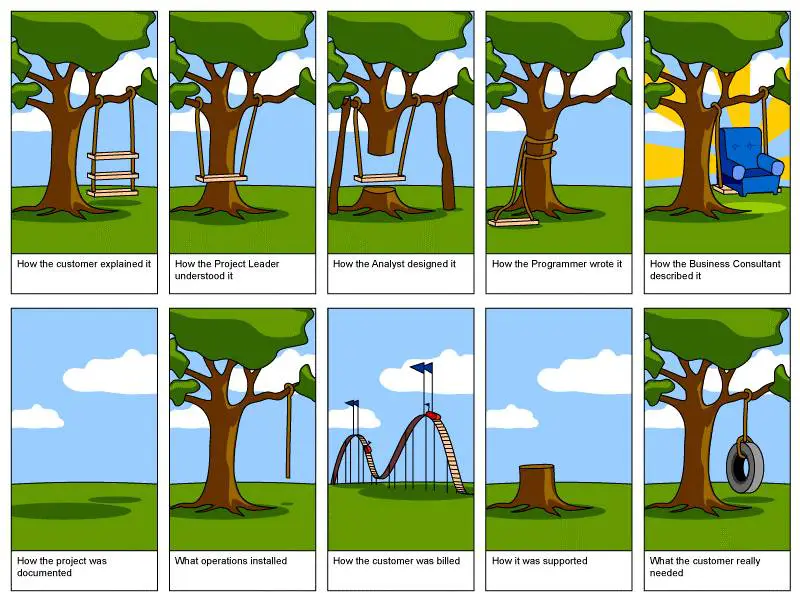
    The second issue is Marketing and Sales team lives on quarter on quarter (Q-o-Q). They have to show the revenue which is the goal for any organization. On the contrary Operations team cannot take decision for one quarter. For example – operations may not say we need infrastructure for one quarter and not in other quarter and thus make huge investment in one quarter and sell those equipment back in next.

    A branding expert told us that marketing managers (brand manager) want to start new brand building exercise (to gain in short term for writing on their resume – ‘I started this initiative’) and move to next level. New manager comes he/she too does the same. Short term gains are there for the marketing manager; yet for long term the brand is diluted perhaps no one knows what would the brand stand for in future.

    This was/is the case of 2008 melt down. Decisions were made on short term with one phrase in each agreement – “systemic risk”. BFSI industry created various certificates (CDR) etc to sell junk to make big buck in short term. Dreams were sold without real fundamentals. In other words, operations did not have the capabilities of generating the kind of returns promised – with a rider of systemic risk – to prospects.

    This is what is conflict of interest for us as individuals – our dreams Vs our realities. The same is true with Organizations – their marketing Vs operations. This is also true for us as economy – our dreams Vs the reality of systemic risk and capacity of economy to fulfill the dreams.

    Image source – http://www.cravingtech.com/blog/wp-content/uploads/2007/11/project.jpg

  • We need pessimists!


    I was thinking about the middle path and two types of people came to my mind – optimists and pessimists. I went back in the memory lanes. As an innovation consultant, I was a part of a Summit on Innovation. Few of the workshops in the summit were on “Culture of innovation” in organizations. Everyone agreed that we need diverse team for innovation, however, everyone agreed that we need to engage only energetic and optimist members in teams. I asked myself; Why are we categorizing people as optimist and others? Does innovation require labeling people and then creating teams? In other words why we – as innovation consultants – are agreeing not to have diversity in team? Even in systematic innovation drives, we need people of different thinking styles and opinions.

    I asked myself let me define ‘pessimists’, to see if my questions make sense in team composition for innovation efforts? According to Merriam-Webster online dictionary, pessimist is one who has an inclination to emphasize adverse aspects, conditions, and possibilities or expectation of worst possible outcome. Pessimists are those who negate or say no to anything because of their experience, knowledge, logical, old understanding or mere negative thoughts. Does it mean that they shouldn’t be a part of any team on say innovation efforts? I have heard somewhere – if an optimist makes an airplane, pessimist makes a parachute. Pessimists could be extra-cautious and introspective people, isn’t it?

    We need pessimists!
    Why we need pessimists too in innovation drives?

    In fact, pessimist is needed at places, because he/she may help improve solution with a “no” for many solutions. For example extra-cautious people help device seat belts in cars, safety values in pressure cookers, exit strategy in project/business plan. This “no” trigger teams to look beyond the horizon and ideate. Pessimists are the people who can be a great part in defining the problem and creating more challenges around the problem by questioning and negating. They endow the team with a new dimension to assumptions. It is well said – a problem clearly defined is half the problem solved. So do we not need pessimists, in defining problems? Pessimists can be a good help in exercises like heuristic redefinition and forward and backward thinking of the team because when they drive their thought process they also have an eye on the rear view mirror. I have heard – “Ideas of pessimists have saved more lives then ideas of optimists”, do we not need a balance in innovation teams?

    Pessimism is one face of a coin, other is optimism and a coin cannot exist without two faces. A good leader and an innovation team is one where best out of pessimists is utilized for improving its performance. Isn’t it right that we need pessimists… too!
    Copyrights KRD Pravin

  • Dichotomy on happiness…


    “There are some things money cannot buy…” I am not talking about Master Card! Generally speaking, I was thinking that there are many things money cannot buy. In fact, the Buddha left his whole empire! He too knew there are “somethings money cannot buy”. This is where I had two minds, and thought to share these thoughts and request for feedbacks.

    The first and foremost thing money cannot buy is LOVE, you are a better judge for this. Other important thing is happiness, in a spiritual context ‘bliss’.

    Sometime back I decided to leave a very lucrative offer the reason was I knew at my heart of my heart, I would not want to do this work and would not enjoy the work. The other option was – nothing! So, it was a tough decision to leave something (something immensely rewarding) for nothing. Recently, I met one of my friends (he knew my previous decision) his first and repeated question to me was – ‘Are you happy?’ And all the time my answer was – ‘YES, are not you happy with what you are doing?’ His response was with many riders – “yes for ‘X’ I am happy, but because of ‘Y’ I have some issues, you know this and you know that and this is what and whatever whatever etc”.

    I thought we take so many decisions “for” or “because of” some or the other things e.g. money. We tend to give drivers seat to our ‘mind’ for making criteria and decision too, while a rear seat to our ‘heart’. Relationship, emotions, all these relate to heart and we largely overlook these while making decision. However, being human we are driven largely by emotions and therefore there has to be a balance between rationality and emotion in decision making too.

    Then came the second perspective – if one wants to be happy no one can stop him/her from being happy. Happiness is a very personal matter. Two persons in similar circumstances could have different feelings (one ecstatic and other wretched). Peace of mind cannot be bought in the market, it has to be felt. If it has to be felt, why cannot one be peaceful while doing whatever he/she is doing? … So the dichotomy is – do we make decision based on few factors and that is the reason for us to be happy or we are happy because we want to be happy and irrespective of the decision we make or irrespective of what happens in our life.

    The question to ask is – happiness requires fulfillment of the CONDITIONS we create for being happy or it is a feeling irrespective of what happens in our life/to us? These conditions, to me, are never ending… as it happens to the squirrel in Ice Age-Trilogy and to Chaipau in Salaam Bombay“. Dichotomy of happiness is you decide on what you enjoy doing or you remain happy irrespective of the situation you are in….

    Related blogs – Cause…, the Middle Path, No judgement its all about perception and Balancing Act, When will we stop?

  • The Middle Path


    I was thinking about the change happening around us on a daily basis. On a lighter side – roads of Mumbai with so many potholes. Well, on a serious note the economic situation in USA, changing thought process of middle class Indian etc etc. Keeping so many thought aside and together what I was thinking to write is about the middle path suggested by the Buddha.

    I believe the challenge economies are facing and have faced are because of their lopsided strong stance. USSR failed (various reasons) one reason was strong rooted socialism. USA is facing great challenges one reason – blind faith in capitalism. I see the good part of Indian economy is balance between socialism and capitalism e.g. public private partnership. The message I see is – there has to be a balance. The balance is needed on various fronts such as the one I suggested earlier e.g. controlled aggression in earlier blog on Balancing Act.

    When I think about following the middle path, I see many avenues for the same in our daily life, in our profession. Think of emotion and logic there has to be a balance. If one is too passionate about something, it may turn into obsession which may be harmful. There is a thin line difference between being a Courageous person and being a foolhardy. Balance between work and life. There are various personality type that need balancing.

    Further, I thought about Prof Lopez and my class of Marketing and his advise to me. I realized – what is required is an accountability when any Marketing activity is pursued. I heard someone saying that Marketing is a bottomless pit. Now – and in the future – there would be a great demand and pressure on Marketing departments for controlling the expenses and achieving the results e.g. Return On Marketing Investments (ROMI). This would require a balance between Marketing analytics and creativity. Message should be conveyed creatively yet keeping the returns expected and doing a first hand analytical research on the ROMI.

    Net net, we have to follow or learn to follow the middle path – economies, Governments, businesses, society and individuals. Isn’t it?

    Related blogs – Irony! Balancing Act and Cause…

  • ‘Balancing act’


    This is one of the stories shared by Prof Mankad with me.

    Once on his tour, the Buddha was resting in the shade of a large pipal tree. Under a nearby tree a group of dancing girls was also resting. One of the apprentice musician girls asked the leader of the group, “How do I tune this string instrument?” The head of the group, a ravishing beauty of a dancing girl, obviously with limited virtue and ignominious fame said, “do not stretch it so much that it breaks and do not leave it so loose that it does not play”. Buddha hearing this went to her and bowed to her with respect. His disciples seeing him bow to a very infamous character were disturbed and intrigued. When they asked Buddha about his behavior, he said, she taught me a valuable lesson in life.

    This story tells us a very valuable lesson. The lesson of balancing act, I recalled the recent incident of Cricket test match between India and South Africa. In that match Indian player Sreesanth and South African player Graeme Smith had an altercation. For this incident Indian Cricket team captain M S Dhoni made a statement in press for Sreesanth – “…there is nothing called over aggression till you don’t cross the limit. There are guidelines which need to be followed. You need to be yourself but at the same time shouldn’t get into others’ space…”

    The balancing act also applies to businesses in terms of product portfolio, organizational behavior and a balance between business and social responsibility (triple bottom line). This also applies to individuals e.g. work-life balance.

    The other important lesson to learn from the story is – one can learn from wherever one wants to learn from and no one is old or young to learn from. This is what an earlier blog suggested – Learning… and possibility thinking.