Tag: app dipo bhava

  • App dipo bhava


    I was fearing writing this blog last week, however I could not resist myself. Actually I feel I am too small to write on this big personality.

    Last week India celebrated 125th birth anniversary of Dr B R Ambedkar. I have immense respect for Baba Saheb, as he is called. He was (I would say ‘is’ even till today) one of the most educated politicians India ever had. He was a lawyer, the chief architect of Indian constitution, an economist and a social reformer. If someone can boast about a PhD he/she can talk about only one big University unlike Baba Saheb – Columbia & London School of Economics. Well, many politicians may call themselves as lawyers & social reformers, however there is a huge difference between Baba and these so called reformers of our time or for that matter lawyer.

    On social reforms, how many Indian politicians can say that they have moved generations on a specific path – path we may question though. How many Indian politicians can say that they have offered opportunities to the generations for growth and equality – the opportunity we may question though. None of any other Indian politician could do and has done – just name any Ms Mayavati! Mr Nitish Kumar! or a leader from Maharashtra Ramdas Athavale! No, no one can be even named with Dr Ambedkar.

    We, in Mumbai, celebrated Baba Saheb’s birthday last week with a lot of pomp. Some areas (I know of Chembur) people made huge rangoli in many others there were temporary gates made, in many other areas hoardings were pasted with wishes on 125th anniversary of Baba Saheb. However, there was a question in mind when I was seeing the celebration in Mumbai. What message Dr B R Ambedkar would give to these people?

    Actually, this celebration is nothing new for me as an Indian. We in India have the habit, or you may call it reverence in refined words, that we eulogize such personality. It has happened with Shirdi ke Sai Baba, Mahatma Gandhi et al you just name any. The question to ask is – what have we learnt from them? What would be just one message they want to give us?

    Coming back to Baba Saheb, I was wondering isn’t it more political than spiritual or social to celebrate the birthday? The problem with any established practice is – even if the person is reborn those who have made something a practice / a ritual would not accept this reborn person’s teachings. They would rebuke him/her. Be it Jesus, Mohammad or Baba Saheb.

    I love Baba Saheb for many reasons some listed above; his choosing Buddhism too is a reason because I believe Buddhism gives a person the right to question, questioning self, questioning established rules and concepts. But, has the community learnt anything about Buddhism from the social revolution Baba Saheb tried to bring to the community? Many converted to Buddhism, but what about inculcating the basic tenets of Buddhism? I asked one of my friends – Buddha never preached harming animals, why do you eat non-veg, forget meditation, forget eight-fold path, answer the basic thing? Nope you have not learnt practicing being vegetarian – which is a practice done at least twice a day. Have you heard of meditation? Nope. What are the steps of eight-fold path?

    I am confident that had Baba saheb be alive today – he would have made only one statement for the masses – Appa dipo bhava “Be a light unto yourself”. Forget these rituals forget these political stands. Your growth is in your hands. Why not use the money spent on putting hoardings for some other constructive work, say scholarship for a student?

    A last word – Even if you do not want to learn being a light to yourself follow the path of Baba Saheb consider education seriously and try to be like him, how many would take this idea seriously?
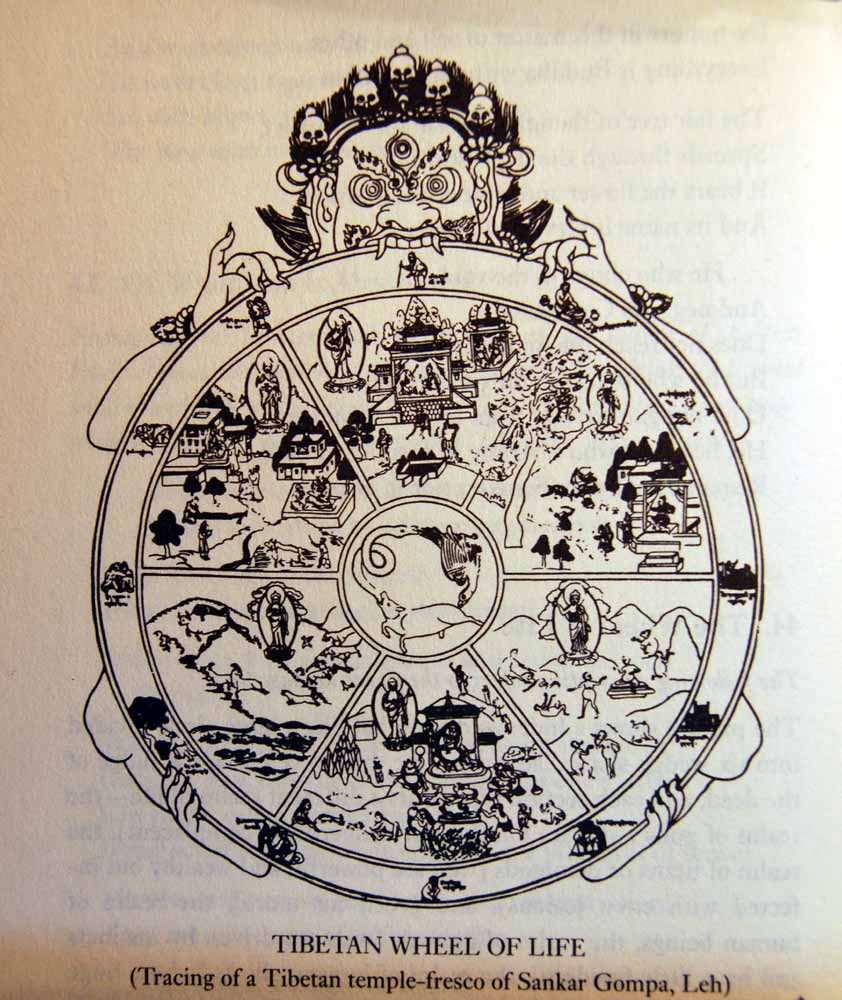
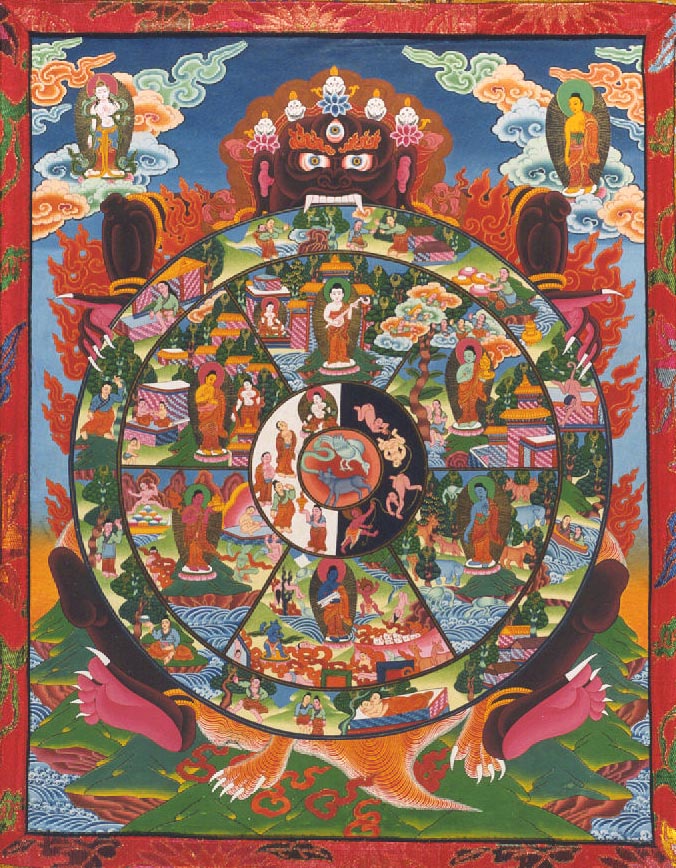
  • Bhavachakra – the wheel of life


    On this buddha Poornima (Sunday 6th May), came across detailed explanation of Bhavchakra. I thought to share it on blog.

    Life seriously is a wheel, is not it? For individuals – Wheel of emotions, wheels of personal development and wheels of social interactions. For organizations and society too this wheel goes on – growth, development and destruction. Check any Indian Soap of prime time, you would come to know what we are surrounded with. It is up to us to learn about this wheel and help ourselves to get out of this – app dipo bhava (be a light unto yourself).

    The following content as well as image on bhavachakra is from this link, which explains it well.

    Bhavacakra or Wheel of Becoming/Wheel of Life is a form of a mandala or tanka (painted wall hanging), used primarily in Tibetan Buddhism.  The painting of a tanka is itself a form of mediation.  Its meaning is very complex, and can be read to represent at least three different realms of manifested effects ofkarmic actions.  It can be read as a diagram for the six different kinds of existence into which one may be born into during the middle rounds of samsara.  It can be read as symbolizing each of the different realms of human existence, lived out by certain kinds of people according to their karmic fortunes of personality type and socioeconomic status.  Or it can be read as a description of situations or states of consciousness that everybody passes through again and again in the course of a single day.

    Its iconographic meaning is correspondingly complex as well.

    In the background are varied Buddhist symbols, such as the moon, clouds in shape of swastika, and always a representation of at least one Buddha orBodhisattva, seen attempting to help sentient beings to find their way to Nirvana.

    The wheel is held by the jaws, hands and feet of the demon, Yama, the judge of the dead, who turns the wheel.  Yama represents the ignorance that comes from greed and “selfhood,” that keeps the wheel of suffering turning.

    The outer rim of the wheel is divided into twelve sections, called the Twelve Interdependent Causes and Effects – 1. ignorance, 2. volitional action or conditioning, 3. consciousness, 4. name and form, 5. six sensory organs (eye, ear, nose, tongue, body and mind), 6. contact or touch, 7. sensation, 8. desire, craving, thirst, 9. grasping, 10. becoming or existence, 11. birth, and 12. decay and death.

    The areas between the six spokes represent the six forms of unenlightened existence.

    There are six wedged-shaped sections, with each representing a different realm of life –

    1. realm of the Gods – Devas (who are blissful but dangerously complacent; always at the top of the wheel)

    2. the realm of the titans, demigods and fighting demons – Asuras (lowest rank of gods, who are powerful and wealthy but infected with envy, jealously, and greed for more; always in the upper half of the wheel)

    3. the realm of “human beings” (always in the upper half of the wheel)

    4. the realm of “animals” (sentient beings, less intellectually advanced than humans, driven by instincts and have little freedom, but can still experience suffering and project karma; always in the bottom half of the wheel; inclusive of birds, fish, and even a worm)

    5. the realm of “hungry ghosts” – Pretas (whose huge bellies but pinpoint mouths and eyes suggest insatiable craving; always in the bottom half of the wheel)

    6. the realm of “hell beings” (who are consumed with relentless rage; always at the bottom of the wheel; beings brought to hell for  past karma, but beings who can escape it through good deeds and reincarnation).

    At the center or hub of the circle is a smaller circle containing the Three Poisons, within a rim of binary demarcation of black and white. The black section represents the Dark Path on which sentient beings are moving downward to the hellish realms. The white section represents the Path of Bliss on which beings are moving upward to the Godly realms. The Three Poisons are personified as a rooster or fowl, a pig or boar, and a snake, chasing one another around and around. They symbolize the forces that keep people caught up in the samsaric round of existence: the rooster stands for greed, the pig for ignorance or delusion, and the snake for hatred.

    The wheel can thus hold distinct meanings, each speaking to different sensibilities.

  • I will only show you the path…


    (A correction, in the title ‘I’ stands for ‘the teachers’ and ‘you’ stands for me or ‘the students’.)

    I have had privilege of meeting Prof Mankad recently, it is always a pleasant experience meeting him. I realized he always has something very meaningful to share and his opinion are always very well thought off, I have a lot to learn from him. While talking to him I realized that many good teachers have given a message – ‘I will only show you the path; YOU have to walk through the road.’ When the Buddha told the story ‘Finger is not the moon’ the message was –

    1. Do not stick to the finger e.g. me, because this (finger) is only a way to show you the path
    2. Get directions and pave your path. It was a message for Ananda – app dipo bhava (in Pali language) Meaning ‘Be a light unto yourself’ when you are done with identification of path
    3. Walk through the path

    Prof. Mankad taught us Macroeconomics, gave us an Financial Times in the exam to write about any current affair why? To make us start reading FT. Prof Moradian made a statement in a class ‘I will only show you the path, you have to walk through it’ (which is the title of the blog). Prof. Lopez gave us inputs on life beyond books and ‘learn to see’, e.g. did you go to Vivocity (a mall in Singapore)? Did you see this or that? What can you infer from that? Prof Ram Kumar gave us assignments wherein we had to go to market and see the performances of brands on ground. Prof Sohan Shah, gave us sleepless nights (believe me we all enjoyed the grind) while giving us assignments on marketing communication, I am pretty sure that each student of the class (perhaps some non marketing students too Ankit Jain and Rahul Krishnan) can independently workout a plan on integrated marketing communication. They have showed us the path, its our responsibility to walk through the road.

    *What I understand is the Buddha was not in favor of a religion; even it happened in case of many more spiritual masters. Why? Because as time passes the directions become rituals, systems you see! When rituals become the ONLY path to be followed it creates conflicts in individuals mind and actions. Therefore the best thing is – to learn the lessons critically and walk through the road towards the goal keeping lessons in mind rather than the literal content of the message.

    I thought to write about four noble truths and eight fold path, then I asked myself, does it make sense to connect everything of Buddhism to Business or literal Buddhism to Business? Is not it important to concentrate on messages and see whether it fits in the business context?

    * Apologies, if I hurt someone’s belief, though I didn’t intend to do anything like that.