Category: Business

  • The Business, the Buddha and both…


    The Business
    What is business? Trade is the underlying concept of business and exchange of one thing for the other is trade. Earlier trade was based on barter system. Later, with the introduction of the concept of money, more sophistication was added to trade e.g. business. Based on a very basic definition of business, I can say life is a business, you trade relations; in fact you trade pretty much everything in life. On a tangent, even the so called most emotional feeling a human being has e.g. love, seems like a trade in today’s depiction of art. Though, love is a sacred feeling which should not be a trade.

    The Buddha
    Here, I want to state I am neither a Buddhist nor supporting Buddhism (any -ims for that matter), I am just associating the business to the longest lasting systems (which are generally religion) in the world. I may write on Islamic banking in future or stories of Jesus. The idea is to keeping eyes and ears open to learn that is how I could relate to Business and the Buddha, and still learning. I found words of wisdom of the Buddha relating to many places in businesses be it Singapore, Western world, India or other places, and that is what Business to Buddha made sense to me.

    … And the business and the Buddha
    There is relationship between business and the Buddha, in future the businesses would be more evolved and we would have more than profits in our mind. I got to watch this Video of Money Control earlier and this is one such instance where we might see an evolution in corporate thinking process. I will take an example on ‘interdependent co-arising’ (a concept of Buddhism) in some future blog. This video is on “Business Sutra” broadcast on CNBC, the link of the same is here relates to the same concept. Indian Walmart – the Big Bazaar – has a dedicated Chief Belief Officer (Dr Devdutt Pattnaik), we might see more involvement of ‘perhaps not belief‘ but social causes in business e.g. CSR.

  • Journey itself is the destination, so learn non-stop…


    As a ritual which every B-school aspirant has to perform, I also wrote B-school essays before joining my MBA program. I remember one of the phrases of one essay the most – “…making mistakes that will cost nothing in a classroom environment…”. I knew I will learn from the mistakes as well. I feel, a failure teaches long lasting lesson then a success. I have learnt a lot from the mistakes during last couple of months. I am sure, I am going to live with and implement these learning in coming time.

    With a lot of disappointment I started writing this blog after my exam of Pricing Strategy. Then I realized thank god I did not commit the mistake in business; one incorrect pricing and revenues and profits take a beating. I started writing my mistakes and learning, so that I can revisit what I should not do and what I learnt. This would remind me that the Journey itself is the destination, so learn non-stop. Here are few of the lessons –

    1. Never believe in the forecasts, forecasts are correct hardly 15-20% of the times. I bet Murtaza and Avanii would agree with me 100% on this.

    2. Start early (in B-School simulation too), starting early and keeping the momentum going; it helps

    3. Always have a “to do list” and prioritize work – for this I wrote funny statement which only a few could understand “Tomorrow is your exam (sense of urgency), day after tomorrow you will die (prioritize your work, before dying what would you do?)”. I used to do this but here in my MBA this has been reinforced to an even greater extent

    4. Failing to score well in exams is alright, but failing to learn a concept and missing to use concept is a punishable offence – “a crime”. I learnt pricing strategies concept, explained the same to my friends and yet in the exam forgot to apply that. There is no ifs and buts for this crime

    5. I always write my blog on one concept ‘collaboration’, I observed this in outside world, I used it a lot in my MBA and that is the way for the future of businesses

    6. Ask questions, better to be stupid for some time. I have been stupid in some classes (recently, in class of Prof Lopez and Prof Ram Kumar) but that is better than assuming something incorrect

    To be continued in next blog…

  • TRIZ in sales and channel management


    Contradictions! We live in a world of choices, conflicts and trade-offs. The following idiom says it all – “you can’t have your cake and eat it too!” In this regard, there is an approach to solving such problems wherein you are faced with contradictions. The theory is named TRIZ – the theory of inventive problem solving. By way of example, let me introduce a contradiction in simple terms.

    Let’s say you want to increase pressure in a vessel and the result of that also reduces temperature, which you do not want. The conflict in this case is clear: increasing one parameter affects the other parameter negatively, or, changing a parameter positively affects another parameter negatively, which creates an undesirable outcome. The idiom used above “you can have your cake and eat it too!” implies a potential physical contradiction- You want a cake but you cannot eat it!

    TRIZ is extracted from the field of engineering. This methodology helps resolve the contradictions without compromise. Lately, I tried applying concept of TRIZ in class of Prof John Davis (Dean SP Jain Center of Management, Singapore/Dubai) on Sales and Channel Management. There was a company which had acquired many diverse companies and thus had a dilemma of structuring its sales force differently to increase efficiencies. The range of organizational options included – letting the sales force be as they were (independent), merge the sales forces, using distributors, or a unique combination of these or alternative structures.

    The solution of merging or having independent sales forces had their own positive and negative implications. This type of issue can be termed as “physical contradiction” in the language of TRIZ. To solve physical contradictions separation principles are applied. So, when applying the principle of separation on condition and space, we can identify that the sales force could be geographically separated (separation based on space). The conditional separation in this case was manifested in determining big account vs small accounts for both distributors and an in-house sales force. Additionally, the conditional separation was represented by a merged sales force (one bag) vs a separate sales force (silo) for product offerings.

    Thus, though TRIZ was distilled from field of engineering but we can apply principles of TRIZ to solve problems in different functions (e.g. sales in this case) and other non-technical fields. I am trying to apply TRIZ in different fields and I have also identified application of TRIZ in marketing, strategy planning and areas where conflict appears, though I feel there is a lot more to be done in terms of making it easier to apply.

  • Ideate – Save the sinking ship


    Prof Mankad said in our class ‘there seems to be possibility of double dip’ while teaching us macroeconomics. I have written on this in my blog at times. At times question comes in mind, why not using concepts of one field to the other the way we do it in TRIZ (The theory of inventive problem solving). I recalled a news shown on NDTV (it was shown in 2008 somewhere in Aug-Nov). I remember this news because it was unique and I rarely watch TV(:)). So, here comes use of TRIZ to tackle the economic crisis in a non conventional way. I am sharing the idea with a hypothetical scenario.

    As an everyday ritual Vijay logged on to his mail box, amongst others the mail from HR stared back at him. Feeling the heat of economic crisis the company was in process of layoffs. How many Vijays have the same stories to recount? How this time can bring us together and make us more innovative to reckon with the challenge – this challenge is not questioning us only on one front of economics but also on cultural and creative fronts?

    Employee-employer relations are unlike marriage where a pair takes an oath to live together, and share all the grief and joy. In this tough time each should support other for survival and future growth and say – “yes! We are for each other”. It has been proved important and useful in the Japan after the World War II. Lately, a group of ex-workers of a mill bid to revive a dead mill; Garware Nylons Ahmednagar. All the workers joined hand for revival of the mill. In this successful bid the sense of belonging was such that the families of ex-employees even-handed over their jewelery and large sums from their provident fund. Way back in 1996 instead of shutting the mill down, if the management and the workers had come together and decided to make a plan to save the mill on a model of a marriage by surviving in the tough time, they might have come up winning and everyone might have lived happily.

    In recent week there was news in FT that EU is considering bailout in some forms. Bailout is a ‘self-mutually exclusive’ option that is – bailout is needed in the toughest time but it is ill-advised as it is ‘passing-the-buck to taxpayers’. Government needs to bail out various industries; however, the companies may misuse the amount. In such case questions are asked that – How to make companies accountable for the same? When to loan, how to loan and how to gauge the performance of the waived organization?

    Bailout can be tackled when government separate this option of bailing-out upon condition of time and space i.e. conditional separation of amount of money offered, accountability of use of money, time-to-time checks and balances. Separation of assets and liabilities can be one more initiative and offering incentives other than monetary could be other.

    Additionally, if we attentively look around we can learn from nature too. Birds fly in flocks, why? Because flocking helps conserve energy, defends against predators and facilitates orientation and communication. Energy is everything involved in the business – various resources, money and time – it needs to be conserved. Instead of salary cut and layoffs companies can take loans from employees, offer shares or bonds to the employees to generate money. This not only can engender trust in teams but also can invigorate teams to work for their own company. Are you keeping those many Vijays in your team? Are you willing to take on the challenge by sticking together, being creative and innovative to carve success over the slump to ply in the present to fly in the future?

  • Six Sigma failed…


    “Not invented here syndrome” is like making a statement to Prof Moradian or Prof Natarajan that your forecasting methods is flawed it does not work in my industry, company or department. Is not it prudent to ask if it worked somewhere, how did it happen? Let us take an analogy –
    Organization = Laptop
    Department = Microsoft Excel (MS Excel)
    When I make a statement–
    “You know what,
    1. Mathematically, 2+2 is not equal to 4 in MY MS Excel therefore Mathematics is flawed
    2. My MS Excel is different from the rest of the world because 2+2 in not equal to 4 in MY MS Excel
    3. My laptop is different from the rest of the world because 2+2 in not equal to 4 in MY laptop”
    If 2+2 is not 4 in your Excel it is not that the math is incorrect, perhaps your algorithm or your laptop processor is at fault. In this analogy Mathematics could be Six Sigma. I have heard that IBM failed in implementing Six Sigma (late 80’s to early 90’s), GE is extremely successful, why?

    Lately, in one of our simulation class Akshat’s team questioned “why Six Sigma failed in our company in the simulation?” one of my teammate wrote on facebook – “After 3 round of simulation today Pravin Krd accepted the disadvantage of using six sigma as corporate project :-)”. I went back to basics to answer this question. What is six sigma? Six Sigma is about vision, philosophy, management system and achieving aggressive goals. Six sigma is also a toolbox and a means to satisfy customers. If Six Sigma fails in an organization it could fail due to – improper vision or management, issues with the goals or incorrect use of tools. The basic philosophy of Six Sigma is reducing defects, how can reducing defect be a failure in a company? If I ask you what you would prefer “good enough” with 99% accuracy or 99.99966 what would you prefer from the following?

    Three sigma (99% accuracy) processes
    5,000 incorrect surgical operations per week.
    2 short or long landings at most major airports each day
    Six Sigma (99.99966% accuracy) processes
    1.7 incorrect surgical operations per week
    1 short or long landing every five years

    Naturally, your answer to this would be better accuracy. Six Sigma is all about facts and working logically to reduce defects, and what follows is reduced cost, customer satisfaction etc. I am not a Six Sigma guru or I am not professing it, I am only trying to put some facts – “the six sigma way”. Experts can jump in and suggest or inform why six sigma could fail and share success stories.

    Source –
    Breakthrough Management Group India training on Six Sigma certification. This Data was a sample from USA.
    Class Blue ocean strategy simulation (BOSS)

  • Next super power?


    Germany? Is that… few days back President Obama was in India, he supported India’s candidature for permanent seat in UN. Germany and Japan the other contenders raised their voices on that. Germany is one of the two elected countries to serve as member of Security Council for two-year terms that begin Jan 1. Germany is also the protagonist for Unified Europe e.g. European Union (EU). Germany is the strongest economy of EU. And the trouble starts here – Germany being the protagonist and the strongest economy faces challenge of saving the EU and the cost could be cases against Government of Germany. Reason? German people were promised two things –
    1. Euro would be as strong as Deutschemark
    2. There would be a “no bail out clause”

    These clauses seem to fail. Euro is struggling because of exposure to stupidity of investment banks and naivety of European countries for example Iceland. Next to show domino effect was Greece in first half of the year, Ireland now and perhaps –Spain, Portugal next to face economic doldrums. “With Great power comes great responsibility” said Uncle Parker [to Peter Parker – Spiderman]. Germany needs to understand it, they need to change their promises or the spiral of over exposure and unified economy [not only of EU but also the whole world] would eat half of our generation.

    Balancing this would make Germany either very strong worldwide or make it pauper.

    China, is that? According to the recent FT news by 2014 China would roughly touch 20% of world manufacturing production and has already equaled US. As I earlier wrote [reference Macroeconomics class of Prof Mankad] China is replicating Japan on many fronts and is doing it phenomenally well. China hold Treasury bonds of US in effect it can twist arms of USA any time. Yet it faces a few challenges –
    1. for a strong economy of China, US and other nations importing Chinese products should be economically strong or China needs to increase consumption of its produce in China itself
    2. growing % of population in old age e.g. less working population.

    There could be many ways to tackle this issue –
    1. Work Visas to people of different nationalities
    2. Automation
    3. A least unlikely one is mildness on communism to attract foreign nationals

    India, is it? Perhaps, yes! I may be biased yet the economic, demographic and intellectual capital it posses, this country seems the contender for coming 10-20 years. The secret lies in the leadership, current duo of Dr Singh and Mr Chidambaram is a good combination. However, India needs to be cautious building next leadership line is the need of the hour.

    Coming back to the troubles in EU, I strongly see a solution in applying TRIZ (the Theory of Inventive Problem Solving) for the situation. As far as the super power is concerned, only time will tell us who the super power is, I would bet on India and China, more on India ten years from now. Cast your vote…

  • The line of understanding


    I heard a story that a person was ready to change his religion because of the strange rituals followed in time of demise of someone in the family. The question to ask at such times is – Are we meant for systems or systems are meant for us?

    A mobile operator and a credit card company did the same with me. I always paid bills on time, at times in advance! Yes, I paid 1/3rd of my credit limit in advance. The problem with them was they did not listen to my problems because of an error in their system! Yes, ‘paralysis of system dependency’ – I would call it – could result in loss of business. I have also heard and witnessed in some cases – not invented here! and cannot work in this setup, type of comments. The reason for such limited thinking is our dependencies and self imposed limitations. I recall one of my senior facing similar situation, told to the client – are tum karo to sahi, bad me dekhenge kya problem hai. (You just do it we will analyze if there is any problem). He could say this with confidence because he knew what works, what is going to work and importantly he was not the part of the system.

    I am not arguing against systems. I am just trying to say that one has to answer the question – why at first place we designed systems? Answer is to

    1. facilitate operations of society (in case of religion, culture and laws)
    2. facilitate operations of work (in case of businesses).

    We resist change – because we have become inured to our system. See what is happening in case of banking reforms in USA. The situation is dire, yet reforms seem to be a tough nut to crack.

    How long are we going to depend on systems and follow the system till death even if systems are not supporting our cause? Were systems made for making our life miserable? Well, I am not asking to rebel against systems, what I am giving a thought to is – why not critically look at why we are doing what we are doing and question our assumptions. These questions and issues if not addressed correctly create rebellion such as hippie movement.

    What I could see is – There has to be two lines drawn, one between system and understanding its short comings and the other is understanding and rebelling against the system. I would call that line ‘the line of understanding’. More on this in future when I take information age Vs other ages.

    I know this all seems a very weird connection, starting with religion, talking about my personal experience, challenge of a consulting assignment and then banking reforms and lastly to hippie movement! The reason I found is – in the end we all are human being, and everything connects somewhere. The need is to learning to see (oops its a title of a book on LEAN, which I have not read yet) and yes questioning assumptions.

  • Double dip!!


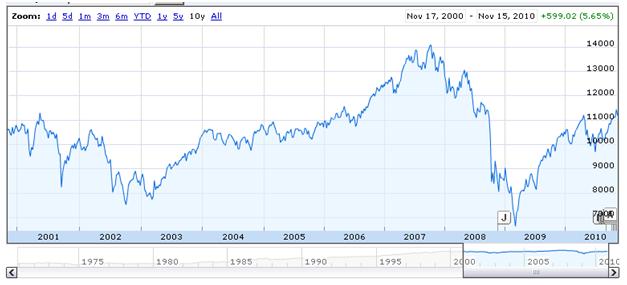
    “There seems to be high likelihood of double dip!” When we heard our professor of macroeconomics Prof Mankad say that we could not believe it. I recently thought to plot some charts and realized that human sentiments are also equally responsible for this. The following is a graph, here we see an increase in the center yet once the peak is achieved there is a drop and no gain. Some call it correction. Well, frankly speaking these are my semester-wise undergrad scores.

    When I had a quick look at the graph I said – ok! I did ok initially, and then my performance dropped, it hurts I improved myself and went down back somewhat. Alas! My undergraduate was over therefore I could not extrapolate things. Yet, if you sem one to two movement there seemed some similarity.
    I tried relating it to the last 10-years NYSE performance. There were phenomenal similarities. I took 10 year performance because it seemed to me that post DOTCOM bubble burst would be a good point to start from, and some other logics. See sentiments are again at work.

    Then I thought about the statement of Prof Mankad, double dip, what about that? There could be a possibility of double dip, why, how and when? Yesterday I was reading Financial Times front page news – Ireland resists bail-out pressure, and viola I got a hint. If nothing is done at this time perhaps the other bottom is not far.
    I recalled another part of macroeconomics class. “Essentially all banks are bankrupt.” Though for self satisfaction we may call them BANKS, on which we bank. Nonetheless banks are sitting eternally on a time bomb ready to explode any time. The bomb of Debt!
    If Ireland does not accept the support from EU perhaps we all would be doomed to see the second dip. The situation is a double edged sword – the world needs an enhanced banking system yet what I read somewhere “if you actually tried to manage according to the regulatory measurements, your bank would fail.” At such times I resort to TRIZ – the theory of inventive problem solving. I would comment on the SYSTEMS in general and TRIZ in next posts.

  • There is no substitute…


    My brother taught me playing Cricket; he introduced me to my Football and Basketball club. I played and represented club and division. I achieved some good accolades in athletics. He was the one who abusively told me when I was in class 5th that let us see if you can pass mathematics of class 10th either. And to his surprise I improved so much that I could solve MSc Physics problems when I was in 12th. He was All India Ranked 16th in GATE and had many PhD offers. He plays flute, he is an artist acts in theaters too. Well, why am I writing all this? The reason is – My brother taught me “there is no substitute to hard work”. He is right he has proved it always. And I recalled the lesson when I saw the following on facebook.

    One of my friends, Rahul Krishnan, recently said – every professor of operations management seem to be fascinated with Japan or Toyota. To this I said, perhaps 10 to 20 years down the line Japan would be replaced by China.

    I started thinking – what is the reason? The reason seems to be – there is no substitute to hard work. Japan did this post World War II, China did in late 70’s to present. In 80’s manufacturing started following Japanese systems, and I think in next few years we will start looking at what does China do differently that it is so economic, so efficient and so competitive?Our professor of Macroeconomics Prof Mankad shared with us how economy changed and Japan became an economic power to reckon with, now it is China. The currency of Japan was undervalued, they became manufacturing super power and export experts. See China, the same is happening now once again – history is repeating itself. Perhaps it will repeat again when we move from TPS to CPS (Chinese Production System) in future. In fact many Japanese companies outsource their work to China. So it is time to learn what China is doing differently.

    No doubt Japan is a nation of hardworking people and so is China. And I come back to the lesson – there is no substitute to hard work.

  • Evolution


    I was wondering about evolution – how, what and when? I asked myself a question – when do we call something has evolved? The answer which came to my mind was –well, when the whole category of the group (species) grows from something old to new, that time we call this movement as evolution.

    If only one entity of a taxonomic group evolves – we may call development as an anomaly. Therefore, an evolution relates to the whole group. Here, it is worth considering that evolution relates to whole group not one entity in a group. We say that whole mobile industry has evolved. This evolution, for example, has been two-level evolution, first, handsets and second, services.

    What point I am making is, the growth in any aspect of a category happens supporting the growth in other related category as well. An ecosystem of the surrounding evolves with evolution of one category. The Buddha said once – whole humanity and the world has enlightened the day I was enlightened. This statement is a very subtle statement, which means a different thing for a different type of category.
    Let us take another example, of sports. First 100 m sprint world record was of 11.6 sec in 1896, current world record stands at 9.58 sec. The whole concept of competition has evolved for 100 m sprint. The product, the arena and the processes e.g. shoes, tracks, clothes, coaches and techniques etc. Technology which was not related to sports earlier has now been very efficiently used to track who is the winner by the photo finish technique. Well, let’s see the business side of this – did Nike exist in 1896? Did Puma exist in 1896? No!

    Effectively, whole ecosystem has evolved in this example. This happens everywhere. In last century many industries have come into existence and many have grown from where those were 100 years back.

    In nutshell, evolution relates to the whole group of a taxonomy. Additionally, everything evolves and the evolution of one particular product results in evolution of all associated services or products.