Month: August 2025

  • Business and the Buddha – Does It Still Stand?

    In 2010 when I started the blog Business to Buddha, my hypothesis was simple – there is a connection between business, economics, management and spirituality. At that time, I found it very logical. But today, I sometimes stop and ask myself – does it still stand true? Or was it only a nice thought to start a blog?

    I go back to Buddha’s teaching of dependent co-arising – we grow when others grow. In business language, this looks like collaboration, co-innovation, ecosystem play. One company wins, but not at the cost of the other, rather both become stronger in the process. In my first blog, I had taken the example of BMW launching Z3 with James Bond movie. Or even in racing – Ferrari and Honda compete, but they push each other to make better cars. Competition, yet mutual growth.

    That is why I felt Business to Buddha makes sense.

    But where does it not work? The reality of quarterly numbers, investor pressure, market share fight – these are not spiritual conversations. Here sometimes compassion or equanimity takes a back seat. You can’t tell your board, “let’s wait for the muddy water to settle before we act.” In these moments, spirituality looks like a luxury.

    Krishna’s Wisdom

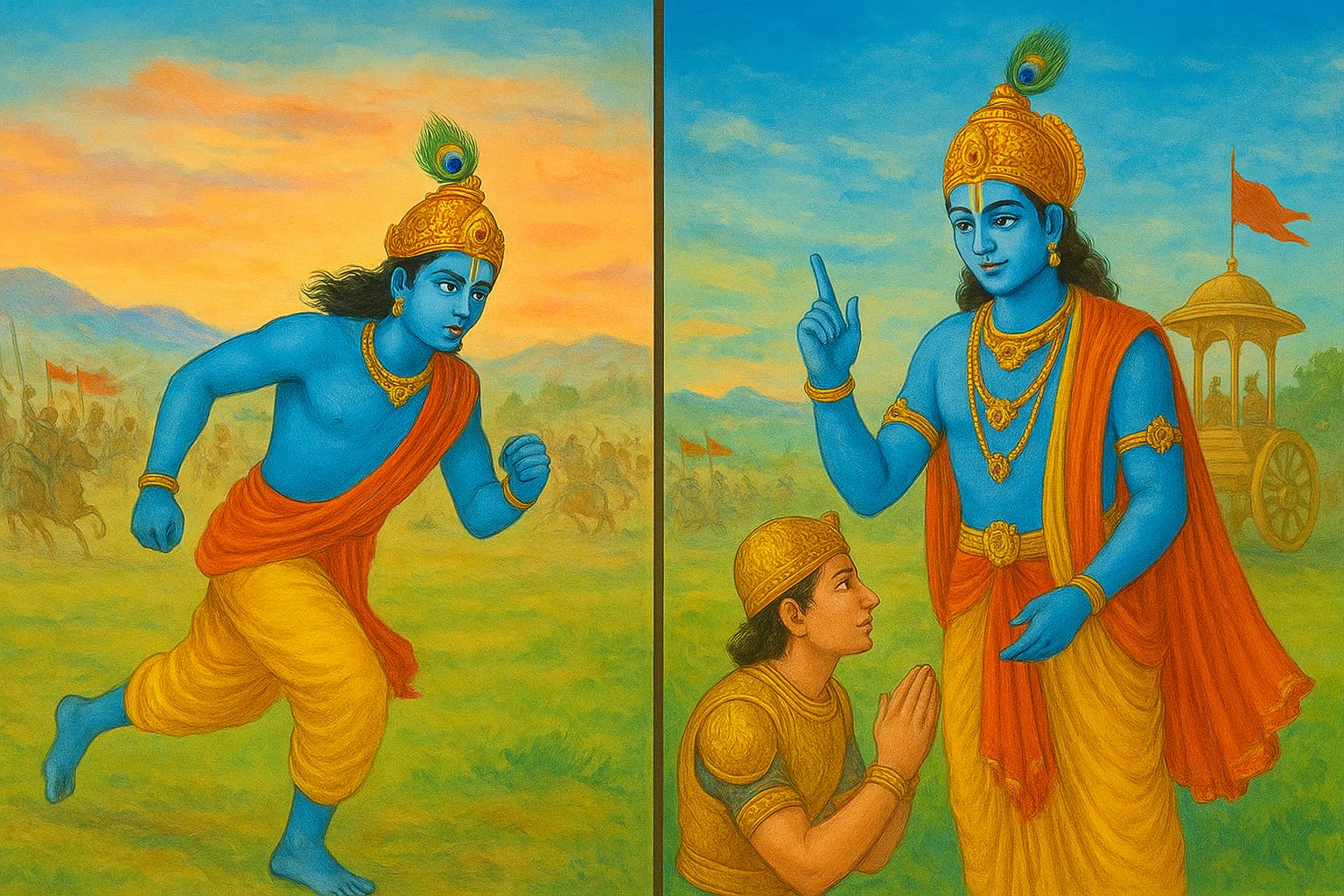
    This is where I feel balance is important. If you see Mahabharata – Krishna himself ran away from one war (Jarasandh and Kalayavan, if I recall right) but later encouraged Arjuna to stay and fight at Kurukshetra. Same Krishna, two different situations, two opposite responses. Business also needs that balance. Sometimes retreat, sometimes full action. The wisdom is to know when to do what.
    Chanakya also wrote – artha (economics) and dharma (ethics) go hand in hand. If either is missing, the state collapses. Maybe that’s what we miss today – we run only for artha and leave dharma behind.

    So does Business to Buddha still stand? I’d say yes, but not as a formula, more as a reminder. It is not that every board decision must sound like a sermon of Buddha. Rather, it is about remembering there is a middle path – between hard business realities and human values. Between quarterly pressure and long-term trust.

    The Buddha said walk the middle path. Krishna showed both – running away once, fighting another time. Chanakya tied economics with ethics. Somewhere in between these, lies the balance for us – in boardrooms, in markets, and in our lives.

    Maybe that’s why this blog continues. Not because I have answers, but because I still feel the question is valid – can we connect business with the Buddha? For me, yes – because life itself is this balance.

    Image generated using AI model

  • Hanuman in Ashoka Vatika: A Lesson in Stillness

    Occasionally, I share stories from Indian culture with my daughter – Adviti. Though, we’ve not watched the recently released movie Mahavatar Narsimha, but I have read the story of Bhakt Prahalad in the form of Amar Chitra Katha for her. I wish I get more time with her to explore, once she grows up, it would be the other way round, probably she would not have time for me.

    Last December when we went to couple of cities in Tamil Nadu, we saw strange carving of animals, seeing those I and my sister were discussing – perhaps our ancestors knew genetic modification or mutation etc thus they had animals with body of horse, head of lion and hands of humans etc. These thoughts have been very unique experience for us. My sister and I were discussing probably Indian culture was too evolved with science (say mutation) and inner science – a balance between physical realm and meta physical realm.

    These fascinating ideas are making me read further more Amar Chitra Kathas with my daughter, plus other books on Indian spirituality. I think even more about what can be additional deeper lesson in these stories? So, here is one.

    Hanuman’s wait

    After leaping across the ocean in search of Sita, Hanuman finally finds her – under the Ashoka tree, distressed and surrounded by demons. He’s done the hard part. He’s made the impossible journey.

    But now comes the real test.

    Despite his strength and speed, Hanuman doesn’t leap into action. He doesn’t rush to speak, fight, or “rescue.” Instead, he climbs a tree and waits. Silent. Still. Observing.

    He watches. He listens. He reads her state of mind. He becomes a witness, not a reactor.

    And when the moment is right – when she’s ready – he gently steps forward, offering only what’s needed: a sign of hope.

    Catch the beautiful song from that moment in the animated film Ramayan.

    The Business Parallel

    Sometimes in business, not acting immediately is the most strategic thing you can do.

    • The product is ready, but the market isn’t
    • A deal is in motion, but approvals are stuck
    • The team is tired, and pushing harder will do more harm than good
    • There are conflicts, but you have to wait – like Buddha told Ananda: wait for the water to flow, only then can you fill the flask with fresh and clear water

    The instinct is to jump in, solve, fix, escalate.

    But good leadership often means holding steady. Watching. Listening. Reading the moment before making the move.

    Just like Hanuman did in Ashoka Vatika.