Month: September 2019

  • Cost of poor quality

    Cost of poor quality (CoPQ)

    In operations improvement, Cost of poor quality is a common management term. Sum total of all the costs that are generated due to defective material produced by a system is CoPQ. There are various costs defined in management systems for this. You can read more about CoPQ at iSixSigma.

    A naive example
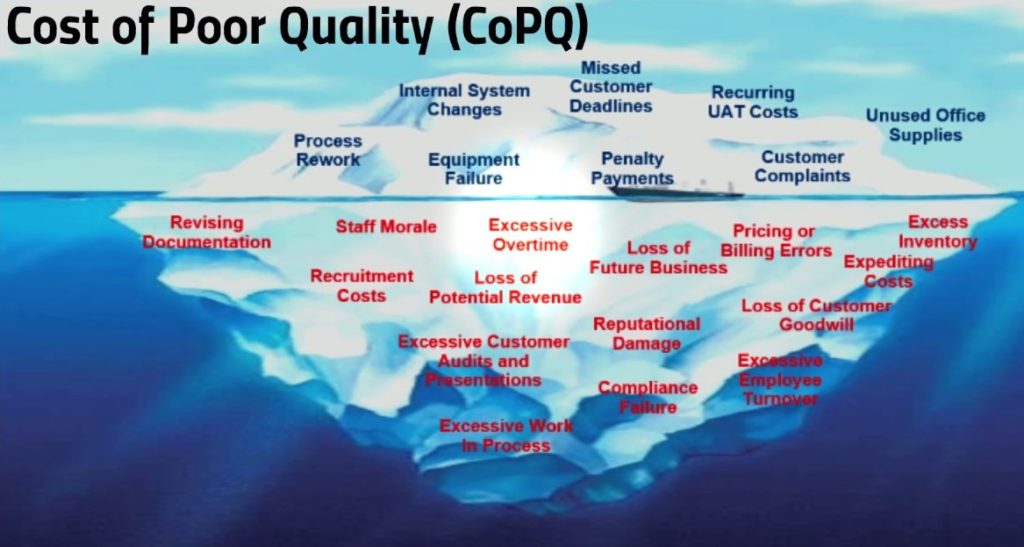
    cost-of-poor-quality

    Since, management example for CoPQ can be complicated by jargon. So, I am taking liberty of making it very layman with few variations in explanation. The context is very India-centric here. There is lot of corruption in road construction projects in Indian cities. Almost every year during rain (otherwise too at some places), these roads are full with potholes. Some people say – you need to search road within the potholes. Why go to any other city – Mumbai is a living example of the same. These roads result in – untoward events (possible serious accidents), high cost of vehicle maintenance and repairs, poor vehicle mileage and at times backache to the travelers even with good quality shock-absorbers of the vehicle.

    The evident cost, in case of Mumbai roads alone, is repairing same patch of road in single season at least 3 times.

    Example of CoPQ In life

    Terrorists – they are an example of CoPQ to society, they waste their life as well as killing other people. Say one of the person’s killed is an educated, married person with a child in his 30s. Death of this person is a loss to the Society, a talent who added to the GDP. The loss to the GDP is for about 20+ years the person could do. Family and child lost a support system. This loss of support could eventually result in inability to blossom and become a better contributor to the society. Society can be better off if a terrorist commits suicide without causing any other damage. Though it is a loss again to the society that a person is dead without adding any value to the society, however it is better than the trouble that person could be to the world.

    Depression of an individual is CoPQ for self and society. The society is losing time and skills of this depressed person. Actually, interdependent co-arising plays an important role in our society. CoPQ can be derived from interdependent co-arising too. If we understand the concept of interdependent co-arising society can reduce terrorists and depression patience.

    How to reduce CoPQ for society?

    When I was thinking about what we humans ban do to reduce the cost, I came back to the same old point – meditation, spirituality and teachings of Buddha and Jain Thirthankars. Both Jainism and Buddhism emphasis on concepts such as non-violence, non-stealing, fidelity etc. Corruption is a type of stealing and terrorism is violence. If one gives proper heed to the virtues, roads will be of good quality and if one meditates regularly his quality of live will improve multi-fold. In essence, practicing these principles the Cost of poor quality can be reduced drastically.

    Image source – Cost of Poor Quality – pt4 youtube video

  • Slingshot

    He was playing with his slingshot. When he released the sling, stone fell down. He tried the slingshot again, failed again. Kunal came to know, he asked me why the slingshot is not working? I looked at the sling where stone was held leather pad. There was some sticky material, mostly a used and thrown chewing gum attached to it. We removed it and Kunal happily started playing with the slingshot again.

    Playing Slingshot (गुलेल) / Catapult, is an immense learning. You pull the stone back with a sling, take an aim and release. You wait for some time until the stone touched / reached the target. There is an interesting analogy in this.The sling is like your present action, preparation and “now”. Your leather pad is like your past experience, your mind (where many things are held). The aim and trajectory is like future. The better control you have on everything, good it is for your life.

    Kunal’s slingshot gave me another insight. The past / mind, if spoiled with a memory that may hurt your present and future, you are putting everything that you have at a stake. In Kunal’s case the pad had a chewing gum – a kind of adhesive. If you stick to the past – mostly not to an inspiring past memories, you are more likely to be stuck in life. Such things bring you down. Have you ever thought of a moment when you were involved in something wholeheartedly? Did your past experiences interfere your present actions like that gum of Kunal’s slingshot? You were focused on the activity – like pulling the pad back, possibly the size and weight of stone and your aim (target) was clear. There was no confusion, no fear and no blockage. You just did what best you could do – living and enjoying the present moment.

    Image source – Pixabay.

  • Businessman Buddha

    I was extrapolating to get into a mind. The mind of a person – who left everything and went to the Himalayas. What changed for him, how his mind responded to the alone-ness. What was going on in there – in the mind? Why he left the society and went to the hills? What conspired? How he changed there? Would he be the same changed person when – in case – he comes back to the society?

    Middle-Path

    Can one have the same mindset of a hermit of Himalaya, in the concrete jungles? Can one balance being a hermit in the concrete jungle? Is it true that people find peace of mind in Himalayas? What is different there and here in the worldly city?

    My recent experience of Art of living‘s Anand Utsav course has given me few more questions and dimensions. Last week I wrote about listening to the tik-tik of wall clock. My wife entered the room switched on the fan, I missed the tik-tik. This is what happens with us in our daily highly demanding and at times stressful professional life. We miss very many things in the noises of becoming someone, owning valuable things, money, designation etc.

    The long and short of all this is balancing the life with awareness and becoming a saint in a professional life. Do we really need to be a monk to be spiritual? Most of us are running to be someone or to achieve something. There is no problem in having ambition and goals; the point is ,it make one restless. Why to be restless and anxious? Is not it a possibility that a person can be centred and yet ambitious? Is not it a possibility of a person being spiritual, professional and successful? These questions have become easier for me to have a perspective after the Anand Utsav course. I would certainly repeat more courses of Art of living.

    Just-be

    One can follow the middle path of being an enlightened master without leaving everything. One can be an enlightened master without leaving family. I see future enlightened masters will be successful professionals. These future generation enlightened master would / may not even talk about high flying esoteric spirituality. They will do their work as any worldly person does. These masters will not leave everything for the Himalayas, they may not sell their Ferrari. I think that is what is the lesson of the Buddha – Middle path. I think that is why current generation enlightened master’s are bringing spirituality to masses and to the day to day life.

    As Osho said long back, many of the masters will be like the Zorba. Zorba the Buddha (Osho’s book) – “… Zobra is Love and Buddha is Awareness… when you are Zorba the Buddha, you have attained the greatest height that is possible in existence…”

    Image source of monk https://www.theguardian.com/technology/2011/apr/17/untangling-web-aleks-krotoski-religion

  • Knowledge and spontaneity

    The ability to remember and to think a lot about our previous impressions, limits us. Is it a possibility that our intelligence is our stupidity? Our ability to remember a lot of things is probably something that hampers us to explore the unexplored? Or this knowledge hampers our ability to look at possibilities beyond the past experiences that we have. Some times some things happen around us that is beyond our ability to comprehend and beyond justification of our past experience / learnings.

    Is it possible that these abilities are making us limited or in some cases mad? Can we be more enlightened more aware, having attention in now? If we have an ease of forgetting things and probably a very limited attention span, is it likely that we will be more aware and be an observant. Higher the attention span it may make us intelligent compared to other animals. Is it a possibility that this boon of attention, remembering things is driving us away from the consciousness?

    You may also like

    Anand Utsave with sri sri brief experience of a course that I attended under sri sri.
    Buddha Purnima A guided meditation that you can try on full moon, guided by sri sri himself
    Why-Analysis – Karma A part of knowledge session on karma
    Adviti and genes of generations Another guided meditation by Guru ji

    How our mind thinks – we analyze, we compare, we try to create analogies and thus we tend to lose spontaneity. Our education system makes us remember things instead of being creative and spontaneous. I was thinking about all this a couple of weeks back and came across this wonderful knowledge sheet by Sri Sri Ravi Shankar (Guru ji).

    alogies and thus we tend to lose spontaneity. Our education system makes us remember things instead of being creative and spontaneous. I was thinking about all this a couple of weeks back and came across this wonderful knowledge sheet by Sri Sri Ravi Shankar (Guru ji).

    Weekly Knowledge #217 Bangalore Ashram 19 Aug 1999 India
    KNOWLEDGE AS A BURDEN – Knowledge is a burden if it robs you of innocence.
    Knowledge is a burden if it is not integrated into life.
    Knowledge is a burden if it doesn’t bring joy.
    Knowledge is a burden if it gives you an idea that you are wise.
    Knowledge is a burden if it doesn’t set you free.
    Knowledge is a burden if it makes you feel you are special.
    Knowledge session Kanakdhara Mumbai
    Sri Sri Ravishankar, Art of living, Guruji
    Guruji

    The best thing about Guru ji is – he makes complex things simple and easy to understand. At times, this simplicity makes one wonder – why a spiritual master is not that esoteric in his teachings? The beauty of the best teacher is making the most complex subject easy to understand, Guru ji does that with perfection.

    Guru ji is visiting Mumbai on 28th and 29th Oct 2019. Do attend the sessions – and experience – music, meditation, knowledge and spontaneity.

  • Signal and Noise

    In Engineering I studied Signal and Noise, their ratio and results in communication engineering. I am not going to bore you with the math of probability and Signal to Noise we studied in Engineering. Though, before we move to the point, I will try to explain it in laymen’s language. Signal to Noise ratio means how much is the strength of a Signal Vs the noise on the background. If strength of Signal is more than that of noise, communication can be comprehended. A simple case is tuning radio in your Mobile.

    Well, beyond the laymen definition, I am here to share an observation. In our daily life we are so busy that we are overwhelmed by the noises around us. At times we miss on the signals, these can be premonition too. My personal experience is, we miss many things in extreme emotions – joy or sorrow. Yet mostly, the signals can be of the burnouts we are facing, frustration or not even stopping to think why am I running like a headless chicken? In some cases the signal can be to sit back and relax. The signal can be to find purpose of life. Honestly, this purpose of life point sounds lofty to me. My logic of purpose has slowly become (not lofty) very small and unimportant.

    Many a times we define the purpose as some grand goal. Having a grand goal is wonderful. I too have such goals, not just one, a couple of them such as for personal life, professional life. However, when I say small and unimportant, these are living life in small bits and pieces such as spending time with Adviti – even if very small. Some purpose can be insignificant such as going to a grocery shop. The point is – when I am doing such insignificant or unimportant tasks – what is going on in my mind? Is the mind wandering somewhere and the task – that I intend to do – is secondary? That is where Signal and Noise comes in play. Noise is the distraction from your primary activity – focus or goal.

    Just-be

    We went for a vacation last month. There I was lying down in bedroom, relaxing. Mind always needs some activity – so my ears were listening to the wall clock – tik-tik. My wife entered the room. She switched on the fan, this noise of fan reduced clarity of the activity – listening to the wall clock tiks. My eyes were closed, attention still on the faint sound of tiks. Soon I lost the Signal of the tiks to the Noise of fan. Whether you call it awareness or time pass, that is subjective. However, this small incident made an impression, in our day-to-day activities we encounter such noises. We miss the fun of the Signal tik-tik to the noise of fan. At times, the noise is nothing but the grand goals or self importance we have created for ourselves.