I was thinking about the change happening around us on a daily basis. On a lighter side – roads of Mumbai with so many potholes. Well, on a serious note the economic situation in USA, changing thought process of middle class Indian etc etc. Keeping so many thought aside and together what I was thinking to write is about the middle path suggested by the Buddha.
I believe the challenge economies are facing and have faced are because of their lopsided strong stance. USSR failed (various reasons) one reason was strong rooted socialism. USA is facing great challenges one reason – blind faith in capitalism. I see the good part of Indian economy is balance between socialism and capitalism e.g. public private partnership. The message I see is – there has to be a balance. The balance is needed on various fronts such as the one I suggested earlier e.g. controlled aggression in earlier blog on Balancing Act.
When I think about following the middle path, I see many avenues for the same in our daily life, in our profession. Think of emotion and logic there has to be a balance. If one is too passionate about something, it may turn into obsession which may be harmful. There is a thin line difference between being a Courageous person and being a foolhardy. Balance between work and life. There are various personality type that need balancing.
Further, I thought about Prof Lopez and my class of Marketing and his advise to me. I realized – what is required is an accountability when any Marketing activity is pursued. I heard someone saying that Marketing is a bottomless pit. Now – and in the future – there would be a great demand and pressure on Marketing departments for controlling the expenses and achieving the results e.g. Return On Marketing Investments (ROMI). This would require a balance between Marketing analytics and creativity. Message should be conveyed creatively yet keeping the returns expected and doing a first hand analytical research on the ROMI.
Net net, we have to follow or learn to follow the middle path – economies, Governments, businesses, society and individuals. Isn’t it?
Do you enjoy driving in the city? Our urban landscapes are often congested with unruly traffic. Personally, I prefer cruising on highways. My wife jokingly says that whenever I’m behind the wheel, it seems like I want everyone to stay home so I can have the roads all to myself. She’s travelled with her colleagues too who vented their frustrations at fellow drivers while stuck in traffic. But let’s set these stories aside. I am writing after a long time, and I have something very special to share.
After navigating the labyrinth of city streets, there’s something truly refreshing about hitting the open highway. Here, you can pick up the pace, leave your road frustrations behind, and relish the journey by listening to your favorite songs or engaging in meaningful conversations with your fellow passengers. The experience becomes even more delightful when you’re cruising from Mumbai to Pune, where the highway unfolds like a welcome mat. I believe there are more such fantastic highways across India, thanks to the initiatives of Mr. Gadkari, who took charge of the transportation department of the Government of India. I’ve driven on routes like Mumbai to Pune, Nashik, and Indore multiple times, and each time has been an absolute delight. And so, I found myself back on the highway once more.
It was a Friday afternoon, and I never anticipated embarking on a journey on a workday, bidding farewell to Mumbai. As I started my car and slowly pulled away from the building, I intentionally drove at a leisurely pace, savoring one last look at the open roads and the beautiful buildings of Hiranandani Powai. I knew I’d miss this place. Another thought crept in – my daughter would miss it even more, as this was the only residential area she’d known in her five years of life. Nostalgia enveloped me, as I left behind 16 years’ worth of memories.
As I turned right onto JVLR (Jogeshwari Vikhroli Link Road), reality hit me. I didn’t own a flat in Mumbai, not even a small one. Why was I attached to Mumbai to this extent? The answer was evident. The city had been a profound teacher, imparting lessons in the value of time (remember the rush to catch that train?), respecting people’s privacy (or lack thereof on crowded trains “mind your own business”), and the resilience of Mumbai in the face of adversity. Of course, that last one is more a testament to individual survival instincts rather than the “Spirit” of Mumbai. In fact, I could write a practical lesson for each of these experiences. If you are from Mumbai, please do not mind the last statement, we all know the political humbug (tokenism for our helplessness) of calling “Spirit of Mumbai”.
As I paused at a traffic signal, I fired up my music playlist and began playing a devotional track. Yet, my gaze kept wandering outside, reminiscing about the places where my wife and I would go on our scooter to buy vegetables, or where I used to drop her off at Kanjur Marg station when she had to commute to South Mumbai.
With my music playing, including the melodious Nirvana Shatakam, and with a 1000-kilometer drive ahead of me, my plan was straightforward: leave Mumbai, spend the night at my cousin sister’s place, find a hotel for an overnight stay the next day, and arrive in Bangalore before evening on the day after that. There was no need to rush, I had good 48 hours with me to drive leisurely.
There was a time when I used to compete with other drivers on the road, trying to outpace the car ahead or the one that had just overtaken me. It was an adrenaline rush, and I even ended up with a speeding fine. After a few long drives to different cities, wisdom prevailed. I realized that my modest car couldn’t compete with those powerful 2000cc+ engines. Slowly, I adapted to the ebb and flow of highway traffic. This time, I was driving from Mumbai for what was supposed to be the last time, and I found myself on the scenic Pune highway.
As the music played on, transitioning from devotional songs in Sanskrit to Marathi, an interesting song came up – “Hum Jo Chalne Lage” from the movie “Jab We Met“. This time, I was driving alone. Most of the time, we tend to travel with company, but on this occasion, there was no one to talk to for the entire day. So, I sang along, listened, and thought deeply while driving.
This time, I was driving alone, whereas most of our trips were family affairs. There was no one to converse with throughout the day. So, I did more than just sing along and listen to music; I also engaged in some introspection. The road stretched ahead, and someone in a Skoda whizzed past me. Their vehicle had at least double the engine capacity of my car. I smiled and briefly entertained the idea of a friendly race. But then I had another thought: what was the hurry? I wasn’t in a rush; I’d be reaching Bangalore the day after tomorrow. I decided to enjoy the journey and not compete needlessly.
On the second day, the nostalgia of leaving Mumbai had subsided. The songs played on, and I found myself once again listening to “Hum Jo Chalne Lage.” I overtook some cars, and others overtook me. This time, I kept my focus on the road, the odometer, the speedometer, and the tachometer. Thoughts of racing and competing with others crossed my mind, but just as I contemplated overtaking a car, it took an exit. That moment struck me – I was on a journey to Bangalore, and there would be many detours and exits along the way. Why compete? Why should I rush to outpace others when I didn’t even know where they were going? Was life a race?
This internal competition I was engaging in reminded me of the broader aspects of life – personal and professional. This reflection on the impulsive race I was trying to win reminded me of how we often approach our personal lives and careers. The irony was that I didn’t even know the destination of the drivers I was competing with. It was a realization that everyone’s journey is unique, whether on the road or in personal and professional life. Even if someone is on a bus, after reaching the last stop, they still have to find their own way home, just as you do after completing your school or college, or you change jobs and workplace.
As I continued on the long journey, passing through villages, towns, and city bypasses, I encountered people who tried to cross the highway in unconventional ways, seemingly oblivious to the high-speed vehicles approaching them. It could be a heart-pounding experience, unable to brake quickly with another vehicle tailing closely behind. That’s when it dawned on me – the thrill of speed is one thing, but maintaining control is equally important. It reminded me of The Middle Path, as taught by the Buddha. In this context, the middle path meant enjoying the drive but at a speed that allowed me to stay in control.
Encounters with stray animals and people darting across the highway added another layer to my introspection. In life, you will encounter individuals who might disrupt your equilibrium. The key is to maintain control over your own vehicle – both your mind and body – and manage the situation or your journey. At best, you can honk your horn to alert others, but beyond that, you have no control over what’s happening in someone else’s life or their state of mind. It’s wiser to maintain control over your own vehicle.
It has been about 10 months since we left Mumbai. The city bestowed upon me valuable lessons and wonderful experiences. But sometimes, one has to move on. Of course, we miss Mumbai, and it’s only natural to weigh the pros and cons.
In the end, what truly matters is how safely, responsibly, and comfortably you navigate your journey. This perspective extends to life as well. My drive from Mumbai to Bangalore was not just a physical journey; it was a journey of self-discovery. Along the way, I learned several valuable lessons:
Everyone’s journey is unique (be it bus or the person overtaking you)
You have to control your life yourself (saving your car and self from accidents)
Advertently or inadvertently people may enrage you, your response has to be your mind body coordination (people honking on you, stray dog coming in front of your car etc)
Take care of yourself and the people in your life (people crossing the road without caring for the high-speed vehicle on highway)
Life is fun, enjoy the ride (listen to the song, sing with it and drive)
One has to move on in life, past is past with sweet or bitter experiences (leaving Mumbai)
Did you learn something interesting from a mundane day’s work? Do share.
I listen to even the data driven opinions with a pinch of salt now. I did it unwillingly and learnt it one can present data to please bosses even if the findings are unfavorable. It happened with a client of ours. They’d invested about 8 Cr rupee in their Above The Line (ATL) marketing. We used to do offer data analytics solution to them. So, we were told measure the impact. We found out, there was almost no impact – statistically, even if you take p-values and seasonality and market condition etc etc. The 8 Cr had gone in drain. However, we’d to help our manager at client’s office “look smart”. We’d to make a presentation that look and feel sound, statistically such that the branding efforts have had a positive impact. We somehow did it, against my wish. I quit the organization soon after, due to various reasons.
Actually we had conveniently changed the goalpost for the client. Our clients objective of the ATL was generating investments, however the presentation of the data was done completely for branding. All the communication for the ATL was regarding “invest with us”. The presentation was not about the impact of that in terms of call to action “investment” as such. Human being are smart, we create our own narrative from what we see, hear and observe.
So, one must take data and findings with open eyes and willingness and honesty to question. I’ve been favoring capitalism over socialism (or some sort of communism), the data suggests that capitalism is somewhat better than socialism. We have many examples – South America going through the upheaval North America is better off, USSR broke down, India moved to more open economy after 1993. Mass production or mass anything is great for economy of scale and businesses. I happened to stumble upon the episode of “Last week tonight” by John Oliver on Amazon or warehouses. John Oliver presents concepts interestingly. He adds humor with numbers and in 20 minutes drive home his point and makes you accept the conclusion.
After watching this episode of Last week tonight, I thought of writing on this. However, as I said, I have started taking data with pinch of salt. I asked myself, are these the only few stories about work condition at Amazon? Why other such stories not coming out? Should one get to see other perspective instead of believing only one side? I came across similar thought published in NYT, so I made up my mind to type it down. My opinion still stays – the quantum can be more or less, presentation may make the statistic look appalling.
The NYT article touches what John Oliver is talking about in his show – work conditions at Amazon. In fact Amazon is forcing competitors to match its standards, which affects lives of employees. I wonder if we really need that toilet paper at lightening fast speed, as John Oliver talked about in his show. Are we sure we want such competitive and capitalistic world? I wish no. Mass production results in unwelcome competition and possible corrupt practices example – using fertilizers for farm produce affecting the soil quality or destroying work life balance of employees for quality of service that may not be the demand of customer.
I’d not envisioned capitalism of this kind to win over socialism – where there is no trickling down as expected by economists however not happening on ground as recently economists found out. If we do not improve our capitalist approach to be more inclusive we will surely pay a huge price of inequality – as Prof Joseph Stiglitz had pointed out in his book by same name.
We need a world that is more balanced, the competition of capitalism can eat into mental peace of individual. Socialism as we know it, tries to make everyone equally poor that bad too, we need balance – the middle path. Few months back when I visited a village, I saw how Modi govt’s socialistic approach of govt worked. I see promise in such approach where there is a balance – in Govt trying to balance socialistic giving and encouraging competitiveness. Though currently, according to data the economy of India is not doing that great. Also some time back GDP calculation method was changed. Should we trust data that can be manipulated to suit narrative? Before trusting anything, should not we ask questions on validity of data and representative-ness of the same?
In 2010 when I started the blog Business to Buddha, my hypothesis was simple – there is a connection between business, economics, management and spirituality. At that time, I found it very logical. But today, I sometimes stop and ask myself – does it still stand true? Or was it only a nice thought to start a blog?
I go back to Buddha’s teaching of dependent co-arising – we grow when others grow. In business language, this looks like collaboration, co-innovation, ecosystem play. One company wins, but not at the cost of the other, rather both become stronger in the process. In my first blog, I had taken the example of BMW launching Z3 with James Bond movie. Or even in racing – Ferrari and Honda compete, but they push each other to make better cars. Competition, yet mutual growth.
That is why I felt Business to Buddha makes sense.
But where does it not work? The reality of quarterly numbers, investor pressure, market share fight – these are not spiritual conversations. Here sometimes compassion or equanimity takes a back seat. You can’t tell your board, “let’s wait for the muddy water to settle before we act.” In these moments, spirituality looks like a luxury.
Krishna’s Wisdom
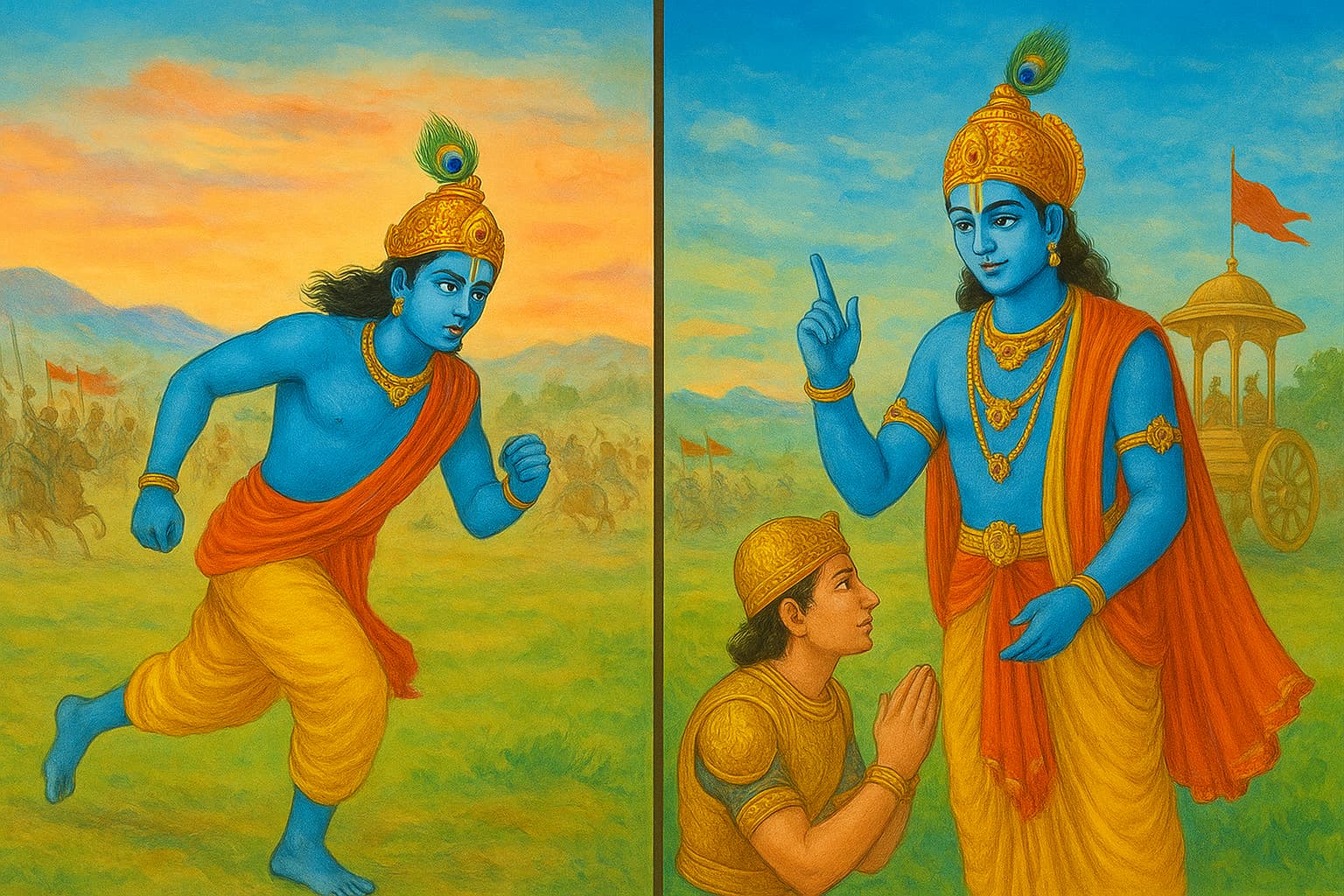
This is where I feel balance is important. If you see Mahabharata – Krishna himself ran away from one war (Jarasandh and Kalayavan, if I recall right) but later encouraged Arjuna to stay and fight at Kurukshetra. Same Krishna, two different situations, two opposite responses. Business also needs that balance. Sometimes retreat, sometimes full action. The wisdom is to know when to do what.
Chanakya also wrote – artha (economics) and dharma (ethics) go hand in hand. If either is missing, the state collapses. Maybe that’s what we miss today – we run only for artha and leave dharma behind.
So does Business to Buddha still stand? I’d say yes, but not as a formula, more as a reminder. It is not that every board decision must sound like a sermon of Buddha. Rather, it is about remembering there is a middle path – between hard business realities and human values. Between quarterly pressure and long-term trust.
The Buddha said walk the middle path. Krishna showed both – running away once, fighting another time. Chanakya tied economics with ethics. Somewhere in between these, lies the balance for us – in boardrooms, in markets, and in our lives.
Maybe that’s why this blog continues. Not because I have answers, but because I still feel the question is valid – can we connect business with the Buddha? For me, yes – because life itself is this balance.
When the need arose Krishna told Arjuna, pick up your arms, and fight. When there is a need, you have to do this duty without thinking about the results. Krishna said you have the right to perform your duty, also you do not have control over the results. Peace comes first when we are trying to reach a peaceful solution or consensus. If the peace fails, relegate peace to second. Perform your duty by taking arms. This is what happened in Mahabharata.
India and her culture and China from a religious perspective
For time immemorial, India has been a harbinger of peace. India’s message to the world has been of spirituality, science, and peace. Every single message from India has been for the progressive world as a one-world family “Vasudhaiv Kutumbakam”. The examples are the first surgery or mathematical genius of Aryabhatta or the message of the Buddha. The best thing, Indian culture has never asked for recognition for any of the achievements. The world knows basic mathematics from the middle eastern name – Algebra. India developed the concepts of algebra, the message of meditation, astronomy, or peace all are open for adoption.
Hinduism has a lot of branches. Every branch is exploration of different aspects of spirituality. Hinduism accepts every approach. Buddhism lays immense importance to meditation as a religion. Meditation is yet another path (Dhyan yog) within Hinduism. A book – Vigyan Bhairava Tantra – contemplates more than 100 meditations. You can read/listen to Osho’s commentary on the same. A better suggestion is to experience the meditations described in the book. The art of living foundation has a special course on Vigyan Bhairav. Buddhism was spread to Egypt in the west and Japan in the east. The western side of India has curbed Buddhism by force – bursting of the Bamiyan Buddha statues is a contemporary example.
India has been a kind country for many centuries. She has to rise to the occasion and not only be a guide for a peaceful world order but also communicate clearly about its national interests too. There are multiple conflicts here such as Chinese and Pakistani occupation on its territories. Possibly, as stated, peace may have to be related to the second spot for that.
Buddhism in China
In the recent past, Tibet was forcefully taken over by China. There are close to 20% Buddhists in China. Buddhist and Communist approach of life is diagonally opposite. Buddhism has a concept of Sangha a community. However, it lays a lot more emphasis on an individual’s personal growth – because enlightenment is achieved by an individual. Whereas the communist approach is – an individual has no value as such. China has been trying to use Buddhism to influence South East Asia, in fact using Buddhism with forums. This is another meddling in the personal life and beliefs of individuals – a very common practice of China.
The way China crushed Tibet (watch 7 years in Tibet), it is going to pay back. China has crushed one such uprising at Tiananmen square. China has been able to control these descents to a great extent – Google and Zoom. It is no secret more you suppress something, more powerfully it will come back. Sooner or later, this is going to happen to China.
Chinese aggression
Recently China has tried to push Indian boundaries on North East Doklam in 2017 and Jammu and Kashmir in 2020. This attack comes with the audacity of pushing the world into a lockdown due to Covid-19 (actually the Chinese Virus). It is a natural response for a country that feels threatened by a potential competitor. Many companies are likely to shift from China to other countries – including India. The other reason for considering India a potential competitor because India is a major economy if everything falls in place, India can grow faster. Though there is at least 5 times gap between the GDP of both the countries, however if mass exodus happens it may adversely affect China in short span.
There are various internal and external factors affecting China. Some of the Internal factors are the aging population of China, shortcomings of the one-child policy. The external factors are abused rules of free trade, debt trap for smaller nations, etc. The world now sees a new way of colonialism from China. This has woken up the world. This aggression if taken forward, is likely to cost a lot not just to the two nations but also to the world at large.
The economy trap of China
If you look at the trade balance of major economies vis a vis China, you would see trade balance is 1:3. Almost every country has trade-deficit with China, in effect China sucks funds from every country! In many ways, China either flouts World Trade Organization (WTO) norms or takes unfair advantages of the same to trap countries. The worst form of trap is – debt trap – giving loans to countries at better rates (naturally these countries cannot service these debts) and later gain control over assets of these countries, Sri Lankan port is an example. Nepal will soon get into this trouble. China is trying to control the sea too. In the east, they are contesting with Phillipense.
In a nutshell, every country, business, and economy dependent on China has a problem with China and yet it is very difficult to look at short term alternatives. This is the kind of overconfidence that anyone should be cherry about. This overconfidence has to be and will be tamed sooner or later. Probably the fear of this taming is forcing China to take aggressive steps against India. Further, in the coming time, China will face the heat of Covid spread worldwide. The whole world has suffered. Recently Geeta Gopinath of IMF wrote, that the negative growth rate is expected to be worse than previously estimated. More likely, the countries worldwide must get compensation from China for this massive loss.
Peace second
There are multiple problems the whole world is facing currently. Starting from the Chinese Virus challenge, economic downturn, and major control of China over many smaller countries to Chinese aggression on Indian territory. The China-India standoff is probably a warning to companies considering moving from China to India, giving a signal that India is not safe. This exposes China to many of its internal problems, suppression of its citizen, forceful control on Tibet to name a few, and external right from the debt trap, surreptitiously controlling land to the aggressiveness across sea routes too.
At the time of Mahabharat the equation was more driven by the military power and the kingdoms aligned to a side. Now, more than military power, it is economic power that drives alignments and overall control on world affairs. In Mahabharat, Pandavas were forced to ask for their fair share of the land they had to fight for it. In the present day world when a country faces such an adversary that is powerful, manipulative, and extremely aggressive sooner or later it has to be relegated peace to the second spot.
We celebrate the festival of Dussehra as win of good over evil. The conflicts were between two different parties – be it Rama and Ravana, Durga and Mahishasura. We are taught these overt conflicts. There is a subtle / covert lesson in these conflicts – the duality of mind. Our contest is with us inside our mind.
Ravana was very intelligent and capable ruler. As a kid, I watched Ramayana on TV. I used to ask this question to my siblings and parents – “how can a person have 10 heads?” To this I was told, it is symbolic. Ravana was so intelligent that he could have shashtrarth / serious discourse (discussions) with 10 different people simultaneously. Ravana was scholar of Shastras and Vedas, that’s the logic of saying 10 heads etc. Besides all this, Ravana was most respected devotees of Shiva. How can a devotee of the supreme lord be evil?
Imagine, a person of such caliber, such profound knowledge and power be known for all the wrong reasons! There are a couple of reasons for that; one is power corrupts and absolute power corrupts absolutely. Further, we need to learn – “with great power comes great responsibilities”. As Uncle Parker says to Peter Parker in the Movie Spiderman.
When, I look at these historical (for some people mythological) events, I see the easiest way to avoid such conflict is the eight fold path of Buddhism.
Perfect Vision,
Perfected Emotion,
Right speech,
Right action,
Right livelihood,
Right effort,
Right mindfulness, and
Right meditation / Samadhi
These are the virtues that can be explained to our generation in different manner for example – right livelihood for the Buddha was dependent on begging. In current generation I believe everyone should be self-dependent for livelihood. When some scholars say Right resolve (in the above list it is replaced with emotion), they explain it as life of a hermit giving up the world. When the Buddha attained enlightened I remember reading in some text he said, “It is not necessary to leave the world, one can be enlightened being a family person”. He propounded the Middle path for the same.
The real flight or contest is within, we can be the best in anything – as Ravana was. However, what matters is how we remained centered to be good. So, if we start taking these eight fold path doctrine in context of our generation, we can be as intelligent as Ravana and as good as Rama. The choice is always ours. This Dussehra I wish we all learn to fight our internal conflicts and Good wins over the evil within.
I was extrapolating to get into a mind. The mind of a person – who left everything and went to the Himalayas. What changed for him, how his mind responded to the alone-ness. What was going on in there – in the mind? Why he left the society and went to the hills? What conspired? How he changed there? Would he be the same changed person when – in case – he comes back to the society?
Can one have the same mindset of a hermit of Himalaya, in the concrete jungles? Can one balance being a hermit in the concrete jungle? Is it true that people find peace of mind in Himalayas? What is different there and here in the worldly city?
My recent experience of Art of living‘s Anand Utsav course has given me few more questions and dimensions. Last week I wrote about listening to the tik-tik of wall clock. My wife entered the room switched on the fan, I missed the tik-tik. This is what happens with us in our daily highly demanding and at times stressful professional life. We miss very many things in the noises of becoming someone, owning valuable things, money, designation etc.
The long and short of all this is balancing the life with awareness and becoming a saint in a professional life. Do we really need to be a monk to be spiritual? Most of us are running to be someone or to achieve something. There is no problem in having ambition and goals; the point is ,it make one restless. Why to be restless and anxious? Is not it a possibility that a person can be centred and yet ambitious? Is not it a possibility of a person being spiritual, professional and successful? These questions have become easier for me to have a perspective after the Anand Utsav course. I would certainly repeat more courses of Art of living.
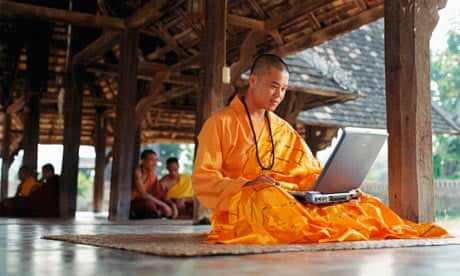
One can follow the middle path of being an enlightened master without leaving everything. One can be an enlightened master without leaving family. I see future enlightened masters will be successful professionals. These future generation enlightened master would / may not even talk about high flying esoteric spirituality. They will do their work as any worldly person does. These masters will not leave everything for the Himalayas, they may not sell their Ferrari. I think that is what is the lesson of the Buddha – Middle path. I think that is why current generation enlightened master’s are bringing spirituality to masses and to the day to day life.
As Osho said long back, many of the masters will be like the Zorba. Zorba the Buddha (Osho’s book) – “… Zobra is Love and Buddha is Awareness… when you are Zorba the Buddha, you have attained the greatest height that is possible in existence…”
Recently I wrote on why socialism fails? The article may sound a complete no-no to socialism. I believe any concept is inherently not flawed. The flaw is mostly in the execution – be it capitalism, socialism or any other “-ism. So, what can possibly be socialism the right way? I am sure many would know Venezuela going through hyperinflation and complete chaos – that is one gift that socialism may give you.
In economics many of the rules are written in some assumption or concept like – “everything else being constant…” the concept will work like this or like that. For an example – demand curve or supply curve. These curves are belied by the prices in some cases such as – price of oil or price of diamond.
Similar is the case of assumption in the underlying concept of socialism. The assumption is – no one will try to game the system. If I take the same example of Sarla or Kishore of the previous blog any Sarla or Kishore with average intelligence will stop working or will try to get a certificate that proves (s)he is the bottom 20% of Indian population to get the benefits of NYAY scheme announced by the Congress Party in its election manifesto.
In India, Amitabh Bachchan got a certificate of being a farmer long back. So, it is not difficult for people to get a certificate to the race to the bottom. Though, off late Mr Bachchan has paid off loans of many farmers in UP. The way a farmer’s certificate was easy to obtain for Mr Bachchan it is easy to get a BPL certificate too. What the scheme Nyay is most likely trying to do is – make youth and many Indians lazy or to game the system. This is how Socialism fails.
There is another example of similar scheme running in India – MGNREGA. I have heard of cases where there is immense corruption in this scheme. People are getting part of the allocated fund per person just for signing a document (rest goes to the chain of officials). Thus, the unskilled people for whom it was an employment guarantee, get money for free. If one wants to get the same work done by someone, the wages asked are higher. It results in increase in inflation.
With schemes like MGNREGA or Nyay, does not the leaders of the political parties implying that they do not have any idea for – 1. how to create more jobs (run the economy) and 2. how to increase skill level of the citizens so that citizen can do something for themselves rather than depending on others. It looks like these politicians have not heard the idiom – “Teach a man to fish and you feed him for life”. By the way, MGNREGA was started by one of the most renowned economists of the world!
If I recall 2009 farm loan waiver of Manmohan Government – again a Congress government – more socialistic in its letter and spirit that did not augur well to our economy. The impact of that according to Bank of America Merrill Lynch the farm loan waiver will cost 2% to the GDP of India by 2019. At times educated economists try to fix a problem at the wrong place. Possibly the Modi Government GDP numbers could have been 2% higher!
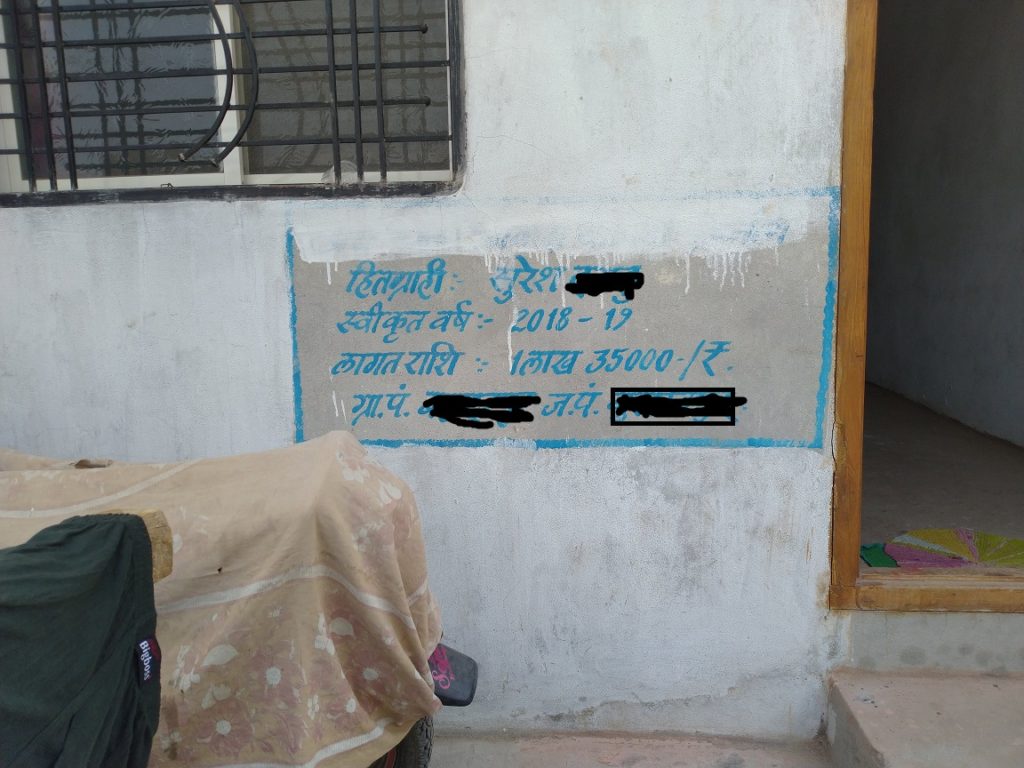
No doubt the basic principles of the right to food, shelter, water, education, and healthcare is considered given in today’s capitalistic economies and countries – example Obama care in the USA or Ayushman Bharat Health Scheme in India. There is a universal education program running in India Education for all (Sarva Shiksha Abhiyan). When I started looking at quick implementations of government’s schemes such as Pradhan Mantri Awas Yojana I feel current Indian Prime Minister Narendra Modi is more socialistic than the Socialists / Marxists in India. In fact, recently I went to a village (about 500 KM from Mumbai), and I first hand saw – took some photos too shown here – the scheme being used by the villagers effectively.
However, good the intentions to keep everyone at an equal level, humans do not seem to have found a way for equality. Possibly in the ant world, socialism is practically depicted to a better extent. Why USSR failed and communism of China is not worth appreciating, why Venezuela failed? Because there is no incentive to work or there is no ownership (common ownership) involved. Further, the move from capitalism to socialism follows communism as a midway stop. Communism gives power to the few, who – like any other human being – would not want to relinquish their power? The result – communism does not seem to end ever.
Socialism (to some extent any -ism) can only work if we create a different scale for all of us – human beings. A different scale for success, survival, and growth. Many times greed and wish to control – people, things and systems – makes way and thus the Marx intermediary (read communism) from capitalism to socialism remains never-ending. Why can not we have a good execution, social good, and profit together? We can have it, provided we look at some new scale to measure ourselves.
If any form of socialism needs to survive it has to be a middle path – a mix of different approach to economics, policy making and system. A system where we reward work, we provide essentials at appropriate cost or subsidy or for free and let people benefit from their work. At the same time, all the world political, social, economic and cultural systems must include teaching spiritual practices, trust and fairness – example is concepts of Jainism – Ahinsa (non-violence), Asteya (non stealing), Aparigraha (non-attachment) and concepts of Buddhism – meditation, interdependent co-arising. These concepts are essentially from different philosophy of Hinduism.
In recent days #MeToo has been talk of the town in India. I do not intend to hurt sentiments of the affected girls. In fact in my social circles whenever such discussions came I supported the girl’s story. Yet, when I am writing this post, I know there has to be a balanced approach, when I vehemently supported them there were always questions – why now? why so late? etc etc. So, here is a story that happens in the life of The Buddha.
During the time of the Buddha, there was a similar incident. Though, I am not trying to justify or deny harassment cases in of Me Too as fake or if the cases / stories are coming out to malign people unnecessarily. In fact, the Bollywood is notorious for such incidents (casting couch) etc, however, someone has spoken openly about it after a long time. In fact, there were cases of journalists (read Vinod Dua) and when a Tehlka founder-editor (read Tarun Tejpal) was accused by a girl – of the age of his daughter – about molestation. Long and short journalism is not sacred either. In fact in the recent times the way journalism is getting exposed – be it Radia tapes or AugustaWestland news for cash cases – is shaking faith in print / other media itself.
There was a CD that came in public for a very short duration wherein a very prominent politician had sex in his parliament (a sacred place for democracy in India) building room. The reason for the quid pro quo was to become a judge in a high-court in India. The woman lawyer compromised for becoming a judge. Off late a news is making rounds that Chief Justice of India (CJI) harassed his staffer some time. Another politician – died recently – was dragged in court for DNA test to prove he is the biological father of an adult – recently that son of the politician died.
In essence many systems where power plays a key role are not clean – be it limelight based Bollywood or fancy journalism or being a politician or judiciary. In another such power system is spirituality and religion, a bishop in an Indian church is accused of raping nuns. The result? Nuns are in question not the bishop! Even though the nuns have come out in open! This is not just one case in isolation, there were many such harassment cases, only few were / are reported.
As the case is with Churches, the power center in olden days in India used to be the spiritual teachers. The Buddha was also accused of raping a women. What happened there may not be the case in general with above mentioned cases of recent times. Let me narrate this story from the book – Old Path White clouds.
Story from Old path white clouds
During the time of the Buddha, his teachings were becoming powerful. There was a big challenge to the establishment of that time. So some people conspired to falsely accuse the Buddha of sleeping with a woman and making her pregnant. They found an attractive, young woman and told her that the Buddha had caused a rapid decline in the faith of their ancestors by luring many young men to become his disciples. Anxious to protect her faith, she agreed to the plan.
Every day she went to Jetavana dressed in a beautiful sari and carrying a fresh bouquet of flowers. She did not arrive in time for the Dharma talks, but waited outside the Dharma hall as people left to return home. At first, whenever anyone asked her where she was going or what she was doing, she only smiled. After several days, she answered coyly, “I’m going where I’m going.” After several weeks of such vague comments, she began to answer, “I’m going to visit Monk Gautama.” And finally, she was heard to exclaim, “Sleeping at Jetavana is delightful!”
Such words burned the ears of many people. Some laypeople began to feel doubts and suspicions, but no one said anything. One day, when she came to one of the Buddha’s Dharma talks. Her belly was noticeably round. In the middle of the Buddha’s discourse, she stood up and loudly said, “Teacher Gautama! You speak eloquently about the Dharma. You are held in high esteem. But you care nothing for this poor woman made pregnant by you. The child I carry is your own. Are you going to take responsibility for your own child?”
A wave of shock passed through the community. Everyone looked up at the Buddha. The Buddha only smiled calmly and replied, “Miss, only you and I can know whether or not your claims are true.”
The Buddha’s calm smile made this woman feel uneasy, but she retorted, “That’s right, only you and I know whether my claims are true.”
The community could no longer suppress their astonishment. Several people stood up in anger, the woman suddenly felt afraid the people would beat her. She looked for a way to escape, but in her panic, she ran into a post and stumbled. As she strained to stand back up, a large round block of wood fell from where it was tied onto her abdomen, and landed on her foot. She cried out in pain and grabbed her crushed toes. Her stomach was now perfectly flat.
A sigh of relief rose from the crowd. Several people began laughing and others derided the woman. Bhikkhunis stood up and gently assisted this woman out of the hall. When the two women were gone, the Buddha resumed his Dharma talk as if nothing had happened.
Summary
The life in current times is not that easy to prove innocence or guilt. Court cases are long drawn and at times the one with influence wins. Many girls / women will be facing defamation suits in the battle of right vs wrong. Many cases may be correct however the point is – how to prove the allegations?
The intentions of this post is not to support or oppose the accused or complainant. Because there may be prima-facie the cases such as Megha Sharma where girl seems to be the culprit.
The point is every generation faces such moral bankruptcy. Some end up on the side of one gender some on the other. This is an opportunity to sensitize everyone that what is inappropriate in discussions, the same must be avoided in actions too.
It is incorrect to ask woman to hide from head to toe, not go out alone, how to dress or they invite rape if wear small cloths! We must teach the boys to respect girl. I believe that only spirituality and practices taught by Indic religion Buddhism, Hinduism and Jainism can help our societies. In particular Brahmacharya (celibacy), Aparigraha (non-possession).
For last couple of years, I have been buying stuff (mostly grocery and vegetables) from where I get a bill (invoice), even if I have to pay a bit more. Reason has been straightforward – I am fine paying more because presumably the one who gives me bill pays tax. It reduces burden on my tax and thus country can improve and prosper. Straightforward logic. However, another thought runs in mind – things are getting automated, be it agriculture or industries. Technology based jobs are likely to get automated too. This will create a scarcity of jobs. We should support roadside vendors otherwise how will they sustain their livelihood.
Next level challenges for Governments and even for private sector will be job creation at grass root. The other thought says possibly there would not be a need of job creation. Things will happens automatically due to automation. On a philosophical level as Ramana uncle keeps on quoting – Sitting quietly, doing nothing, spring comes and the grass grows by itself. ~ Basho. This no one would require to do job, the same possibility suggested by Keynes.
The world thus would be a kind of utopia, we hopefully wont require ruling over the other. It would be a time of soul searching, digging inside doing inner revolution. I strongly believe prosperity of each individual is the best way to reach the Utopian world. Economics, fails at such Utopian world, because where there is scarcity there is demand and supply. However, if everyone is prosperous probably no one will feel wealthy. Feeling of being wealthy at that time would be defined by some other measures – not necessarily by money. Currently too we are on the verge of redefining wealth, money is not what you have in your pockets or home is no more the only wealth. Wealth is – stocks you have, count of zeros in your accounts, may be in future we would look at bitcoins in your electronic wallets.
Possibly, the Buddha was disillusioned by wealth – he was a prince after all, wealthiest of kingdom – when he saw a sick old man, a dead body etc. Likelihood of seeing a Buddha like person is far higher in prosperous economy. India was at peak of its economic, scientific and spiritual knowledge. The world now and in future needs to think about spirituality and economics in same plane. The world we are creating for our coming generations should have growth, livelihood, sustainability and spirituality together. This requires learning a couple of concepts of Buddha’s teachings deeper – i. interdependent co-arising ii. the middle path and iii. righteousness (speech, action, livelihood,efforts, mindfulness, concentration, view and resolve).
I think we need to think beyond jobs creation, wealth, we need to think about a holistic development of human race because the grass grows by itself.
Happy Buddha Purnima, may everyone become The One soon.